

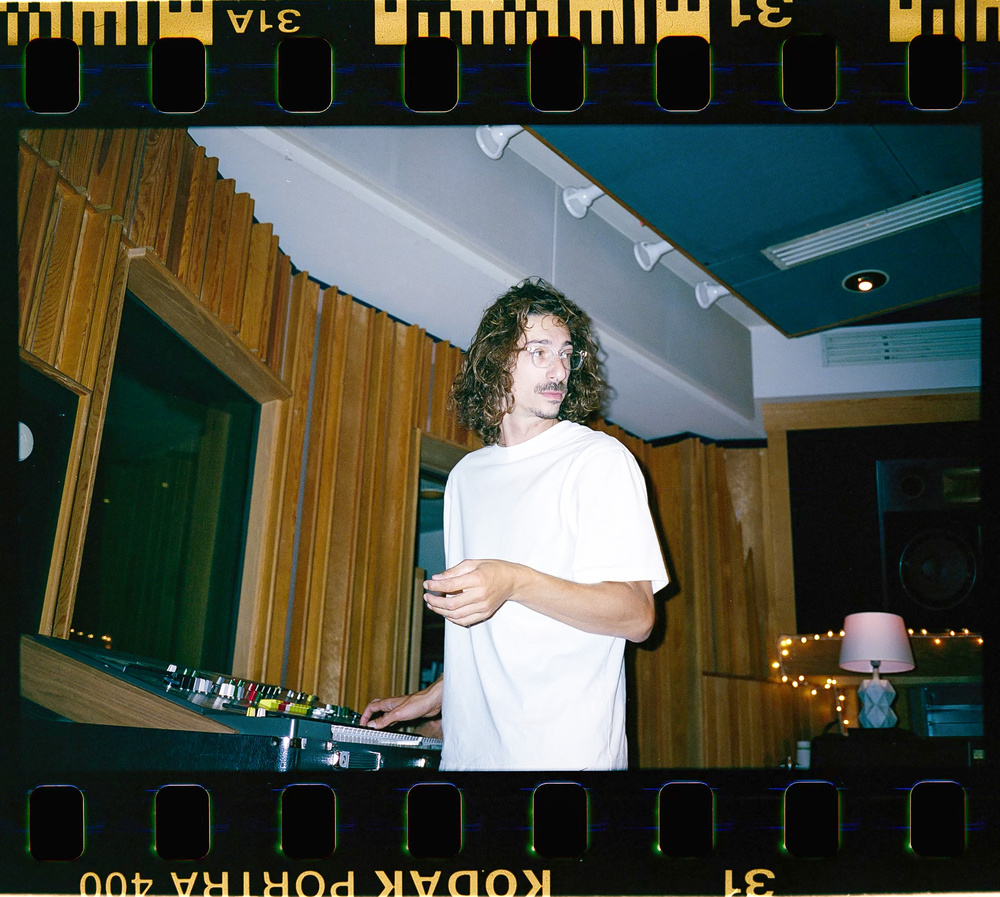
Songwriter, producer and musician Carter Lang has built a stellar career on collaboration and a love of obscure hardware.
“I’m categorised as a songwriter and a producer. But I also feel an artist in how I create sounds, and help bring an artist’s vision to life. What I do is not about me. It’s not about making a name for myself. It’s about the music that comes out of collaboration. I don’t care if it takes one person or five or 10, the question is always: how can we make music that gives us and other people the chills?
“Out of all the things I’ve worked on, I don’t think there was one time that we thought, ‘We need to make a hit today.’ Instead, you land on an idea, it becomes a thing, and eventually hits sometimes happen. The question in that situation is always, ‘How can I get everybody to be excited about what we’re doing, without forcing anything?’”
Carter Lang’s laid‑back, collaborative approach to writing and production has made him extremely successful. Growing up in Chicago, Lang started his musical career playing classical piano, guitar and bass before being introduced to synths, and to the Akai MPC 1000, in the late ’00s. The beats he was making at home resulted in him becoming part of the Chicago hip‑hop scene. “A friend sold me a Roland JX‑8P, and the sounds were so mesmerising and warm! I then bought a Roland SH‑2000, which is such a charming, interesting synth. That was my introduction to early ’70s monosynths. It has a very classic sound.
“I was never super good in the box, and the MPC allowed me to start making my own compositions and arrangements. It was my introduction to rhythm, and sampling, especially of records. I worked with a rapper called Zack Wicks who really inspired me, but who sadly passed away while I was still in school. He showed me Sun Ra and Frank Zappa and tons of esoteric music that the great producers were sampling. That got me curious about the sounds that were used on these records. Later when I got into pedals, I was able to combine them with synthesis, sampling and drum machines in a way that sounded good.”
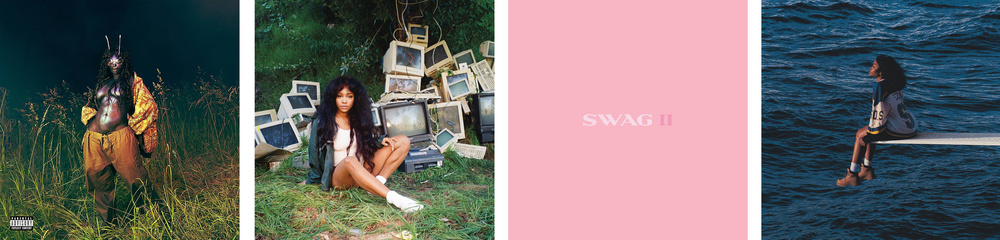
Carter Lang’s work with SZA and Justin Bieber has made him one of the hottest producers around.
Going South
Lang went to New Orleans to attend the Loyola University music business programme, which allowed him to explore many different sounds and genres as it was “a laboratory of playing in different bands”. On returning to Chicago, Lang started to work with the hip‑hop collective Savemoney, particularly their members Chance the Rapper and Vic Mensa, as well as rapper Mick Jenkins. The MPC 1000 was still a crucial tool for him, one that allowed him to “differentiate” himself and “add value to the writing process with interesting sonic flavours and rhythms”. Not long afterwards, Lang’s career took a step up when he began working with SZA in 2015, playing as a guitarist in her live band and co‑writing and co‑producing half of her debut and breakthrough album Ctrl (2017). Lang went on to co‑write and co‑produce Post Malone and Swae Lee’s monster hit ‘Sunflower’ (2018), which is the seventh most streamed song of all time on Spotify.
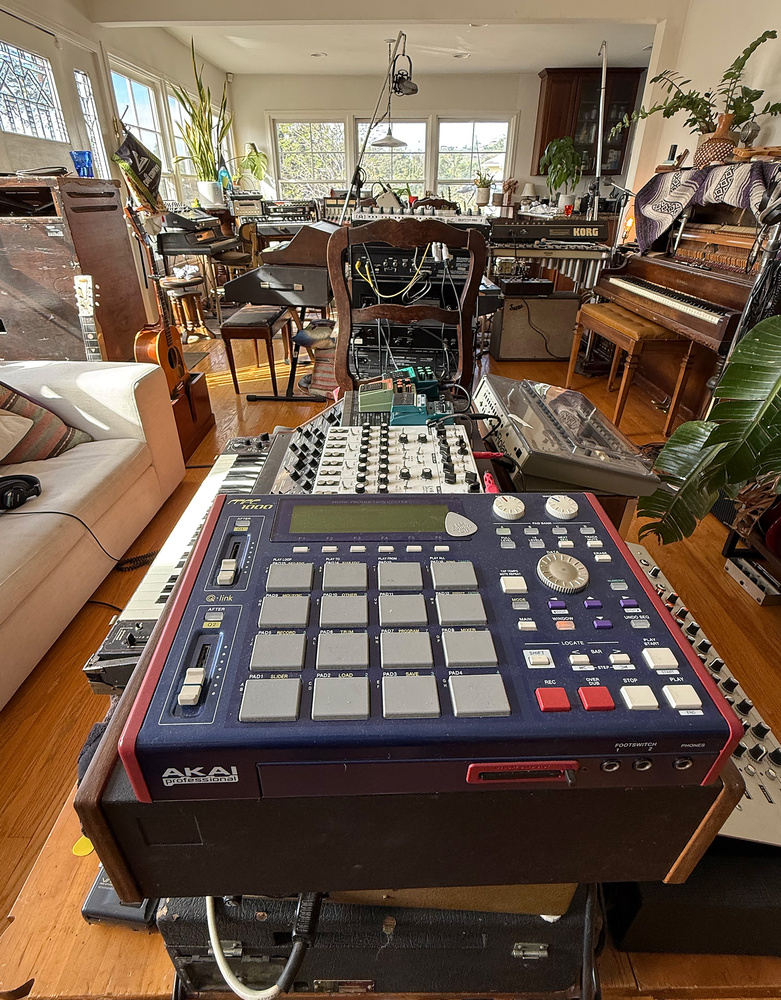
Although he also uses Ableton Live, Carter Lang credits the Akai MPC with helping him carve out a unique identity.
“Ctrl was a dream and super defining for my career. SZA and I really crafted a sound together. Then ‘Sunflower’ came out of nowhere. It was based on a beat made by Louis Bell and I, and then our management pitched it to the Spider Man: Into The Spider‑Verse [2018] movie, and suddenly it’s the main part of the movie. That song became larger than life, and a great calling card for me. It allowed me to move forwards in publishing and to acquire a lot of gear! It also prompted my move to LA in 2019, so I could be closer to many of the friends I was working with, and led to me establishing my current studio.”
Since then, Lang has gone from strength to strength, being at the heart of the making of SZA’s second album, SOS (2022), as well as the extended and reissued version, Lana (2024), and of Justin Bieber’s albums SWAG and SWAG II. In addition, Lang has worked on tracks by Camila Cabello, Chance the Rapper, Doja Cat, Lil Nas X, Alicia Keys, Kali Uchis, Lola Young, Rosé and more. Lang has had a hand in more than 30 Billboard‑charting songs, six of which went to number one. He has received 10 Grammy nominations and two Grammy Awards.
Lang went on to co‑write and co‑produce Post Malone and Swae Lee’s monster hit ‘Sunflower’ (2018), which is the seventh most streamed song of all time on Spotify.
Comrades In Arms
Reflecting Lang’s emphasis on working with friends, the credits of songs he’s been involved in typically draw from a small group of co‑writers and co‑producers: Rob Bisel (see SOS March 2023), Blake Slatkin (SOS February 2023), Jared Solomon, Omer Fedi, Dylan Wiggins, Mk.gee, Dijon Duenas, Tobias Jess Jr and Eddie Benjamin.
“Of course, being a producer sometimes means being behind the computer and recording and editing my friends, instead of jumping in and always playing. I’ve found a lot of joy in watching the flow and discovery of people playing, and not feeling so eager to apply my own sound or cast my opinion on a song idea as it develops. Instead of saying, ‘OK, we need to do this,’ I encourage others to do what they do, while not losing sight of how everyone in the room is feeling.
“As a producer, I read the room, and focus on everyone feeling stoked about the idea we’re working on, and not pressured to meet certain expectations. I watch the flow happen, and make sure that the artist is feeling it too, asking questions about what they like and want. It’s best to be vocal about it, instead of dealing with implicit expectations of needing to do this or that. I don’t want people to sacrifice their soul to make a hit. The aim is to make something that fits the artist’s world and that’s also fresh and new. I don’t like to contain myself or others in the creative process. When I hear something I like, I do positive affirmations. I don’t do a lot of negative affirmations. I let people play, and when it’s hot, let’s keep going.”
Beautiful Things
By way of example, Lang recalls the two songs he was involved in on Reneé Rapp’s album Bite Me, a UK number one a few months ago. “Both songs began with a guitar riff, and my friends Jared [Solomon] and Omer [Fedi] embellished it with more guitars and tones. I also played guitar on ‘I Can’t Have You Around Anymore’, and on ‘Mad’ I helped create the structure and arrangement of the song, and then Omer took it back to his place and dialled it in with Reneé, and made it into something beautiful.”
SZA’s latest hit ‘BMF’, from Lana, was made, recalls Lang, “with Omer and Blake [Slatkin]. It’s based on an Omer guitar lick, and Blake played drums and I played bass. We made the initial beat a long time ago, and when we played it to SZA she did something amazing to it. I formatted the song in Ableton, and programmed some stuff and added a synth. This is a song that I really had a hand in. It’s pretty minimal, and turned into something crazy with a hypnotic, poppy vibe.”
On the Rosé song ‘Drinks Or Coffee’ from her hit album Rosie, “Dylan [Wiggins] and I manipulated samples in Ableton and then we played them on a keyboard. But in the end, there’s a mystery behind the sounds and behind how these songs were done, and I think that’s fun. People wonder, ‘What was that thing?’ I think it’s good to let people’s imaginations run wild. They can then hopefully do something that creates a mystery as well. Not everyone needs to be doing or using the exact same things.”
On the making of Bieber’s SWAG, Lang notes, “There were some sessions we did with him in New York, in a friend’s living room, where we walked away with incredible emotions and a real sound. Everyone relinquished their expectations, we had a great rapport with each other, and something really magical happened during that week. I was playing guitar on some tracks, and bass, and we just let the room do what it does. Mk.gee, Dijon, Eddie [Benjamin] and I played the guitars and in fact all instruments on ‘Daisies’. That track is pretty much 100 percent analogue.
Carter Lang’s collection of rare vintage gear includes (clockwise from top left): Dynacord EC280 delay, Wersi Bass‑Synthesizer, Korg Poly‑Ensemble string machine and Olson Rhythm Beat drum machine.
“I had a really amazing opportunity to record a lot of Justin’s vocals and to be able to arrange a lot of them. In no way was I controlling the process. I just happened to be able to record him super‑fluidly in Ableton. The microphone that we were using most was the Shure SM7, and occasionally I’d bring my Telefunken ELA M 251. That was primarily the vibe, but it changed every time. There wasn’t really one specific mic or signal chain that we used. It varied depending on the environment, and what gear was available. It was nice to see how his vocal sound changed on different mics and just inhabiting a space and seeing what each piece of gear had to offer. I later got the chance to bring a lot of the material for the album back to my studio and do my Carter thing.”
Breathing Space
Lang’s “Carter thing” is a creative and post‑production process, again very laid‑back, that consists of “layering and overdubbing at my studio, making sense of what’s there, trying different tones, and so on. I might get on my drum kit and play and feel like time has stopped. No one has a gun to my head telling me, ‘Do this in this amount of time.’ I come back to things over the course of many days and months. It’s not a rushed process. Sometimes something happens really quickly, and then I let it sit for a while and come back to it later. Mostly, I’m manipulating the audio that we have in Ableton, and I’m getting things to sound and feel like they are in their most natural place and not covered up by a bunch of other stuff. It’s about letting things breathe.”
All this is done in Lang’s “madhouse” home studio in LA, most of it in a huge room full of daylight that’s so choc‑a‑bloc with gear, that, he says, “I hardly have any space left to actually live here. Every table is full of stuff! The beautiful daylight reminds me of the openness of Rick Rubin’s Shangri‑La studio. That studio made a real impression on me in the years leading up to living here. This room here looks like a miniature Shangri‑La. Or rather, a Strangely‑La.”
The latter is a reference to the abundance of weird and wonderful gear, which all ends up being sent through some more common gear, notably Lang’s DAW of choice, Ableton, and “Universal Audio Apollo x8p and x16 soundcards, the older versions — they suit my way of working. I also work with a gnarly pair of ADAM A7X monitors. I like having small nearfields close to me.
“In the back of the house I have a couple of PMC 8‑2 monitors. I’m having a new studio built at the moment, with a 48‑channel API desk, a big live room, iso booths and so on, and the PMC’s will sound great there, with the big blaring Augspurgers I’m having fitted. I’ll be enveloped in sound, it’ll be amazing! But for now, with the ADAMs I have no distractions. They just show me what I need to hear, really close to me.”
The Good Stuff
Lang’s more esoteric gear includes “a set of 10 mic pres from the late ’70s, designed by the late and legendary Oliver Archut, who founded TAB Funkenwerk. He used to remake a lot of Telefunken and Neumann stuff. I bought these 10 mic pres from Riverside Studios in Cologne, and they told me that they used to be part of a one‑off console Archut made for the West German Philharmonic Orchestra. They have EQs and really high gain. They’re great.
“I have bought tons of mic pres over the years, that are waiting to be used in the new studio. I’m really happy with my remakes of the Neumann mic pres that are Danner cassette modules. There was a board of 40 channels, and I have 12 of them. The same with the Sennheiser mixer with KAR‑15 preamps that was made for the Nagra portable recorders: high gain, Class A, with great distortion. They have a really nice drive to them, and I tend to use them for synths and drum machines. I also have tons of obscure DI boxes, that I use to send signals to different effects and split things out. I might send a signal to an effect box that has multiple outputs, which I may send to an amp and my pedalboard. I may have three or four different signals plus several room mics, just for one instrument.”
Vintage and modern gear side by side in Lang’s rack. From top: Studer tape machine, Furman power conditioner, UA Apollo x8p and x16 audio interfaces, rack of 10 input channels made by Oliver Archut, and Eventide H3500 Harmonizer, with a pair of rackmounted Neumann input modules at the bottom.
The instruments in Strangely‑La include “a Serge modular [synth], with all these banana plugs and so on. At one point I was thinking of using it to create a solo album that’s very minimal and about textures that I find soothing. My Yamaha CS60 has been a real pleasure to work with the last few years. I love string machines, and have units like the Farfisa String Machine, the Freeman String Symphonizer, the Korg Polyphonic Ensemble PE‑2000, and so on. Another favourite unit is the Steiner Crumar Master’s Touch, which is a wind controller that I can use with my Moog, ARP and Oberheim synths. The Yamaha FX500 also is a really interesting box, but it always breaks down, just like the Mirano 3R‑S Echo Chamber. I also have a Bel delay and sampler from the early ’80s, and a Hawk tape delay.
“It was and remains exciting to find pieces of gear that can help make your sounds even better and richer, and raise those hairs. I started to uncover that by being influenced by people that have been in it for a while, like Mike D from the Beastie Boys and his sons, [producer/mixer] Norm Block, and Eric from Uniform Music. Digging into what different preamps and delays and other things sound like, and feeling I had to catch them all, has been really affirming my journey. Though I bought most of my gear person to person, I was also looking at eBay and Reverb, and at a certain point getting more gear felt like an arms race!
Smile Curves
“Soundscaping is all‑encompassing: designing tones and chaining things together in ways that might seem unorthodox or backwards, but create a unique sound. The studio space I’m in now has afforded me to do that, because I prefer working with hardware for the initial point of creation. For that, analogue chains are just irreplaceable. They add an initial smile to the music. And I don’t feel I have to replace anything later on, as opposed to when I work with plug‑ins, and might have to replace the sound or layer it a few more times, just to get enough thickness and warmth or take away the aliasing.
“However, I get into the box as well, where I will use plug‑ins to give me a vibe, whether it’s a slap delay from a random UAD plug‑in or utilising all the random plug‑ins in Ableton, just to create different chains. I don’t normally pull up a lot of software instruments, though I did so a little bit more this year, when I was in situations where I didn’t have much of my gear with me and just got creative. I’d find a patch that I really liked and kept using that, and it became a sound. When I have to, I will work in the box as well for the initial creation point.”
Lang also has an impressive collection of guitars and basses, and an extensive pedalboard that he created when part of SZA’s band. “When working with SZA I wanted to be able to create different textures, and I built the pedalboard in a briefcase that I bought at a thrift store, so I could easily travel with it. I got for example a Strymon Volante, and some interesting delay looper pedals and got into looping as well. These pedals also lit up the writing and recording sessions we were doing, with all sorts of textures that would trigger new ideas. At that point I realised that a single piece of gear can be a great starting point when writing with others, and can even become the crux of a creative process.”
One obvious disadvantage of hardware is that it’s not terribly portable, so for sessions away from home, he has to be selective. “Friends and artists definitely come to my place to write and record, and work with and experience all these instruments. But I also travel around a lot, and like to bring a random funky drum machine that’s fun to manipulate, like a Roland TR‑909 or the TR‑808 or a Korg, or something weird that is going to help inspire a sound, like an Ace Tone. I’ll also carry a guitar if there isn’t a guitar there, a bass if there isn’t a bass, and a small synth module or something, just to have some sounds immediately available. And I may bring my Denon DIC EM‑1000 half‑inch tape delay, which is super cool and almost impossible to find. Or my Quad Eight digital reverb, which is rare as well. It’s really fun to mess with people’s sounds using these units.
Lang’s studio is home to a rare EML Synkey synth (top) and Freeman String Symphonizer.
“Having said that, I often don’t use any of them and may end up going with whatever the flow is. They are there as a safety net. If there’s very little gear in a place, it may inspire me just to see what I can work with. I may just bring my laptop and rummage through my Ableton Finder window and try some keywords to see what random drum sound or random loop they bring up. As I said, I’m not into soft synths much, but I sometimes use Arturia stuff, like their Yamaha DX7 or Minimoog Model D, if I don’t have real ones around. The native Ableton plug‑ins can be really inspiring to effect a sound that’s already good before it goes into the box, but I tend to be very minimal with them.”
Carter Lang: What I bring is primarily about dedication to the room and to genuine friendships, and the capacity to see an idea through.
Ideas Man
“I’m not known as the toys guy,” concludes Lang. “What I bring is primarily about dedication to the room and to genuine friendships, and the capacity to see an idea through. I just want to have a good time with my friends and meet new people and bring relationships together. I’m really like a chameleon, adapting to the situations as they emerge, whether we’re in my place, someone’s home or a commercial studio. Wherever we are, it’s about the attitude and expectations in the room. If people are sitting with their arms crossed waiting for someone else to dance, it isn’t fun. Everyone should have the feeling that they can contribute equally.
“The most common situation is that all music and lyrics are made in the room. Sometimes someone brings in a basic idea they have done before as a starting point, but it’s rare that someone comes in with something fully prepared. Ninety percent of the time, we make it together. And then one of us will take it home to develop or finish the idea. I may get on the computer and work on the idea, or I may relinquish control and let someone else take it into their realm, and trust that they will respect the vibe. We all want to see each other win. When I work on it, I want everyone to be surprised by what I have done, but also to feel that they have been part of something and that it’s a win for everyone. It brings me a lot of joy to spread that love.”

