

 Dean Reid (left) and Kieron Menzies at Rick Nowels’ The Green Building studio, where most of the production on Lust For Life was done.
With a stellar line-up of producers, engineers and co-writers behind her, Lana Del Rey appears to be unstoppable...
Despite the stylised and otherworldly nature of Lana Del Rey’s music, which continues to be far removed from what’s normally dominating the charts, she has managed to carve out a spectacularly successful career. Since her chart-topping 2012 debut Born To Die, three more albums have gone to or near the top of the charts: Ultraviolence (2014, a UK and US number one), 2015’s Honeymoon and now Lust For Life, which once again hit the top spot on both sides of the Atlantic.
The first two of these involved a large number of producers and writers, but for Honeymoon Del Rey whittled her core production team down to star producer Rick Nowels and his associate Kieron Menzies, who engineered and mixed the album and co-wrote one song. Grammy Award-winning songwriter, multi-instrumentalist and producer Nowels, who has worked with Adele, Madonna, Fleetwood Mac, Sia, and Cee-Lo Green, is once more the major force behind Lust For Life, along with Menzies and Dean Reid. However, as the album title and a smiling Del Rey on the cover suggest, the mood is a little more upbeat this time, with more expansive arrangements and several guest writers and featured artists, including legendary pop producer Max Martin, beatmakers Boi-1da and Metro Boomin’, rappers ASAP Rocky and Playboi Carti, and singers the Weeknd, Sean Ono Lennon and Stevie Nicks.
Setting The Scene
 According to Menzies and Reid, 85 percent of the album was written and recorded at Nowels’ The Green Building studio in Santa Monica, while everything was mixed there by the two of them. Work on the new album began in 2015, immediately after the completion of Honeymoon, with a recording session for the title track at The Village Recorder in LA.
“I don’t think there was a concept at the beginning,” recalls Nowels. “It is all a collection of songs. But she was in a certain head space. I remember at the very beginning of the Honeymoon record she said: ‘I want to make a jazz album.’ This turned into songs like ‘Honeymoon’ and ‘Terrence Loves You’. They’re maybe not technically classic jazz songs, but they are her versions. Since it had to be jazz, we could not have really strong, big beats, so the beats were chilled, and there was a lot of orchestra, and every song on that album was in a minor key. But I think almost every song on the new record is in a major key. That was not a conscious decision on our part, however. Every artist wants to go into new territory, and not repeat him- or herself exactly. We knew for a long time that ‘Love’ would the opening track, and ‘Lust For Life’ would be track two, and the picture of the new album emerged as we got more songs.”
“Those two songs set the tone for the record,” Menzies adds, “and after that it was a direction that we kept in mind when we worked, and that influenced our choices of sounds and samples, and also the kind of plug-in techniques that kept occurring in the songs. This all helped give consistency. Lana has ideas in her head, which she may or may not communicate, and we simply follow her lead. I’m not sure Lana had a vision for what the end result was going to be, but she knows what she wants and the concept from the beginning was definitely the ‘Lust For Life’ title. Rick often says that she is a poet. The most important thing for her, and for anyone who makes vocal music, is to get the message of the lyrics clear and out there. So a lot of what we do production-wise and mixing-wise is dictated by the narrative of the lyrics.”
More Than Engineering
Kieron Menzies, who is originally from Canada and plays piano and drums, has worked with Nowels since 2001. Dean Reid is a native of San Diego and a guitarist, and started working for the producer in 2003. Since they began working for Nowels, the pair have built up an impressive credit list, with joint credits including Nelly Furtado, Ronan Keating, Marina and the Diamonds and Dua Lipa. The two associates’ credits on both Honeymoon and Lust For Life are very wide-ranging, and include not only co-production, engineering and mixing but drums, tape loops, percussion, keyboards, synth pads, strings, bass, electric guitar, guitar synth, synth bass, flute, vocoder and more. Menzies also has a co-writing credit on one of the songs. “The fact that I also play instruments definitely is a plus in Rick’s eyes,” remarks Reid, “and I think that these days you have to be able to do a little bit of everything. I don’t know many people who are strictly engineers, and don’t play at all.”
Having said that, most of the tracks on Lust For Life began with Reid or Menzies acting purely as engineer, while Nowels and Del Rey did their thing. Reid: “Rick is Lana’s primary writing partner, and when they are writing it’s just Rick, Lana and one of us in the room. We are there just to be the tape recorder, while Rick is usually on keyboards or piano — once in a while guitar — and Lana sings into her [Shure] SM7, which is her favourite microphone. Lana and Rick generate ideas the old-fashioned way, with Rick doing chords and song structure and Lana words and melody. Sometimes she will have composed an entire melody and lyric, and she will just sing it to Rick and he will find the appropriate chords. That happened on a couple of songs.”
 Rick Nowels is a hugely successful songwriter and producer, who has worked with everyone from Adele to Fleetwood Mac.Nowels adds: “There is a modus operandi. She will normally come in with something like a verse or a chorus, or both, recorded on her iPhone. At the very least she always has the title, and usually a melody. I then start playing some chords, and from there the song comes together pretty quickly. Sometimes she forms a melody that’s based on the chords, but in general I try to follow her as verbatim as possible. At times we get some unusual chord progressions or some unusual movement because she writes the songs in her head, a cappella. Although she normally brings in a start, we have written some songs from scratch in the studio.
“She writes the lyrics as our work on the songs progresses, and she always finishes them in the studio. Generally speaking the whole song is written very quickly, usually in 45 minutes, and she then wants to go into recording mode right away. We put up a click track, and I have to very quickly get some sort of definitive piano part together. The piano part, or the voicings if it is a pad, are critical, so the whole thing works as a keyboard/vocal song. While we record we usually wear headphones, and I play piano live and she sings live. So one of the great aspects of the records is that there is a performance aspect.
“Lana and I always write with just voice and piano or voice and guitar, so the songs are always very solid in their composition. Lana is a supreme melodist and lyricist, and her songs always have an emotional power to them. They also have a coolness and her own unique language, which makes them very modern. I think she’s writing future classic songs.
“I’ve always had the philosophy that you record the vocal when your love affair with the song is at its strongest, and this is right after you write it. With every new song you write, you think: ‘This is the best thing I have ever done in my life,’ and ‘This is the best song on the planet,’ and that means that it’s the best time to record it. She records maybe three or four takes; usually, take two or three is the one, and then that tends to be it. There’s very little vocal comping. We only go in and change things if there is a lyric change. And after she has laid down the lead vocal, she immediately goes in again to do the backing vocals. The backing vocals — the way she stacks her voice, the parts and counterpoints she sings — define a lot of her sound.
“As soon as we get the song written and the vocals recorded, we go into arranging mode. We can add grand musical parts as well as spooky, weird parts. I’m very specific that the main piano or guitar part is definitive, so the song will speak with one voice and one instrument. After I get an overview and the big picture sounding good with my playing, Kieron and Dean start contributing their parts. I also brought in some superb musicians on the album. Patrick Warren has done strings and keyboards on all the Lana records since ‘Summertime Sadness’. He is a big part of the ‘Lana sound’. Zac Rae played keyboard and drums, Mike McGarity played drums, Aaron Sterling played drums, David Levita played electric guitar, Gary Ferguson played drums. We all share a certain aesthetic and they contributed beautiful intelligent parts to the records.”
Evolution
Of the 15 percent of Lust For Life that wasn’t done at The Green Building studios, some of the songs, like the Boi-1da track ‘Summer Bummer’, were started by guest writers or producers at their own studios; in other cases Del Rey, with or without Nowels, Menzies and Reid, travelled to a few other studios in LA, New York and London, to work with other writers, producers and featured artists. ‘Love’ was co-written and co-produced with top writers and producers Benny Blanco and Emile Haynie, while Swedish star pop producer Max Martin collaborated on the title track, following which Abel Tesfaye, aka the Weeknd, was invited to duet with Del Rey on it.
 The title track of Lust For Life is a duet between Lana Del Rey and Abel ‘The Weeknd’ Tesfaye.Reid: “There were several different approaches with this album. Some songs were done in a day, with whoever was in the room. With others, like ‘Lust For Life’, it took a village to bring it back home. The original song was a long ballad with pads and vocals, and then Max’s crew rearranged it into more of a pop structure with beats, and then Lana wanted to do more of a ’50s doo-wop style spoken-word thing in the verses, so Kieron programmed a beat for that section with a more Motown sound, and we recorded her new spoken-word vocals, plus the transition into the chorus, which sounds a lot more like Max’s demo. The song evolved piecemeal and quite naturally and ended up being quite complex.”
Nowels: “It was one of the first songs written for the album, and we completed the first version, and it was a beautiful piece of art. It’s one of my favourite songs. During the process of making the record Lana had a meeting with Max Martin and he said: ‘That verse could be a chorus!’ — ie. the ‘Take off your clothes’ part, which originally was a verse. There was a lot of energy in the room around making a hit single, so we rewrote it and made that the chorus of the song. In the end there were two versions of the song, with the new version ending up on the album.”
Menzies: “The first version was more ominous, but the spoken words and Motown/Phil Spector beat in the verses gave it more of a Shangri-Las vibe and a walking-in-the-sand feeling. It also added to the future-retro thing that Lana is so fond of. Throughout the making of the album she kept talking about Blade Runner being an inspiration.”
Reid: “Once we had the verses, the song was pretty much up and running, and then one night Abel came in, and worked with Rick and Lana and Kieron, and they replaced a number of vocal lines. They also did a lot of ad-libbing and sang the duet part. I then added some bass and guitar parts.”
Virtual Reality
From the moment Nowels and Del Rey laid down the basic outlines of each song and recorded the vocals, Menzies, Reid and Nowels began arranging and programming the musical backings. Apparently, some of the many instruments at The Green Building were used at various points, but large parts of the arrangements were played and programmed by Reid and Menzies using virtual sound sources. When asked how many “real instruments” were used on the album’s title track, they initially look nonplussed. After explaining that this means any instrument played by hand and recorded with a microphone in their studio, their answer is: “there was some live piano. That’s the only thing that was miked up. There’s also a Roland GR-55 synth guitar in the chorus, and a DI’ed live bass DI. Plus six tracks of Mellotrons.”
As for the rest, Menzies and Reid used some soft synths, like, according to the latter, “a [reFX] Nexus for the synth bass part. This was modelled to sound like Max Martin’s chorus bass, which he played on a Roland Juno 106. The vocoder part literally is a Waves Morphoder, with some plug-ins on it.”
Menzies adds: “I work in Ableton Live a lot. I don’t use the arrangement window, but just set up loops in Ableton; though I don’t think I used Ableton for the title song. Most of what I do is dropping samples straight into the timeline in Pro Tools, and then I treat them with plug-ins. All the drums were done like that. I do this because I am better with the plug-ins in Pro Tools. There is no science to it, I do it differently every time. Often I am pitching things up or down, or taking like a piano hit and turning it into a hi-hat, or taking a sound that sounds natural and make it sound unnatural or vice versa, and so on, with plug-ins doing a lot of the work.”
No Mix
Kieron Menzies and Dean Reid emphasise that they mixed the songs as they went along, and that there usually wasn’t a clearly defined separate mix stage. “We often do late-night rough mixes,” Menzies elaborates, “so Lana has something she can take home, and that we can play in our cars to check. I’m a great proponent of the car listening test! The two rooms in the studio are networked via Ethernet, so each session always exists on two drives at the same time, and Reid or I may be working in either room, though never on the same session at the same time! In Studio B we’ll be listening to our little three-inch Genelec 6010 speakers. But every time we think we’re in the final mix stage, it turns out we’re not, because the next week we’ll be adding new parts. So we walk a fine line between what we consider to be production and programming and what we consider to be mixing.”
Reid: “I only think that we are mixing when it is time to send a bounce to the mastering engineer. Otherwise I think of mixing and processing more as production. But when we thought we were getting to the end with ‘Lust For Life’ we split the session out to an SSL Sigma analogue summing mixer. This made a world of difference. The track opened right out, whereas before it felt choked. We could suddenly hear individual bass parts and the transients of the drums. We used the Sigma on a few of the songs on the album, but not on all of them. With ‘Lust For Life’ there definitely was a final day during which we did the mix, which became the definitive version, and then there was one more day of recalls and some vocal rides and whatnot. And once we got to the point where Lana loved the mix, it was pretty much it.”
Well Turned Out
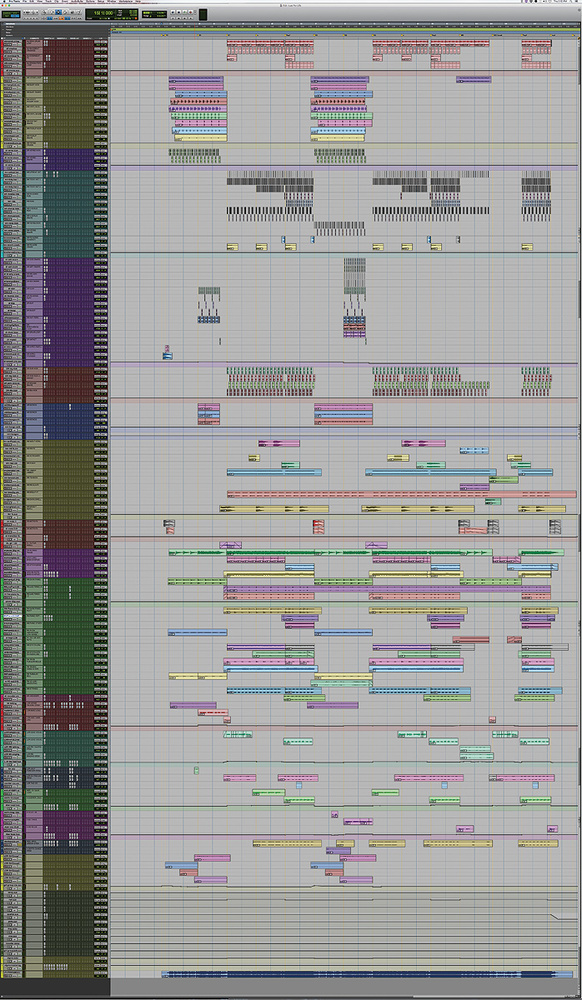 This composite screen captures shows the entire Pro Tools Edit window for ‘Lust For Life’. Unusually, it is organised by contributor rather than by type of instrument!Given that production and mixing is a continuous process for Reid and Menzies and that there’s not an identifiable mixing stage or mixing method, it makes most sense to simply examine the final session to get a sense of what’s there and how it was treated. As the session had swelled to an enormous 129 tracks by this point, it has to be done using a birds’ eye view, with the occasional swoop down to scrutinise some of the more important details.
The first thing that’s obvious from looking at the session is that it is exceptionally well organised, with clear colour coding, and all clips perfectly topped and tailed, and the contents on every track described in the comments box. Another striking aspect of these groupings is that every group has one aux bus track at the bottom, which in almost all cases also functions as the send to the Sigma for that section. Reid: “We organise our drum tracks by programmer, and each programmer gets their own aux, not just to be able to process the entire group, but also to be able to quickly mute and unmute multiple tracks. It’s a way of grouping tracks, without actually using the group function.”
Reid’s and Menzies’ session layout is unusual, because people usually organise DAW sessions by grouping tracks according to musical function. They nevertheless roughly order the tracks by each programmer in the order of drums, sound effects and musical content, followed by the vocals, with each vocalist having their own group. More commonplace are their aux effects and mixdown groupings at the bottom of the session.
The entire session consists of, from top to bottom (take a deep breath): five drum tracks by Ali Payami (red), 10 verse drum tracks by Menzies (yellow-green), three verse drum tracks by Reid (purple), another 12 drum tracks by Menzies (turquoise), 15 drum and sound effects tracks (by Reid (deep purple), five “big ass” drum tracks by Reid (red), five bongo tracks by Mighty Mike (blue), 11 tracks of sounds (‘dark swell’, ‘riser’, ‘screamer’ and so on) by Menzies (yellow-green), four more tracks of sound effects by Reid (red), four bass tracks by Reid and Max Martin (purple), 16 Nowels keyboard tracks (bright green), five Lana Del Rey talking tracks (red), five Lana Del Rey lead vocal tracks (turquoise), three Lana Del Rey backing vocal tracks (dark blue), five the Weeknd ad lib tracks (purple), two the Weeknd lead vocal tracks (blue), five Lana Del Rey ‘girl’ backing vocals (yellow-green), nine aux effects tracks (dark green), and finally three mixdown tracks (yellow-green).
Drums
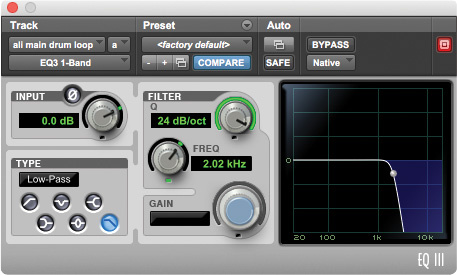 Much of Kieron Menzies and Dean Reid’s mix processing was aimed at making things murkier and darker, in order to fit Lana Del Rey’s distinctive sonic aesthetic. This was achieved on Ali Payami’s main drum loop by cutting everything above 2kHz and running the remainder through the UAD Thermionic Culture Vulture saturation plug-in.Reid: “Ali Payami works a lot with Max [Martin] and his tracks form the foundation of the main groove in the choruses. Initially, after Max had reworked the track, Ali’s tracks carried the entire song, but we then eventually remade the verses to be more 1950s or 1960s. I think Ali works in Logic. Some of the plug-in treatments on his tracks came from Max. The main drum loop has an Avid EQ3, which is a very sharp low-pass filter at 2.02kHz. I added the UAD Culture Vulture, to add some bite and aggression on that drum loop and make it rock a little harder.”
Menzies: “The green tracks below are my verse drums, with the Phil Spector-like beat, with some weird samples and loops which I distorted to make them sound not quite natural. I thought that the ‘vinyl snare’ is a cool sound, and it has the EQ3 7-band, boosting 4.2dB at 148.5Hz, and the Waves H-Comp, which adds quite a bit of punch that wasn’t there before. A snare sound that has been sampled from a vinyl record and cut before the snare has finished sounding has a certain sound to it, which I think fits Lana’s aesthetic. It’s retro and at the same time has a futuristic glitchy sound. Having sample-based drums is part of what gives this track the attractive quality it has.”
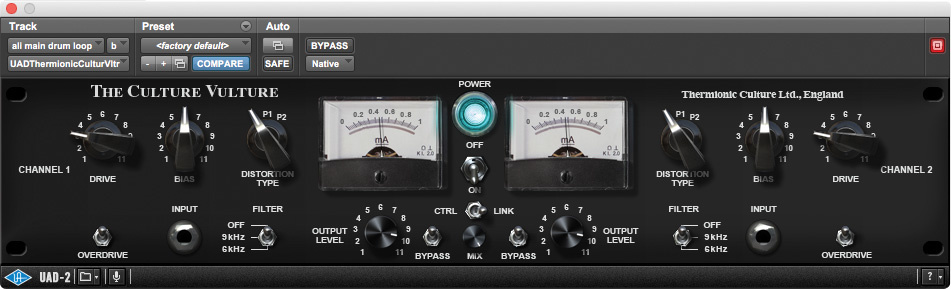 UAD-2 Culture Vulture plug-in.
Reid: “My verse kick and snare are just there to add a bit more punch. The ‘T’ on my ‘Verse Bus’ is the UAD Thermionic Culture Vulture. A lot of the purple stuff is pitter-patter-like drums in the pre-chorus that have a futuristic techno sound, and that sound cool with the Phil Spector-type beat, again chasing this future-retro thing that Lana likes. The ‘V’ on many of my tracks is the Valhalla Vintage Verb, which we love. A trick we used a lot in working with Lana is to have saturation or distortion after the reverb, as opposed to before it, because that creates a unique kind of chaos. So we may put the SoundToys Decapitator after the Valhalla, or the Lo-fi, like on my ‘Wet snare’ track. The ‘7’ that’s after the Valhalla on some of my tracks is the EQ3 7-band, which is boring, but I still love it.
Reid: "We love the FabFilter plug-ins, which almost everyone seems to use these days, but when it comes to notching out harsh frequencies or just an easy high or low-pass the EQ3 is so easy. Just tighten the Q all the way, sweep to find the frequency you don’t like, and turn the gain all the way down. My red tracks underneath the purple tracks add some extra thickness and bombast in the verses.”
 SoundToys’ Devil-Loc plug-in was used to add grit to several parts, including several hi-hat grooves; the ‘upbeat hat’ also received the attention of the Valhalla Vintage Verb and AIR Flanger plug-ins to make it sound more spacey.Menzies: “The turquoise tracks that I did are there to make Ali’s loop bigger and flesh it out. His loop was very ambient and washed out, whereas my drums are dryer and more aggressive and hip-hop, plus I added a 16th-note hi-hat for some more movement. The track ‘Upbeat Hat’ has the SoundToys Devil-Loc, to dirty it up a bit, and the Valhalla Reverb, plus an AIR Flanger, to sci-fi the sound a bit. The two ‘Ticky Hat’ tracks below also have the Devil-Loc. I really like that plug-in. As soon as you put it on, you only have to have the Crush and Crunch knobs at 0, and it is already working. I use the Devil-Loc as a low-pass filter, to darken things up a bit, which is more fun than doing that with an EQ.”
Music
 In a quest to get more ‘spike’ from Max Martin’s synth bass part, the mixers added compression from the Waves CLA-2A plug-in, fine stereo detuning from the Avid Pitch II processor, and more Culture Vulture saturation.Menzies: “All the yellow-green tracks, including ‘wolf howl’ and ‘screamer’ and so on, are ambient and hard to define, and add interest to the production. They’re a big part of Lana’s sound. Once again, I treat the original sounds heavily with plug-ins, and then print them. The ‘wolf howl’ track, for example, may have had delay and reverb and distortion, and I committed all that, so you don’t see those plug-ins in this session. In fact, there are no plug-ins on them here, because I already had the sounds the way I wanted them.”
 Avid Pitch II.Menzies: “There are a lot of plug-ins on Max’s chorus bass, the ‘8th note bass chorus’, which I put on. It was a mono Juno track, and I added a Waves CLA-2A to try to get some more transients, and an Avid Pitch II and three instances of the EQ3 7-band — we could have combined that in one EQ3 — and the UAD Culture Vulture. We really wanted to get some more spike out of that part.”
Reid: “In Rick’s section there’s a ‘piano riff’ part that has a lot of plug-ins, which are the Waves OneKnob Wetter, the EchoBoy with a subtle eighth-note delay, the Decapitor to add some crunch and to squash the sound a bit, and the EQ3 7-band.”
Vocals
Reid: “The first vocal track is the ‘Vocoder’ track on which I used the Waves Morphoder, and which I then printed. Next is the track with Lana talking, which has a whole bunch of plug-ins. The first one is the EQ3 7-band amping up at 1kHz, then there’s the CLA-2A for some basic compression, the Avid De-Esser, the McDSP Futzbox to give it that radio effect, and other De-Esser, by Waves, a Waves C4 and an Avid Dynamics 3 Compressor. There are a couple of plug-in presets that I often use with the C4 and the Dynamics 3 compressor just to rein in the vocals a bit. The C4 has the ‘Pensado Vocal’ preset and the Dynamics 3 ‘Vocal Leveler’ preset. A lot of the vocal tracks hit one or both of these ever so slightly.”
Menzies: “There are five sends, all marked ‘F’, because I labelled all the aux tracks effects. These aux effects tracks are at the bottom of the session and consist of a delay from Waves H-Delay, a hall from the Avid Reverb One, a spring reverb from the AIR Spring, a quarter-note delay from the Echoboy with a FabFilter Pro-Q2 to take out some mid-range, a Valhalla VintageVerb plate, a Valhalla Freq Echo, a slap delay from Echoboy set to 16th notes, a vocoder delay from the H-Delay and a ‘girl group’ reverb from the Valhalla VintageVerb set to a long 3.6s delay.”
Reid: “We often have a starting point for the vocals, which consists of a de-esser, an EQ like the EQ3 7-band or from the Waves SSL channel, a UAD LA2A or CLA-2A, and the Waves C4 multiband to brighten things up a little bit as it’s acting more aggressively on the lows and low mids than the upper frequencies. And then all lead vocal tracks have multiple sends to the effects tracks. Abel’s lead vocal track, ‘main unison stem’, has the UAD Neve 88RS, which I mentioned before [see box], and with which I am darkening his vocal and adding some low mids. We really wanted them to sound like they were in the same room, even though their vocals were recorded at different times. We are very proud of this mix, and very happy when Apple and Spotify people commented on how well their voices fit together during early listening sessions.”
Stereo Mix
 No fewer than 10 plug-ins were used on the master bus beginning with the UAD 610 preamp emulation.Menzies: “All ‘group’ aux tracks and several of the individual audio tracks are sent to the SSL Sigma, and the 2-mix signal from that comes back on the ‘Sigma Auto’ track, on which you can see some volume automation with just a 1dB bump in the choruses — a trick I stole from Bob Clearmountain! The signal then goes through the ‘Sigma Print’ track and gets printed below that. We did it that way, because we wanted the volume automation to hit the 2-bus compressors on the ‘Print’ track, and if you put it all on the same track, the volume automation comes after the compression.
“The Print track has a whole range of plug-ins, almost all of them are UAD. The first plug-in in the chain is the UAD 610b EQ, next are the UAD Curve Bender, the UAD SSL stereo bus compressor, the Massey L2007, the UAD Ampex ATR 102 tape emulation, the UAD Precision-K, the UAD Shadow Hills mastering compressor, the UAD L3LL Multimaximizer for some extra volume, and the FabFilter Pro-Q2. The compressors are barely tickling. They all just colour the signal slightly.”
Reid: “We don’t use this chain all the time, we mix and match for each track until we get the sound we like. Some of the songs have a completely different chain on the 2-bus. But a lot of the mastering for the song happened here at The Green Building. We did a shoot-out, with Adam Ayan at Gateway Mastering, working with a more chilled-out version of the mixes and on a version with everything on it, and Lana preferred the latter. This made sense because it’s a maximalist, big track!”
 UAD-2 Shadow Hills Mastering Compressor plug-in. UAD-2 Shadow Hills Mastering Compressor plug-in. |  Waves L3LL Multimaximizer. Waves L3LL Multimaximizer. |
 Massey L2007 Mastering Limiter. Massey L2007 Mastering Limiter. |  UAD-2 Chandler Curve Bender mastering EQ. UAD-2 Chandler Curve Bender mastering EQ. |
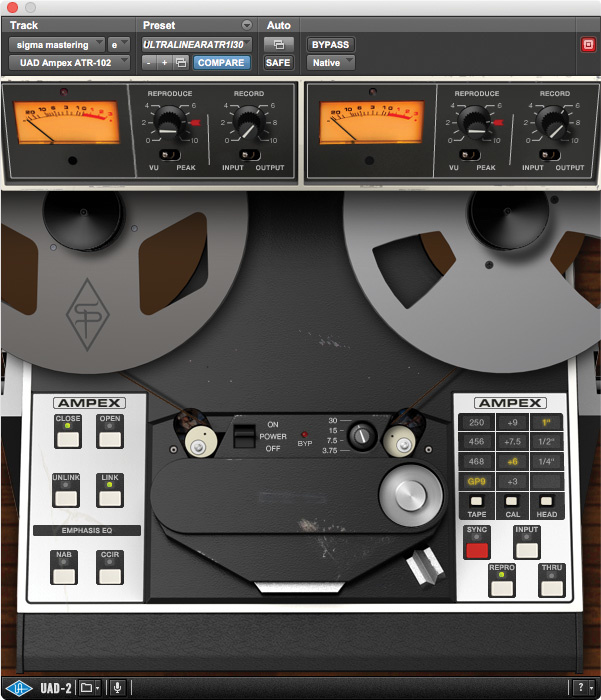 UAD-2 Ampex ATR102 tape simulator. UAD-2 Ampex ATR102 tape simulator. |  UAD-2 SSL G-series stereo bus compressor. UAD-2 SSL G-series stereo bus compressor. |
 UAD-2 Katz K-Stereo ambience processor. UAD-2 Katz K-Stereo ambience processor. |  UAD-2 Precision Maximizer. UAD-2 Precision Maximizer. |
Losing The Desk
Rick Nowels’ The Green Building is a two-room studio that has been headquarters to its owner, and Dean Reid and Kieron Menzies, for the last decade. It has tons of musical instruments, especially guitars and keyboards, but is otherwise a typical 21st Century facility, based around Pro Tools HD, a few choice pieces of outboard, and no desk. The monitors are ATC SCM45A Pros, replacements for the KRK E8 monitors that Nowels has had for 20 years, and which Menzies says they blew up eight times. “Lana likes to have it loud! She likes for the sound to envelope her and to get lost in the sound.”
“All my early records were done in big studios with big desks and big tracking rooms,” reflects Nowels. “I come from that world. Many great records were made that way. I started off working on tape, and then moved over to digital, and from what I understand, you don’t need a board any more. We had an old nice API board at one point in the studio, but it sat on the floor for two years, because nobody wanted to use it.”
Menzies: “I loved that board, but the problem was, it being from 1974, that you had to run tones through it every day just to make sure all the faders were at the same levels. It had that kind of analogue funky magic. But with all the records that we make now, we mix as we go along, which you can only do when you work in the box.”
With regards to recording at The Green Building, Menzies explains that it took years to find “Lana’s favourite microphone. It’s on a stand, so it’s the SM7b. We record her using a BAE 1073 mic pre, which then hits a UREI 1176 [compressor]. I generally don’t use EQ on her on the way in, but I think the signal also goes through a flat API 550b, just for the sound, and that’s it. For monitoring her vocal I set up the AIR Spring Reverb [plug-in], because when she sings she likes to hear herself the way it will be on the record. The reverb from that plug-in is one of the characteristic elements of her vocal sound. UAD has an AKG reverb with a really cool sound, but the UAD stuff can add latency to the session, so we try not to use that at the beginning of the session.”
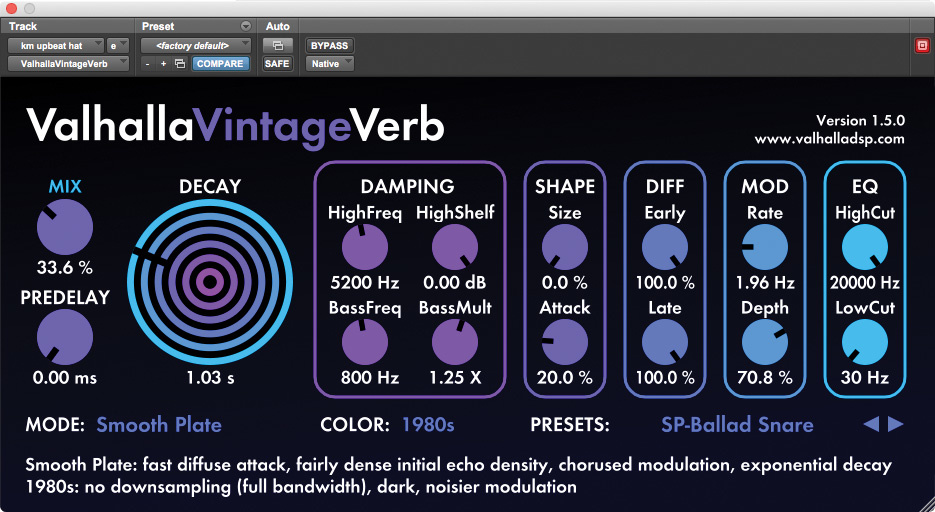 Reid: “The AIR is a very simple reverb, but it works great on her voice. We tried many more expensive spring reverbs, but we keep gravitating back to the AIR. We also use the Valhalla Vintage Verb a lot on her tracks. Partially because it sounds good, and partially because it is so easy to use, and it does not cause any latency that I can hear. It simply does not give you problems. You can do like 60 seconds decay time on the reverb, it never ends.”
Menzies: “We recorded Abel [the Weeknd] through a Manley Gold tube microphone, also going through the BAE 1073, and then a [Teletronix] LA2A [compressor/limiter]. I did not EQ him on the way in either, but we later used the UAD Neve 88RS channel strip plug-in on his lead vocal, because when we had recorded his vocals they did not sit very well with Lana’s voice. The Manley is a very bright microphone, especially when it’s side-by-side with an SM7, so I adjusted the EQ curve of the Manley to make their voices fit together. There is a lot of atmosphere on the record, and she picked the SM7 as her favourite vocal microphone because it has the dark aesthetic that she likes. It’s a creative choice, and we wanted the same aesthetic on Abel’s voice.”
Murky & Mysterious
Some artists are happy to hand over their work to producers and engineers once they’ve made their own contributions, but Lana Del Rey was hands-on throughout the entire process, including mixing. Kieron Menzies: “She’s very involved during all stages. Obviously she’s central to the writing, but she also sits with us during a lot of the production and mixing. The vocal sounds that you can hear on the record usually are set up very early on, with her input. This is part of the mixing as you go. There also was a lot of deliberation in how we treated sounds, and for things not to sound over-hyped, contrary to most of what’s out there today, and she also had lots of input in that.”
Dean Reid: “We do a lot of low-pass filtering and lo-fying to take the edge off the high end. We use plug-ins all the time to darken stuff. With vocals and acoustic instruments I’m always notching out harsh frequencies. Any high squeal or ring will be sucked out. Lana likes to listen to things on her iPod on the beach, and she wants them to sound murky and mysterious. We’re very conscious of that. If we do something that doesn’t fit and that sticks out, we immediately get reactions from Lana or Rick. There is this thing about Lana that if we know she’ll be showing up in half an hour, we have an instinct about what she’s going to like and what not, and so it’s like: ‘Hurry up and make it sound good, so when she walks in the door she’ll be smiling.’ And if she’s not smiling we know how to pull it together really quickly. But she’s in the room for much of the process, and incredibly meticulous about vocal levels, for example. A lot of the vocal rides are dictated by her. She hears 0.2dB differences in volume, and when we got the first mastered songs back, she was really dismayed by how they sounded, and it turned out to be the dithering down from 24- to 16-bit that was bothering her! She has great ears and an impeccable sense of aesthetic.”
Media
Download the large version of the Pro Tools screen capture here:  inside-track-1017.zip