

As if I haven’t harped on about it enough by now; Schlappi Engineering are a developer going from strength to strength, in many respects in the vanguard of module design in 2025. While their last few fearless offerings consisted of outrageously modulatable oscillators (witness the Three Body), musical binary counters (the Nibbler) and analogue‑does‑digital signal mangling (BTFLD), the Boundary Layer is a module whose design actually harks back to a much more classic synth topology. How will Schlappi fare in the heritage game?
OK, ‘heritage’ probably isn’t the right word here: the Boundary Layer is hardly a Moog‑inspired ladder filter. But it does take more than a few cues from the likes of the Serge DUSG and Make Noise’s modern classic, the Maths. Those modules are case studies in just how much is possible with moving voltage, almost in its purest form. At its core the Boundary Layer is a three‑channel function generator with oodles of cross‑modulation, audio‑rate oscillation and slew‑generating possibilities, endowed with generous amounts of I/O, and all in a respectable 16HP.
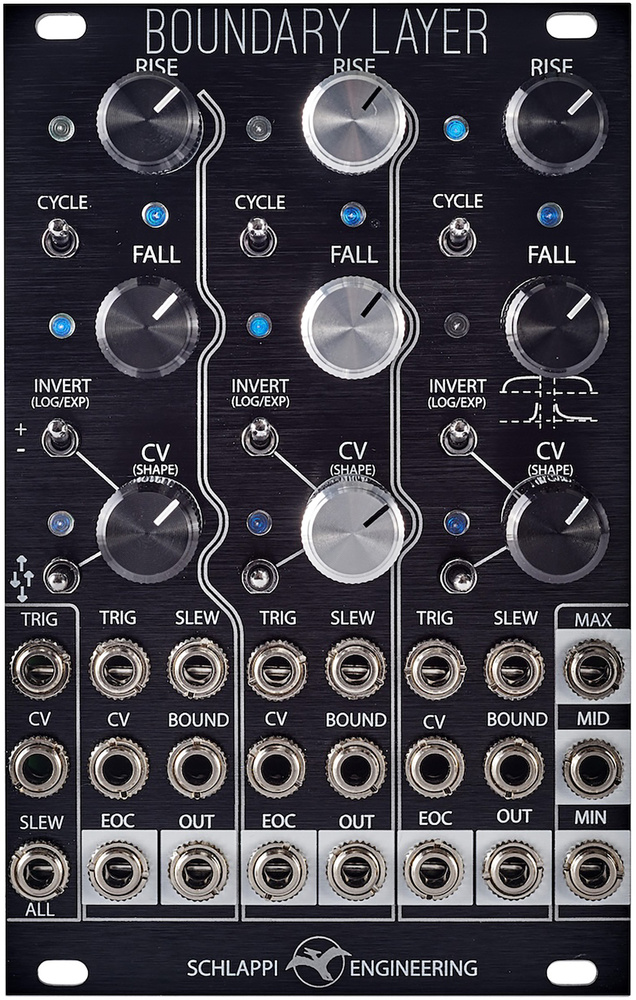
The three channels are, in the first instance, identical: each has controls for the rise and fall time of its slope, along with a CV control for modulating that rise or fall, or both. These neighbour three switches: one for cycling the envelope, one for inverting the input voltage and one, very usefully, for choosing whether incoming voltage applies to the rise stage of the envelope, the fall stage, or both. With nothing patched to the CV input, the CV knob and accompanying Invert switch become controls for editing the shape of the slope, with the switch toggling between a rounded logarithmic or plucky exponential curve.
When it comes to inputs, beyond the expected Trigger and CV jacks there’s Slew and Bound. Slew, if you feed it gates, essentially shifts the function of the envelope from attack‑decay to attack‑release; feed it CV working at 1V/octave and it’ll deliver pleasingly editable portamento between values. Which is to say, er, slew. The Bound input comes into play with the Cycle switch on, replacing the threshold of the slope’s rise and fall with an external signal. This, I found, is marvellous for creating syncopated patterns and stuttering, semi‑predictable behaviours. As for outputs, beyond the conventional voltage output there’s an EOC gate output, which can be switched to mark the end of either the rise or fall stage of the envelope by a header on the rear of the module. Each channel generously has its own header, so different channels can behave differently if you wish.
Envelopes, modulation, slew limiting; this is all, of course, highly functional. You hardly need me to tell you how useful it is to have a source of super‑responsive function generation at your fingertips, particularly if you’re familiar with the Boundary Layer’s predecessor, the single‑channel Boundary. But far from simply three Boundarys (or should that be ‘Boundaries?’) layered up, the Boundary Layer’s magic really lies in the way it combines its three channels.
This starts with the panel’s six holistic jacks: the three All inputs for triggers, CV and slew can be used to control all channels simultaneously, but with the added benefit of having an OR logic relationship with each channel’s own gate — that is to say, the channel will be triggered when a gate at either input is high. Even with various triggers creating asynchronous slopes across the Boundary Layer (and across a patch), the occasional trigger sent to the Trig All input allowed me to whip the whole lot back into order while still feeling just the right amount of free and loose.
The three All outputs are labelled Max, Mid and Min, and respectively select the highest, median or minimum of the three channels’ output voltages. Once again, this gives the Boundary Layer that excellent ability to combine CV in a most inventive but natural way, and it goes without saying that beyond the mathematics of the Max, Mid and Min outputs, impulsive patching is rewarded just as royally.
When set to cycle, the rise and fall stages can naturally move fast enough to go well into the upper reaches of audio rate. I was mildly disappointed to find that it can’t track accurately at 1V/octave like a conventional oscillator, but what it can of course do is hard‑sync with an external oscillator, meaning that even the simplest input signal can take on some seriously gritty — and modulatable — timbral character.
Internal patching is also lots of fun with the Boundary Layer, for instance patching the End of Rise output of each channel to the trigger input of its neighbour to create cascading strumming movements. Another patch I found tremendously rewarding was to set channel 1 to audio rate and send the outputs of channels 2 and 3, set slower, to its Bound and CV inputs respectively, creating some very rich timbral movement.
The strength of Schlappi Engineering modules is their uncanny ability to endow a patch with incredibly bold movement, sonic grit and a general feeling of being ‘on the edge’ in a way that is somehow as wild as it is controllable.
Indeed, if it wasn’t obvious by now, the strength of Schlappi Engineering modules is their uncanny ability to endow a patch with incredibly bold movement, sonic grit and a general feeling of being ‘on the edge’ in a way that is somehow as wild as it is controllable. The Boundary Layer is no exception to this rule, taking one of the most simple concepts in synthesis and still managing to open up new and intriguing creative avenues. Approved.