

Like a medieval cathedral, the Redshift 6 is a massively ambitious creation. There are other similarities too...
If you’re a modular user, you may recognise the name Supercritical from their two Eurorack offerings, the Demon Core Oscillator and Neutron Flux Filter (reviewed in SOS Jan 2020 and Dec 2021 respectively); two modules of formidable power that bring the worlds of analogue and digital together with finesse. If you happen to own either of those two modules, you will likely be pleased to know that they are both key constituents of the Redshift 6, the company’s first polyphonic desktop synthesizer and nothing if not a powerful statement of intent. It’s worth acknowledging early on that there’s also the distinct possibility that you’ve seen the Redshift 6 doing the rounds for some time already. Even when featured on the SOS YouTube series at Superbooth 2025 it had already been out for some time; and in fact was even on display at the Superbooth before that.
Why, then, are we only publishing a review of it now? Well, it comes down to a simple, endemic issue with the electronic instrument industry, about which I have in previous reviews made my feelings clear. Upon its release the Redshift 6 was, in simple terms, not finished. And, depending on your perspective, it might still be described as not finished. I say this for reasons which will become clear, but for now I’ll leave it at the fact that key buttons, such as FX, yield only a message saying ‘coming soon’, and I’d hazard a guess that anyone who bought a Redshift 6 upon its release will be starting to wonder what ‘soon’ really means.
Hex Appeal
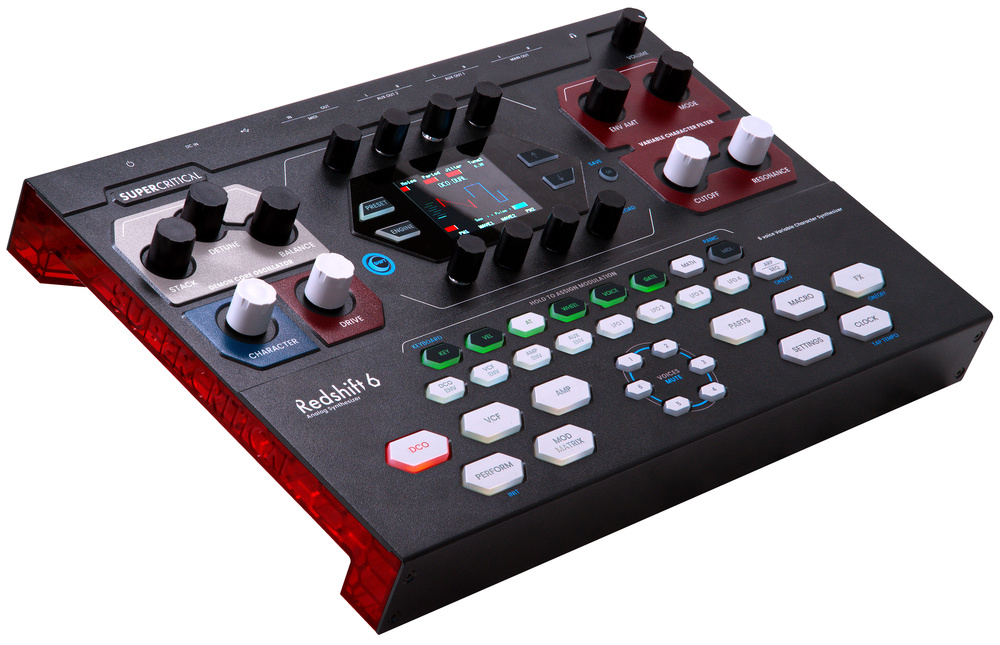
In any case, I do have a synth before me, in the flesh. What is it? Well, its not trying to emulate anything that’s come before, that’s for sure. On the chassis it says it’s a ‘six‑voice variable character synthesizer’. Each of its six voices comprises a staggering 16 digitally controlled analogue oscillators, including one for white noise. The interface itself strikes me, if I’m honest, as a little dated‑looking, with its big rubbery hexagonal buttons, small screen and transparent red plastic sides; more at home next to 2005’s Roland V‑Synth XT than next to my Torso S‑4 sampler or Make Noise 0‑Coast. But who knows, in a few years it might be aesthetically on trend again, as these things often go. Plus the sides light up, which I will never complain about. What’s important is that the build quality here is substantial and leaves nothing to be desired.
The workflow of the Redshift 6 ostensibly revolves around the screen and its accompanying soft knobs, with the panel buttons used to access its various screens. A handful of large endless encoders on either side of the panel then provide instant access to key parameters: on the right side are controls for the filter, including cutoff, resonance, filter mode and envelope amount, and on the left are controls for overdrive, ‘Character’ (discussed anon), and oscillator stacking, detuning and balance. At the bottom are buttons for things like viewing the DCO details and filter cutoff. The closest thing to a ‘home screen’ is that called up by the Perform button, which displays a handful of useful parameters simultaneously such as the active preset, bpm and drive amount. A ring of buttons at the bottom of the panel is labelled Voices. Although, confusingly, these in fact are for editing parts, not voices, they are well positioned and do make quick work of accessing the Redshift 6’s various layers.
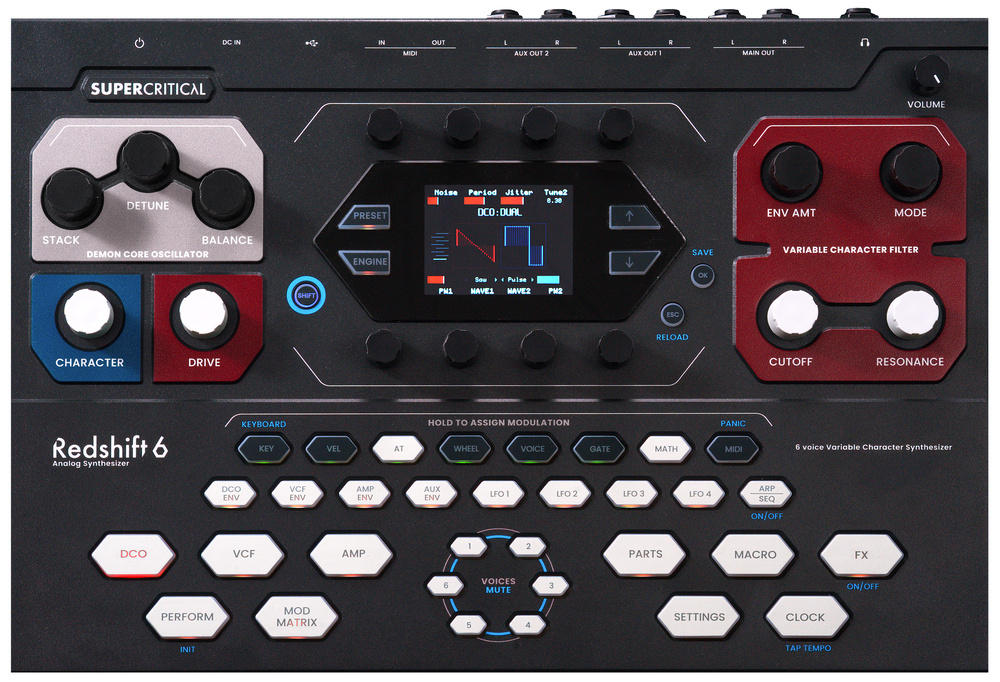 The Redshift 6 measures 378 x 254 x 63mm and weighs 3.5kg. And the sides light up!
I should say: it all really works. My fears of menu‑diving were all but allayed when I happily came to realise that more or less all screens were only one layer deep, and even more convenient is the modulation matrix workflow, which if desired can involve simply holding the relevant modulation source button (this could be the mod wheel, one of four LFOs, any of the envelopes, and so forth) and moving almost any parameter to have it modulated by that source. This presumably also includes MPE, the sequencer and something called ‘Math’, though none of these is either functional or, in the case of Math, elucidated in the manual. Though I missed some graphical features — for instance moving parameters to reflect modulation — the fact that it’s then also possible to get an editable overview of all modulation on the Mod Matrix screen means that there’s little to complain about when it comes to fine‑tuning movement.
Character Study
The Redshift 6’s aforementioned Demon Core ‘Multiperiod Digitally Controlled Oscillators’ are powerful, to say the least. Their design, in a nutshell, allows a single analogue core to produce several simultaneous waves, each with pitch and phase control. Impressive. With all six voices going together, it’s possible in effect to sound a whopping 96 oscillators at once. There’s ‘super‑saw’, then there’s ‘super‑super‑super‑super‑super‑super...’ you get the picture. I can’t but voice my disappointment to find the button for synth Engine not to be functional in this firmware, meaning that all I had to play with was a fairly traditional (and rather rudimentary at that) dual‑oscillator topography. This engine only offers sawtooth or pulse waves, with pulse‑width modulation and detuning available, but that’s about it. No waveshaping of the sawtooth and no other waveforms. Alas.
But what does ‘variable character’ mean? This pertains to one of the Redshift 6’s most impressive features, which is the fact that it can morph between the idiosyncrasies of several different types of synthesizer, digitally controlled but sonically all remaining in the analogue realm. Fair to say if I’d managed to include such a function on a synth, I’d probably lead with it in the name as well. In technical terms, this combination of analogue circuit design and digital control algorithms means that a raft of parameter behaviours can be altered according to which ‘character’ is selected: ostensibly these comprise tuning stability, gain staging, filter type, envelope shape and distortion behaviour. Five ‘characters’ are on offer: Liquid (represented by a droplet icon) is described by Supercritical as “spacey resonance, [with] filter pings dripping with dew”; Crisp (represented by what looks like either a piece of toast or a T‑shirt) is “a bright state‑variable filter”; Fat (represented as a ladder) is described as “our take on a ladder‑ish filter character”; Sour (a smiley face) amounts to “the squelchy acid thing”; and finally Mean (a smiley face with horns) imbues “highly unstable bad behaviour and distortion”. These are possible thanks to the aforementioned Neutron Flux Filter design, Supercritical’s ‘ultra‑flexible’ digitally controlled analogue filter whose core can be shaped more or less endlessly. Once again: impressive.
Fun emoji‑style icons aside, it would have been nice to have a little more detail in the manual about what sorts of synth topographies these draw from, aside from the more obvious Fat (Moog) and Sour (TB‑303) characters. To my ear several references came and went (a Sequential‑style Curtis filter sound here, an MS‑20‑type character there...). The crucial thing, though, is that between all of these it really is possible to approximate almost any behaviour you’re likely to be looking for, from Polivoks‑flavoured wildness to the musical smoothness of an Oberheim SEM. These aren’t just separated into five distinct categories, either: holding the Shift key it’s possible to interpolate between them and sit somewhere between two different behaviours, which can further be accentuated when pushing the overdrive. It’s all rather brilliant, and I say that as somebody who believes that variable distortion is a severely underappreciated sound‑sculpting tool in synthesis. If you’re even remotely persuaded toward gritty, lo‑fi electronic sounds then suffice to say the Redshift 6 has you covered.
 On the back panel are quarter‑inch sockets for headphones, stereo main outputs and two sets of aux outputs. These are accompanied by some MIDI ports of the time‑honoured five‑pin DIN variety, a USB‑B port, an input for the external power supply, and a power switch.
Playing The Part
The next layer of the Redshift 6’s workflow is in the organisation of its Parts, and this is another area where it really shines. The Parts screen and accompanying ring of buttons essentially allow the Redshift 6 to act as up to six different synths in one, playable in almost any configuration. The Parts screen is very clearly laid out and with colour‑coding to boot — handy, since it’s easy to occasionally get confused by the concentric numbers of voices, oscillators per voice, parts, paraphony and groups of parts. In fact, hitting any of the six Voices (that is, parts) buttons changes the overall backlight colour for all the Redshift 6’s buttons, which does help it feel a little like editing a totally different synth.
Key to this aspect of the Redshift 6 is the fact that it’s essentially multitimbral, all the time. That is to say, there is no specific ‘multitimbral mode’; you simply unmute another part, select it and sculpt its sound discretely to add it into the mix. Of course, the Redshift 6’s six voices means that you do have to think about how these are allocated across the different parts: with one part engaged, that part can polyphonically enjoy all six voices. With all six engaged, by default the synth of course sounds in six‑voice multitimbral unison. Then there’s everything between these two poles: you could have one Part set to be two‑voice, another as three and another as mono. There is also the option of up to five‑part paraphony, so within that allocation it’s still possible to further expand the chordal power of five tonal oscillators per voice.
Things only get better in the Parts department: they can be grouped so that various custom combinations can be played at the same time. You can reserve voices for certain parts to mitigate voice‑stealing, and you can even split the keyboard between different Parts. It’s quick and easy to allocate different MIDI channels to control different parts, making the Redshift 6 an immediate best friend of my Elektron Digitakt with its different MIDI sequencer channels. Atop this, thanks to the two sets of stereo aux outs on the back, it’s also possible to send different parts — as six discrete mono synth voices if desired — to completely different destinations. One or two extras would have been handy (for instance a Mixer view to quickly adjust each part’s relative volume), but in general, in case it wasn’t clear, this is what I mean by ‘six synths in one’, and combined with the flexibility of the Character parameter, it more than fits that description.
The Redshift 6 is a powerful synth with masses of very exciting potential.
Unfinished Business
The Redshift 6 is a powerful synth with masses of very exciting potential. Its interface won’t appeal to everyone, but the workflow is by and large very well thought out indeed. The sounds that are available at the time of writing are brilliant; it’s a synth that can attack a recording or performance from a multitude of different angles, taking on a litany of different roles. In many ways, in fact, this makes it a most rare and laudable thing, which is a synth I’d probably recommend to anybody who is only planning on owning one.
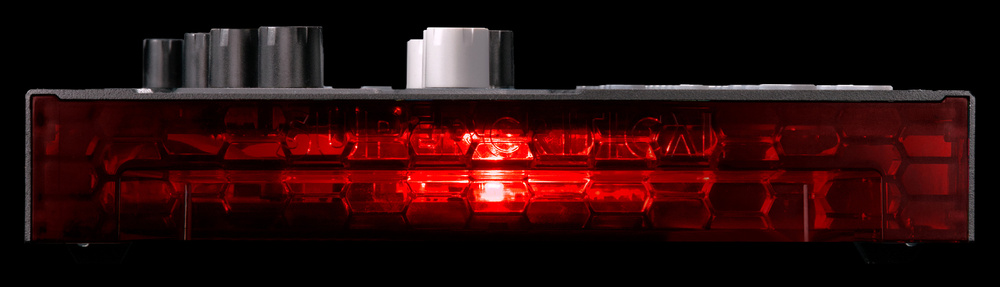 Did we mention that the sides light up?
But, as I mentioned earlier, I cannot turn a blind eye to the fact that the Redshift 6 — at least, the one I have before me — is simply not finished. While I understand that today’s instantly downloadable firmware updates mean that developers can release instruments and then continue working on them behind the scenes (and that in many cases this is a wonderful thing), that doesn’t justify developers releasing units while they’re essentially still in beta. I mentioned earlier that this might depend on your perspective: you might be more than happy with a more classic dual‑oscillator polyphonic synth with oodles of character and incredible amounts of flexibility. I have to say, in many ways if this was all that was in the offing from the Redshift 6 I would still be highly impressed with what is a rather brilliant piece of electronic instrument design.
But as it is, the carrot of more functionality has been dangled: if I had spent the asking price of £1099$1448 in January of this year and was still waiting for even one other synth engine to arrive — not to mention the arpeggiator, sequencer and the effects engine, which for many may understandably constitute the reason for buying it — I daresay I would be starting to question my purchase. And even the ‘public roadmap’ provided on the website is frustratingly vague, with interest‑piquing things such as a DCO engine for drum sounds in the ‘Planned For Later’ column. Are the days of excitedly unboxing a synth and staying up into the wee hours tinkering with it, exploring all its nooks and crannies, feeling the creative injection of a new piece of gear, behind us? Call me a Luddite, but it doesn’t feel quite so much fun to hit several brick walls within the first five minutes of switching the thing on (Macros and FX, for instance, are hardly at deep‑diving level, they’re among the biggest buttons on the panel). If, however, you are willing to wait, judging by what’s already on offer, I can say with a good degree of confidence that you will not be disappointed.
Pros
- It sounds fantastic.
- Easy and intuitive workflow.
- Different Parts means multitimbral, six synths in one, or anything in between.
- Well‑designed variable Characters.
- Great onboard distortion.
Cons
- It’s not finished!
- Might look a little dated to some.
- The screen could occasionally be put to better use.
Summary
Though frustratingly still lacking several functions, what’s already on the table is brilliant‑sounding and incredibly flexible. The Redshift 6 can be one powerful instrument, six synths in one, or anything in between.
Information
£1099 including VAT.