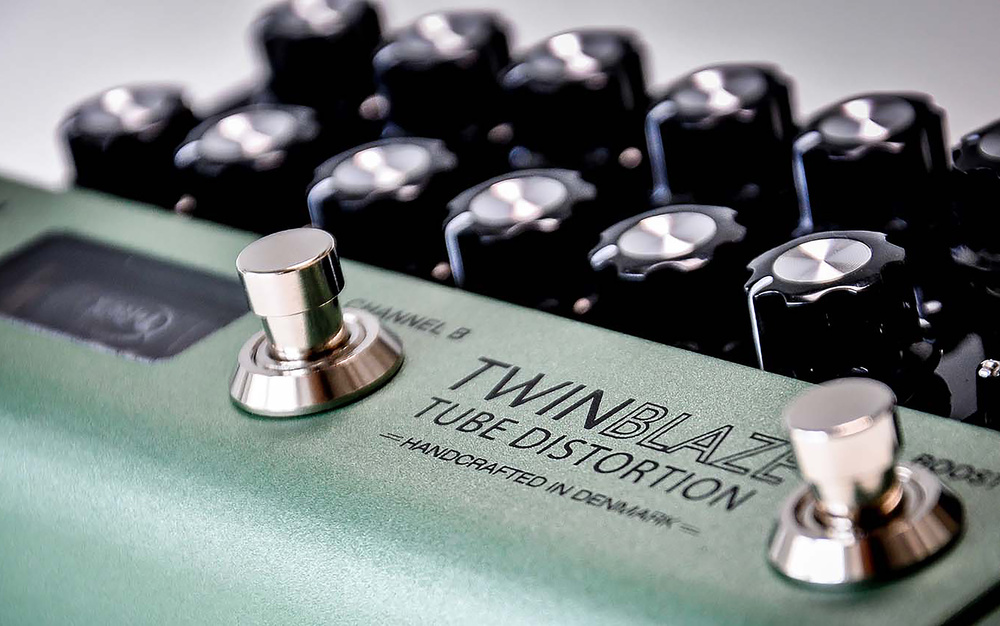
If you’ve always wanted an overdrive or distortion pedal featuring two fully independent channels with exactly the same facilities, here it is!
I collected quite a few T‑Rex pedals when they were first launched, as they always seemed to offer something slightly different from other brands, and have kept an original T‑Rex Replica delay on my gigging pedalboard for nearly a quarter of a century. So it’s great to see the Danish guitar‑pedal brand back in the hands of original founders Sebastian Jensen and Lars Dahl, and displaying their blend of audio quality and design innovation once again.
Their new TwinBlaze is a two‑channel distortion pedal, with a single 12AX7A tube stage. Admittedly, there are quite a lot of drive pedals that purport to be ‘two‑channel’ units, but few of them fully live up to that description. The TwinBlaze certainly does. Here, you have two identical channels, with the same control line‑up — Gain, Bass, Middle, Treble, Presence and Level — plus a Crunch/Lead mode switch. Individual footswitches are configured to select Channel A/bypass or B/bypass, and there’s a third footswitch for a post‑distortion boost of up to 20dB that you can use to lift your sound up‑front for a solo without changing the tone or drive level.
It’s not as big as it might look in pictures — it is actually the same depth as a Fulldrive, and only about 40mm wider, so it won’t eat up too much precious space if you’re a pedalboard user. Power comes from a supplied 12V DC external PSU. The current draw is a fairly hefty 500mA, so do bear that in mind if you’re using a multi‑output PSU. There are top‑mounted quarter‑inch jacks for the input and output connections, augmented by a speaker‑emulated jack for direct recording or using as a PA feed.
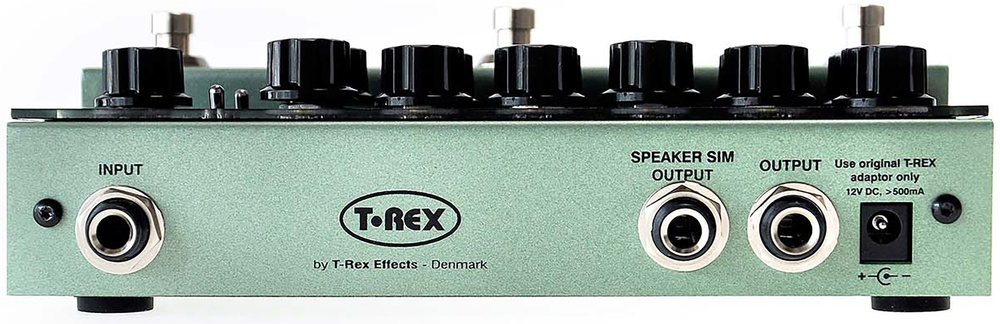 As well as the main quarter‑inch jack input and output, there’s an analogue filter‑based speaker‑emulated output.
Two Full‑featured Channels
The real flexibility in this pedal lies not just in the fact that both channels have a full complement of EQ and gain controls, but also that either channel can be set to the pedal’s Crunch or Lead voicing. This means you’re not stuck with having a dedicated Clean and Lead channel: you can have a semi‑driven Lead channel in A and a fully saturated solo tone in B by setting both channels to Lead mode; or a pristine, super‑clean A and a semi‑clean B, by running both channels in Crunch mode (Crunch can stay clean at low gain settings). At maximum gain in Crunch mode, you will get a bit of distortion with humbuckers, but not a lot with single‑coils. Personally, I’d have liked just a little bit more range on that one. There’s no shortage of gain in Lead mode, but with an independent Level control for each channel you can achieve any relative balance that you want and then use the independent Boost facility when you need to be louder.
The 12AX7A isn’t just a ‘marketing tube’! A switch‑mode, step‑up circuit feeds 200V DC onto both anodes (a 12AX7 is a twin‑triode: effectively two tubes in one), so the little red LED sitting behind it really is “just for fun” as the designer describes it, rather than something to make a ‘starved’ tube look like it has a proper working voltage on it.
The two channels are apparently identical, with the same operating frequencies for the EQ: Bass at 80Hz; Middle at 1.3kHz; Treble at 2.3kHz; and Presence at 2kHz. Obviously, there’s no power‑amp stage for the Presence to work as a filtered negative feedback circuit, as it would in a normal guitar amp design — Presence here actuates a shelving filter, raising or lowering everything above 2kHz to achieve a similar audible effect.
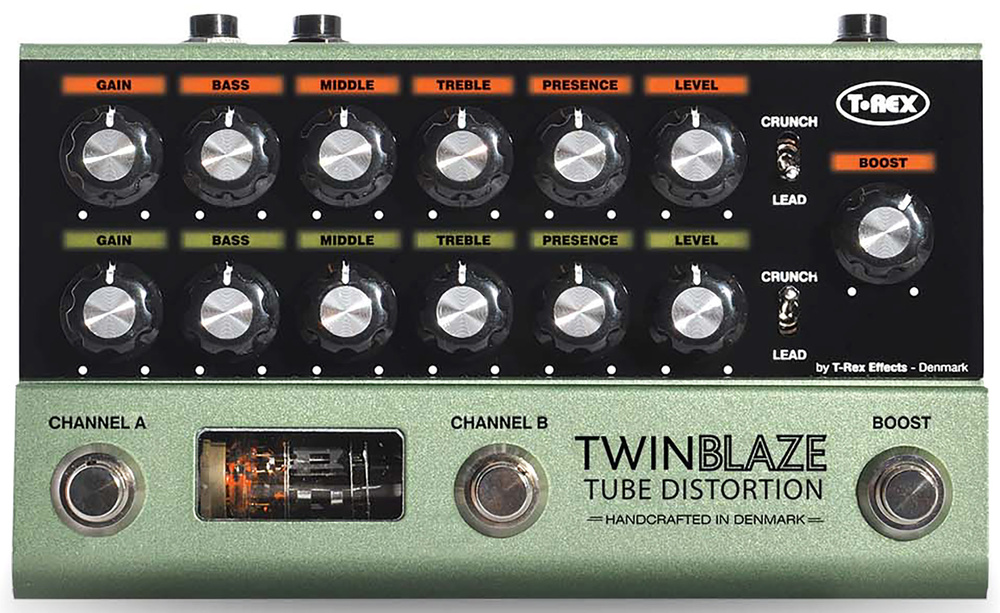 The TwinBlaze features two identical channels, with the all‑analogue circuitry based around a 12AX7 dual‑triode valve — and it’s more than just a ‘marketing tube’!
The two halves of the 12AX7 are cascaded to achieve a certain amount of tube clipping, but there are some diodes in there as well. Some people may get a bit sniffy about diode clipping in a tube‑based pedal, but I have no problem with it: there are much‑loved classic tube amps that derive a lot of their distinctive distortion voicing from having an integral diode clipping stage.
The Crunch setting has some intrinsic voicing to it, with a little midrange push. To match the bypass tonality (if you want to keep the basic sound of your amp just with a bit more gain) you need to fully cut the Mid band and raise the Bass a little. That bit of ‘pre‑voicing’ works fine, however, for running a three‑channel Clean (bypassed), Crunch and Lead setup. Lead mode has got plenty of depth, and has no trouble getting into scooped‑mid, Dual‑Recto, dark distortion territory or a more mid‑pushed traditional lead voicing.
Self‑noise is commendably low even at higher gain settings, but there is perhaps just a little more channel‑switching thump than I’d prefer, on the review model at least. It is only about the same as you get with many true‑bypass pedals, but this is a buffered bypass design and I have heard quieter switching.
Both channels sound great into an amp that is ‘cooking’ a little bit already, whatever settings you use.
Amp Dependent
As with any overdrive or distortion pedal, the TwinBlaze’s sound is significantly dependent on the amp you are using it with. Both channels sound great into an amp that is ‘cooking’ a little bit already, whatever settings you use. With a clean, mid‑scooped Fender amp at moderate levels, you always have to work a bit harder, but there’s certainly still enough gain and midrange available in the Lead voicing to get it to ‘sing’.
The dedicated speaker‑sim output is an analogue filter, so it’s never going to stand comparison with the real thing or a digital emulation. But it’s certainly usable when there is nothing else available. I guess the fact that it sounds not dissimilar to the speaker sim on my 30‑year‑old Mesa V‑Twin suggests there is only so much you can do with response shaping in the analogue domain. As always, the cleans are nice; the fully saturated distortion tones are smooth enough; it’s the in‑between stuff that is challenging for an analogue speaker sim.
All in all, the TwinBlaze hits its target, offering the full flexibility of two equally spec’ed valve overdrive channels in one pedal. It’s reasonably compact for what it does, robustly built, and competitively priced for a unit still handmade in Denmark. And if you are worrying about the longevity of a valve‑based circuit in a pedal, small‑signal tubes like a 12AX7 don’t wear out like power tubes and, properly driven, can give literally decades of use. What’s not to like?
Hear It In Action!
While putting this pedal through its paces, I captured some audio examples to give you a better feel for how it sounds. You can find these on the SOS website at https://sosm.ag/t-rex-twinblaze
Pros
- Either channel can operate in Crunch or Lead mode.
- Enough gain range for pushed cleans or fully saturated leads.
- Independent, post‑distortion boost facility.
- Low self‑noise for the amount of gain on tap.
Cons
- Quite heavy for pedalboard mounting.
- A small amount of switching noise.
Summary
High‑quality, valve‑based distortion, with a ton of twin‑channel flexibility, in a handmade, compact pedal — without a boutique price tag.
Information
£249 including VAT.
When you purchase via links on our site, SOS may earn an affiliate commission. More info...