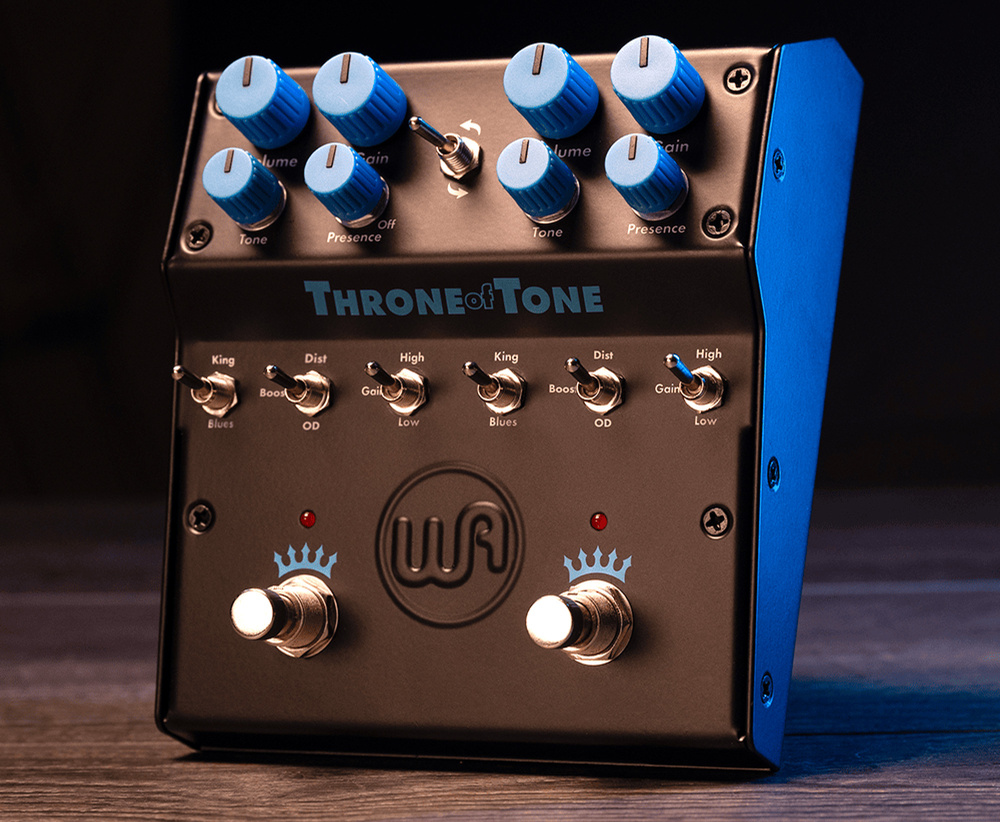
With two different distortion stages, an insert point and external controls aplenty, could this be the only overdrive you need?
Warm Audio make a number of pedals based on existing or classic circuit designs, and they’ve generally impressed. As the name of this one might suggest, the new Throne Of Tone owes its inspiration to the Analogman King Of Tone, a somewhat boutique dual overdrive pedal, whose designer cites Marshall’s Bluesbreaker pedal as his own inspiration. The original King Of Tone allowed for an extra degree of user tweakability compared with the Bluesbreaker, though, courtesy of internal switches and trimmer pots — and the Throne Of Tone helpfully puts all of these on the outside to improve access. All but one of these controls are on its top panel. The exception is the Voltage Boost switch, which is on the rear panel, and when active this doubles the internal voltage from 9 to 18 Volts to allow more internal headroom — something that’s particularly useful when using the clean boost setting, since that too breaks up eventually if the gain is set high.
Game Of Tones
Both sides of this pedal are identical, with rotary controls for Volume, Gain, Tone and Presence. The last of those shifts an internal filter from 500Hz to 2.3kHz to add extra brightness and bite. Below the knobs are three switches, the first of which changes the voicing from King to Blues. Both produce perfectly decent tones, but Blues is the one that offers that bit more bite and clarity. Apparently, the Blues setting uses TL072 op‑amps and is voiced to emulate the Bluesbreaker pedal, whereas King uses JRC4580 op‑amps and is voiced to emulate the King Of Tone.
Next comes a three‑position switch for selecting Distortion, Boost or Overdrive. Boost provides a nominally clean boost, while Overdrive handles lower‑gain drive sounds. Distortion delivers more dirt and saturation of course, but it still never gets excessive. Warm Audio have also included insert send and return jacks, so that other effects can be placed between the two drive channels where desired. A graphic EQ could be a very interesting addition, for example.
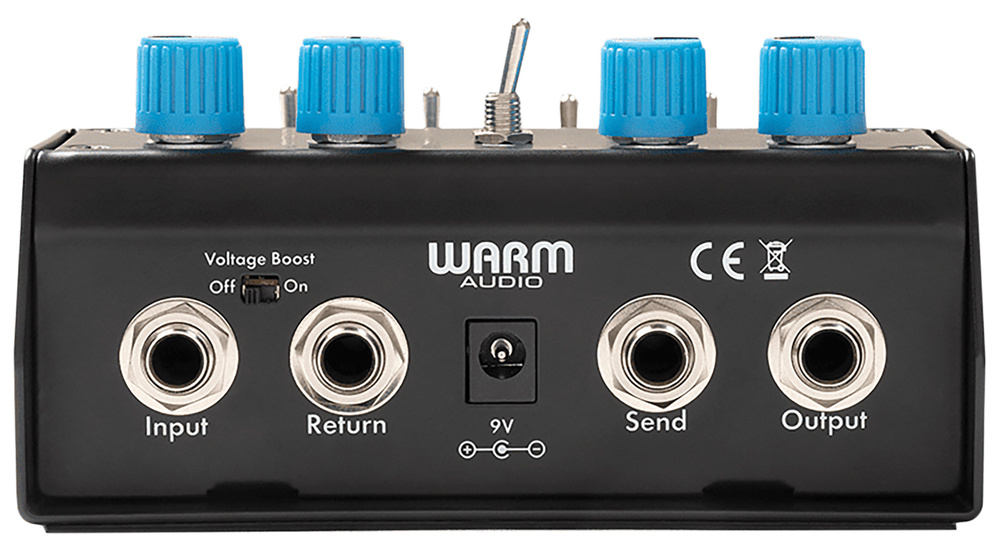
These modes are created by changing the clipping topography of the circuitry, which uses two op‑amp stages per channel. Clipping is produced by diodes in the feedback path of the second op‑amp stage, and also by separate diodes to ground following that stage; switching allows the two sets of diodes to be taken in or out of circuit. The first op‑amp stage provides the gain, and the tonal shaping is handled by a passive filter network at the end of the signal chain. A third toggle switch selects between Low or High gain modes. A toggle switch between the two channels allows their order to be switched, and each channel has its own footswitch with red status LED.
Diode In Your Arms Tonight
It’s common practice for guitar players to stack different overdrives, and having essentially two independent drive circuits in one pedal makes this very easy. The way the two channels interact allows for some very expressive drive characters, one option being to push a clean boost into an overdrive, though it can also be rewarding to stack two lower‑gain overdrives as an alternative to a single drive pedal set to a higher gain. As each pedal has its own bypass switch, the player can choose between three different drive settings during performance by using either channel on its own or both in combination.
Overall, the natural character of the guitar and amplifier still come over strongly, while the range of drive goes from just adding a little hair up to classic rock, but not as far as modern metal. Coaxing your own optimal tone out of the pedal can take a little experimentation, as the ways in which the two channels can be set up and combined provide a lot of flexibility, but having all the switches where you can get at them makes life much easier than having to go inside the case for internal settings.
I definitely have no argument with the clipping behaviour of this circuitry...
As is so often the case with highly regarded pedals, the original King Of Tone has an associated mythology regarding its ‘rare as unicorn droppings’ diodes and their influence on the sound. While I have no way of knowing whether the same diode types or close equivalents are used here, I definitely have no argument with the clipping behaviour of this circuitry.
OK, this pedal may be viewed by some as a clone of tone, but it’s affordable, versatile and very solidly built. If having different shades of overdrive in one pedal appeals to you, then the Throne Of Tone may well scratch your itch.
Summary
More than a mere clone, the Throne Of Tone offers takes on both the Bluesbreaker and King Of Tone pedals — and puts all the tweaking options on the outside where you can reach them!
When you purchase via links on our site, SOS may earn an affiliate commission. More info...

When you purchase via links on our site, SOS may earn an affiliate commission. More info...