


Baby Audio escalate their war on bad‑sounding audio with a vastly more powerful toolset for tackling problem resonances.
Baby Audio are the very model of a modern plug‑in development company, with a readily identifiable visual aesthetic, a wealth of novel ideas and a laser focus on ergonomics. Their plug‑ins usually manage to offer a usefully broad range of control without over‑burdening the user with parameters, and so it was with their take on the concept of resonance suppression or ‘de‑harshing’. The flip side was that their original Smooth Operator didn’t offer quite as much to the power user as rival plug‑ins such as Oeksound’s Soothe 2.
Four years after Smooth Operator appeared, Baby Audio have returned to the idea, but rather than create a version 2, what they’ve done is more akin to a ground‑up reinvention. And, as the addition of the term Pro to the product name would suggest, it gives the power user everything they could want and more.
Greater Operator
In the original Smooth Operator, nearly every control appeared only as a graphical node on an EQ‑type curve. This was elegant on paper, but in practice was not quite as intuitive as it might have been, especially with regard to the interaction between different controls. Baby Audio have retained the EQ‑like interface in the Pro version, but they’ve made things a lot more editable, and have given up on the idea that the curve alone can accommodate all the necessary settings. Instead, an inspector‑type panel to the left of the window allows you to adjust global controls, whilst a parameter list along the bottom displays settings for the selected node.
Each node has its own set of EQ‑type parameters: frequency, bandwidth and offset from the global threshold, which is represented in the same way as gain in an EQ curve. Offsetting a node downwards with respect to the global threshold makes it more likely that Smooth Operator Pro will apply processing in that band, whilst lifting it above the global threshold tends to exempt a band from processing.
The nodes also inherit numerous dynamic and spatial parameters from the global settings, which are grouped under the labels Focus, Comp(ression) and Imaging. By default, these labels are dimmed, meaning that the nodes follow the global settings, but parameters in these three groups can also be set independently for each node by enabling the Override Global option.
Focus Groups
Two new and very welcome global controls are the Lo and Hi Preserve dials, which respectively set low‑ and high‑frequency limits on Smooth Operator’s domain. As with any dynamic process, there are times when it can be a struggle to persuade a resonance suppressor to focus on the upper midrange and leave the bass region alone, since there’s usually so much more energy in the low frequencies, so the Lo Preserve option is particularly valuable. Another interesting global control is Correction, which has just two options labelled Even and Skew. The latter is said to apply perceptual weighting to the correction curve; details are scant, but in practice I usually preferred this option.
The original Smooth Operator provided a single global slider labelled Focus, which broadly governed the granularity of the processing. Smooth Operator Pro replaces this with a panel of three parameters. The Peak/RMS switch for the detector is a reasonably common feature in a conventional compressor but not one I’ve seen in this type of processor before. Detail controls the bandwidth and number of the individual resonances that will be detected: at high Detail settings you’ll see tens of needle‑like corrections being made in each band, whilst the results of using a lower setting look and sound more like conventional dynamic EQ. Isolation is a slightly mysterious control which, if I understand the manual correctly, sets the extent to which ‘out of band’ frequencies are factored into each band’s detector algorithm. Whereas the consequences of adjusting the Detail control are readily apparent both in the sound and in the visualisation, the Isolation control can be very subtle.
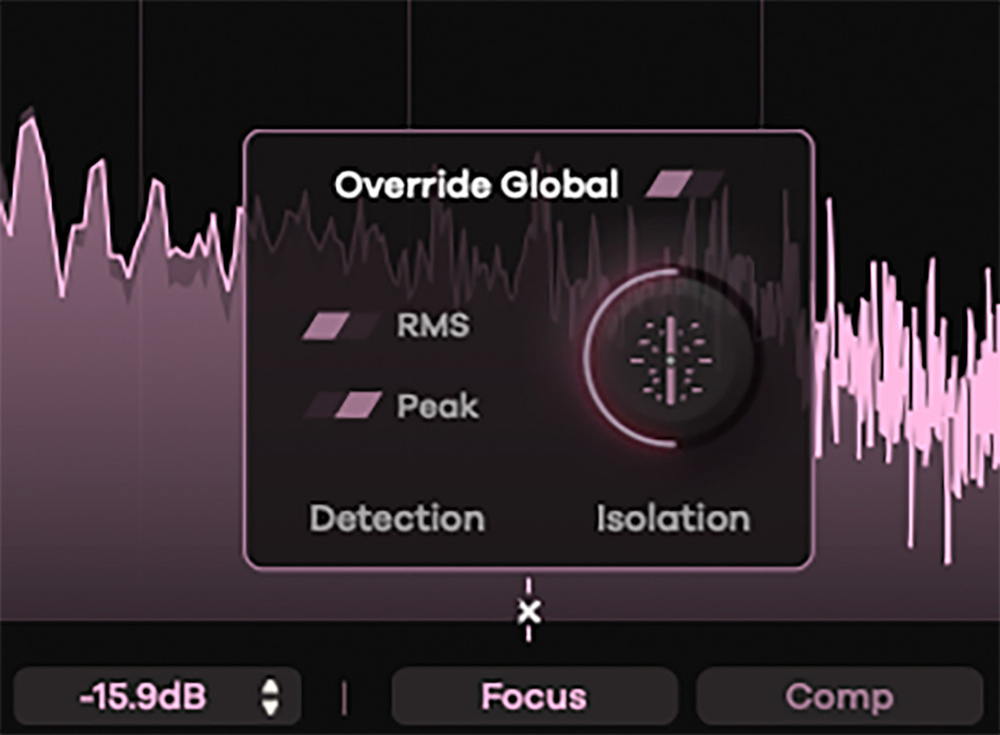 Many Smooth Operator parameters can be set on a per‑band basis, overriding the global settings.The Comp group of settings will be refreshingly familiar to anyone who’s used a compressor, with a hard/soft Knee switch and fully variable attack, release and ratio controls. The addition of adjustable time constants is particularly welcome, as the fixed attack and release times in the original Smooth Operator weren’t always fast enough.
The controls in the Imaging panel relate to channel linking. Smooth Operator Pro can smoothly operate in either left/right or Mid‑Sides mode, and two circular controls allow you to offset the balance so that more correction is applied in one channel than the other — which is probably more useful in Mid‑Sides mode — and to adjust the degree to which the detector signal is common to both channels. Reducing this Stereo Link setting to zero effectively makes Smooth Operator Pro act like a dual‑mono processor.
As I’ve already mentioned, all of the Comp and Imaging controls can be applied on a per‑band as well as a global basis, as can the Isolation and Peak/RMS options. Detail, however, remains global.
Black Ops
One of the notable features of the original Smooth Operator was that it seemed to be designed for creative as well as corrective applications. You could achieve some very interesting results by deliberately pushing it too hard, and that remains the case with Smooth Operator Pro. If you don’t create any nodes on the graph but simply pull down the global threshold control, you’ll hear your audio being radically rebalanced in ways that are often quite ear‑catching, but surprisingly artefact‑free. You probably wouldn’t want to use it across an entire mix in this fashion, but hearing what it does can be a useful step in diagnosing the faults in those tricky mixes that sound somehow ‘wrong’.
It’s in the corrective field that the improvements in Smooth Operator Pro really make their presence felt.
But it’s in the corrective field that the improvements in Smooth Operator Pro really make their presence felt. Indeed, if the original erred on the side of simplicity at the expense of versatility, you could perhaps accuse Baby Audio of going the other way with the new version. In practice, I didn’t often find it necessary to set parameters on a per‑band level, or dive into the Imaging settings. Thankfully, though, you can ignore these features if you don’t need them. The PDF manual is rather terse, and doesn’t explain everything as fully as I’d like; in particular, the operation of the Isolation and Correction controls remains rather enigmatic. As a result, Smooth Operator Pro is perhaps less easy to master than Oeksound’s Soothe 2, but unlike the original, it competes head‑on with the OG in this field, and incorporates some features that aren’t available there. It also boasts an excellent selection of genuinely useful presets.
As time goes by, it’s increasingly rare that I do a mix without incorporating resonance suppression on something, whether it be a gritty drum overhead, a harsh violin or a badly recorded vocal. Smooth Operator Pro provides all the tools that are needed for this, and plenty more besides. The full version represents excellent value, and the upgrade from version 1 is a total no‑brainer.
Summary
Smooth Operator Pro lives up to its ‘pro’ billing, providing a massively expanded set of tools for tackling harshness and unwanted resonances.
Information
$129; upgrade from Smooth Operator $29.
$129; upgrade from Smooth Operator $29.