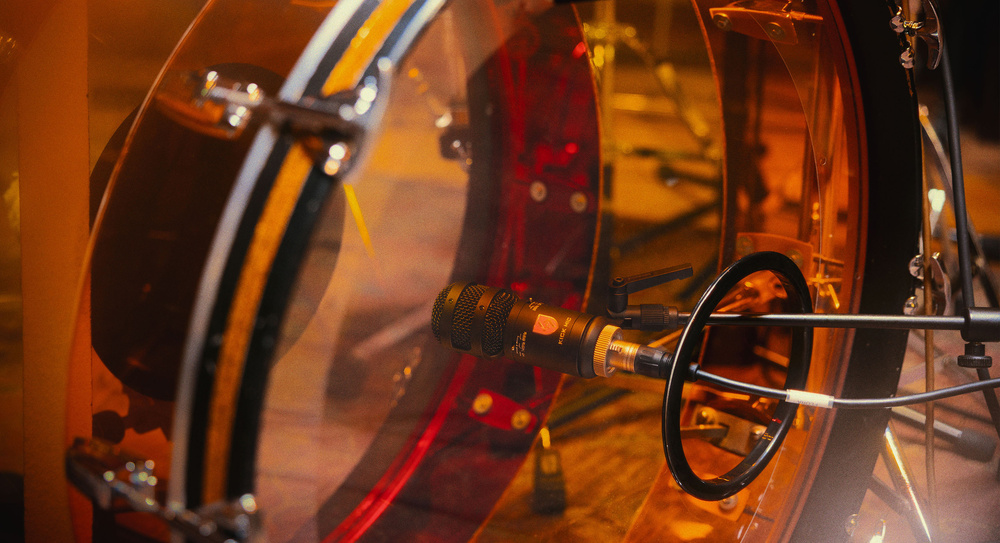
Lauten’s latest makes crafting the perfect bass drum sound a breeze.
Lauten Audio’s Kick Mic is an end‑fire capacitor microphone, designed specifically for use with bass drums. In contrast to some conventional kick‑miking practices, this mic is intended always to be placed inside the drum, via a hole cut in the resonant head. According to Lauten Audio, this approach addresses common issues such as low‑frequency build‑up, phase problems from reflections within the drum shell, and unwanted bleed from other kit components.
Physically, the Kick Mic is robust and compact, suitable for both studio and live use. The mic body measures 125 × 50mm and it weighs 290g. An included swivel‑mount collar with a thread adaptor (for compatibility with both EU and USA mic‑stand threads) allows precise positioning inside a kick‑drum port. Unlike some swivel mounts, this one locks in place very securely. The only other accessory supplied is a soft storage pouch.
Requiring 48V phantom power and equipped with a FET preamp stage, the Kick Mic has a tight cardioid polar pattern designed to remain directional down to very low frequencies — around 50Hz. (In contrast, most directional mics tend to become more omnidirectional at low frequencies.) The Kick Mic’s KC608 capsule, which is specified to operate over the full 20Hz‑20kHz frequency range, features a 17mm diaphragm mounted within a 40mm element in a rear‑ventilated chamber — a topology intended to deliver a fast transient response and a balanced blend of beater attack and drum‑body resonance. As with most kick mics, the frequency response is intentionally not flat, but at same time it’s not so dramatically shaped as some other kick mics like the AKG D112.
Because of its intended position inside the drum, the capsule is designed to handle very high SPLs of up to 146dB. Self‑noise is low at less than 15dBA, which is negligible in the presence of a loud source such as a kick drum. Figures for sensitivity are almost irrelevant for a mic working in such high‑SPL environments, and I needed to set a very low mic gain on my interface to achieve a sensible level without the risk of clipping.
Another key aspect of the design relates to what Lauten call Air Coupling Modes. These are essentially vents in the rear of the capsule, intended to mitigate the effects of turbulence created by the rapid movement of air inside a kick drum as the beater strikes. The aim is to prevent the mic from being overloaded by a build‑up of headroom‑eating sub‑bass energy, which can lead to a muddy or distorted sound. These vents also help the mic to maintain its directionality down to very low frequencies.
Onboard tonal shaping is provided by switchable 140/80 Hz high‑pass filter and 5/12 kHz low‑pass filter, offering several tailored response options to suit the drum and musical style. These filters allow the user to tame excessive low end, emphasise the midrange, or soften an overly aggressive beater attack.
Pumped Up Kicks
The Kick Mic’s recommended placement inside the drum significantly reduces spill from nearby drums and instruments, while the ability to balance the impact and resonance of the drum by adjusting the position of the mic makes it relatively easy to achieve a strong kick‑drum sound. Gone are the days when engineers had to spend hours chasing a usable miked kick sound! The tight polar pattern also minimises the effect of internal reflections, and with careful positioning and EQ switching, it’s possible to coax a wide range of bass‑drum characters from a well‑tuned drum.
For live work, the benefits of quick setup and reduced bleed are substantial, and the mic’s high SPL handling capability means even the loudest drummers won’t faze it. However, the Kick Mic also performs well with smaller drums — for example, tested with a 16‑inch Tama kick, it still served up a surprisingly weighty recorded tone. As expected, altering the mic’s position changes the character in very perceptible ways: the furthest‑forward recommended setting places the mic’s EQ switches just inside the drum, and yields a balanced, ‘general purpose’ kick sound. For the small bass drum I found this position to be the one that delivered the most depth and weight. Fine‑tuning the placement may be necessary depending on the drum’s construction and tuning, so for a large kick drum that tends to be heavy on bass and short on beater click, moving the mic a little closer to the beater helps achieve a better balance. Further tonal variation can be heard when moving the mic from a centre position towards the edge of the shell. Because the Kick Mic is an end‑fire design, positioning is relatively straightforward even when the resonant‑head hole is small.
For any given session, the ideal mic placement spot can be found very quickly.
While bass drums may seem like known physical quantities, when you get them into the studio every one seems to behave differently, and that’s where the Kick Mic comes into its own — its predictable behaviour means you soon get a feel for what tonal changes to expect when adjusting its position. For any given session, the ideal mic placement spot can be found very quickly. The reduction in spill from other sources is also a valuable attribute.
In summary, the Lauten Audio Kick Mic represents a genuine solution to a number of routine problems when faced with miking kick drums. It may not be the only mic able to produce a good kick sound, but its ‘better mousetrap’ benefits are definitely worthwhile.
Summary
The Kick Mic has a number of well‑thought‑out features that make it a real problem‑solver when recording bass drums.
Information
£482 including VAT.
Synthax Audio +44 (0)1727 821870.
When you purchase via links on our site, SOS may earn an affiliate commission. More info...