

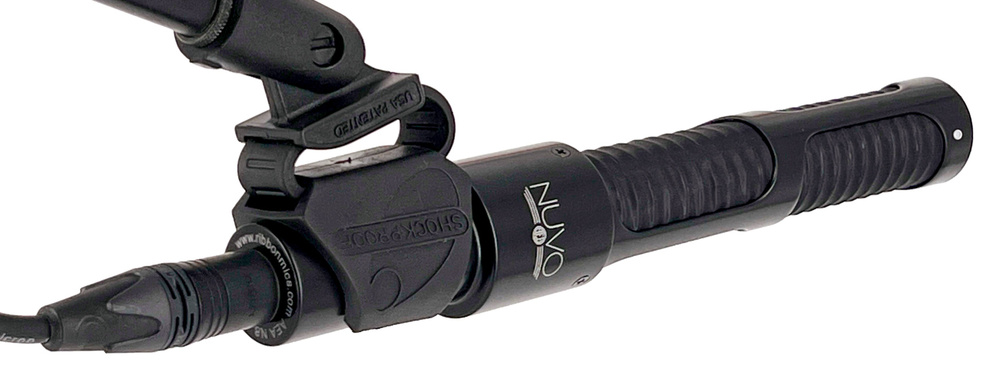
The N28’s clip is decoupled from the stand by a soft plastic loop that adds a degree of shock protection.
AEA aim for the middle ground with an intriguing new stereo ribbon mic.
It’s hard to describe the sonic character of a microphone without resorting to cliché. In the case of ribbon microphones, those clichés often involve adjectives like ‘smooth’, ‘warm’ or ‘dark’. But are those really fundamental aspects of ribbon mic ‘tone’? Or do they arise because of the way the mics are being used?
If you swap out a typical capacitor mic for a ribbon in a close mic placement, the chances are you will notice that the sound is indeed thicker and richer at the low end. But that is partly because nearly all ribbon mics have a native figure‑8 polar pattern, and consequently exhibit lots of proximity effect. In terms of true low‑end response, a pure velocity mic such as a ribbon struggles to go as low as an omni capacitor mic — so if you carried out the same swap in a distant mic placement, it might well be the capacitor mics that sound deeper.
At the same time, most ribbons have less high‑frequency extension and presence than their capacitor brethren. Consequently, if a ribbon mic is ‘voiced’ so as to sound balanced in close‑mic placements — perhaps by deliberately attenuating the low end to compensate for proximity effect — it may well sound middly and boxy in distant applications, lacking both air at the top end and weight at the low end. That’s a phenomenon AEA have tried to counter in their well‑established R88, which is described as a “far‑field stereo ribbon mic”, and offers greater than usual high‑ and low‑frequency extension.
The R88 is available in active and passive versions, and has also spawned a mono derivative called the N8. But now AEA have introduced a second stereo model, with slightly different applications in mind.
Active Service
The Nuvo N28 is available only in an active version, and is significantly more compact than the R88. Its two ribbon motors are likewise mounted one above the other in a fixed Blumlein configuration. Below this, a bulge in the body of the mic houses a pair of Lehle transformers with a 1:89 step‑up ratio, and a newly developed buffer/line‑driver circuit that delivers a comfortable sensitivity of 6.1mV/Pa. Finished in satin black, the N28 is very attractive in a self‑effacing sort of way, with a helpful white circle identifying the front. It ships with a compact, allegedly shock‑absorbing clip and a 15‑foot cable that attaches to the mic using a five‑pin XLR, with a conventional pair of three‑pin male XLRs at the preamp end. Both of these need to be fed with 48V phantom power. All in all, it’s a classy package, let down only by a cheap and nasty plastic case.
Whereas the R88 is designed for distant miking scenarios, the N28 has a different raison d’être. It’s described as being “ideal for medium distances” — which, AEA clarify, means distances from eight inches to three feet. That’s an interesting and relatively unusual concept for a stereo mic. A Blumlein array has a 90‑degree acceptance angle; at three feet from the source, that means the entire stereo field will be filled by an instrument measuring a little over four feet across. Most drum kits are bigger than that, never mind a grand piano or brass section. Conversely, placing the mic eight inches from a source is likely to deliver a stereo picture much wider than the way the same source would ever be perceived in real life.
A less rigid interpretation of AEA’s design goal might be that the N28 is a stereo mic intended for capturing individual instruments rather than ensembles. Which, in my experience, makes it pretty much unique. What it means in practice is that the N28 has a “mid‑field low‑end response tuning” designed to deliver a balanced low end at the kind of intermediate distances AEA are talking about: within the range where proximity effect is a factor, but not close miking as such. AEA also say that the mic has more obvious presence in the upper midrange than the R88.
Naturally, the N28 also inherits many characteristics typical of ribbon mics in general. Its two motors both have a very clean and well defined figure‑8 polar pattern in the horizontal plane. In the vertical plane, high‑frequency response tends to fall away as you move off axis owing to the shadowing effect of the body and the other ribbon motor. The published plot suggests that the frequency response (of, presumably, one N28 motor measured on‑axis) is broadly flat up to about 5kHz, and thereafter falls away in a fairly smooth manner, being about 8dB down at 10kHz and 11dB down at 20kHz.
Heavy Metal
During the review period, I had the chance to try out the N28 on drum overheads as well as on vocals, acoustic guitar, electric guitar amps, mandolin, hand percussion and the like. Lots of engineers I know and respect love ribbon mics as drum overheads, but personally I find it can be a struggle to make them work at the mix. When you’re expecting the body of the drum sound to come from close mics, you can have too much body in the overheads! If that’s your thing, though, the N28 delivers it in abundance. In line with AEA’s description, the very low end is indeed curtailed compared with some other ribbon mics I tried, but we’re really talking only about the 50Hz region here. At all normal distances, there’s plenty of heft and weight in the 100‑300 Hz zone, so the fundamental resonances of snares and toms really pop out. At the top end, meanwhile, cymbals come across as polished and, in a subdued sort of way, airy.
There’s plenty of heft and weight in the 100‑300 Hz zone, so the fundamental resonances of snares and toms really pop out.
In the world of compact stereo ribbons, obvious competitors to the N28 might include models like the Royer SF‑12 and Extinct Audio Valkyr Stereo. I didn’t have either available for this review, but I do have a pair of mono Extinct BM9s, which are to all intents and purposes one half of a Valkyr, and have used the SF‑12 a fair bit in the past. Both the BM9s and the SF‑12 are quite forward in the upper midrange in comparison to many ribbon mics, with the SF‑12’s presence lift perhaps tending slightly further up the spectrum than that of the BM9. The same phenomenon is not so apparent with the N28; put it up alongside the BM9 (and, by extension, the Valkyr) and you’ll typically get less 50Hz and 3kHz, and more low midrange. Which is preferable obviously depends both on the source and on your tastes, but I found myself liking the sound of the N28 on a lot of things.
As I said at the start of this review, it’s probably a cliché to describe a ribbon mic as sounding ‘smooth’. Nevertheless, it’s an apt term for the N28. That relatively unhyped midrange means that it doesn’t emphasise gritty hash or harsh resonances in the way that brighter mics sometimes can, yet at the same time, it doesn’t lack definition, and nor does it sound soft. And, as is often the case with coincident stereo mics, the results can be startlingly lifelike. One of the best sounds I got with the N28 was by placing it parallel to the fingerboard of an acoustic guitar. This really did make it sound as though the player was sitting inbetween the speakers, giving a private performance to the listener.
Ultimately, it would be a shame if anyone was put off buying the N28 by AEA’s description of its intended role. It’s certainly not a mic that suddenly starts to sound bad when you get an inch further than three feet from the source! Its deliberately controlled low end would only really be an issue if, for example, you were to use it as the only mic on an orchestra or a large brass ensemble. In most real‑world applications, that area of the frequency spectrum is likely to be either irrelevant, or covered by other mics. In practice, given the N28’s richness in the ‘upper bass’ and low midrange, any EQ you deploy is far more likely to be cutting than boosting at the bottom end. And with its compact dimensions, stylish yet unobtrusive appearance, healthy sensitivity and ability to drive long cable runs into any preamp, it’s practical as well as euphonic. Although it’s complementary to AEA’s R88 in some ways, there’s a very large area of overlap where both mics will do a fine, fine job.
Summary
The Nuvo N28 is a high‑quality stereo ribbon mic with a wide range of possible applications.
When you purchase via links on our site, SOS may earn an affiliate commission. More info...
