

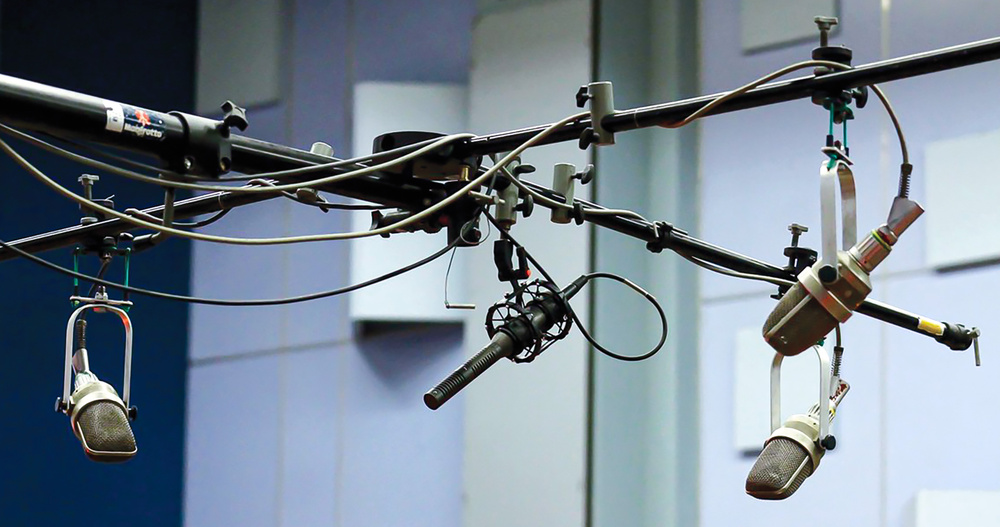
We dive deeper into the theory and practice of hybrid arrays, and consider the benefits of using more than one array.
In the previous part of this series, I introduced the concept of hybrid stereo mic arrays, and explored some of the initial practical processes you can undertake to choose either an established named array — all of which are defined precisely — or to adapt the idea to tailor your own to the recording task in hand. This time, I want to dive a little deeper into the subject, and we’ll start with some useful tools that can inform your choice.
Visualisation
In Part 4, I mentioned the advantages of visualisation tools for optimising the SRA and capsule configurations, and the increased parameter interaction when tweaking hybrid arrays means good visualisation tools become even more helpful. However, there’s another way of looking at these things that I’ve found very educational and informative: The Stereophonic Zoom. This was the title of an academic paper presented by Michael Williams to the AES Convention in London in 1984, and it has been enhanced by its author ever since, culminating in the excellent Multichannel Microphone Array Design book that I reviewed a couple of years ago. That book covers a far wider range of mic configurations and applications than we’ve been exploring here, though, so perhaps an easier introduction to the concepts can be found in an article on Grace Design’s website: www.gracedesign.com/support/StereoZoom10.pdf.
Michael has, very generously, also published the associated graphs for a range of stereo arrays using different polar patterns on his website (www.williamsmmad.com/MAD/2ch/2ch.htm). I’ve redrawn one of his graphs for cardioid capsules configured in a stereo array. The capsule spacing is shown along the bottom axis and the mutual angle along the vertical axis. The blue lines indicate the SRAs provided by different combinations of capsule spacing and mutual angle, while the orange blobs identify the parameters employed by the named hybrid arrays discussed previously.
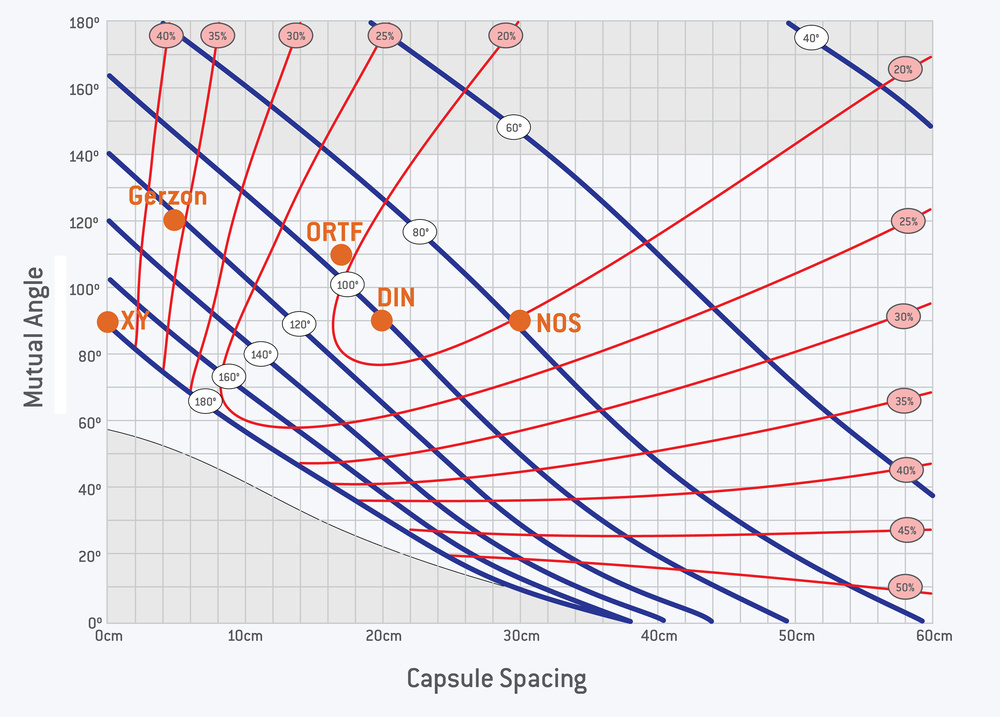 The capsule spacing and mutual angle of various ‘name’ hybrid arrays. The shaded areas (top and bottom) indicate regions where the direct/reverb ratio varies across the stereo image.
As you can see, the X‑Y coincident cardioid array, with zero capsule spacing and a mutual angle of 90 degrees, lies close to the blue 180‑degree SRA curve. The DIN array, with its 20cm capsule spacing and 90‑degree mutual angle, is offset to the right of the X‑Y array, sitting close to the blue 100‑degree SRA curve. Hopefully, examining this graph will help to make a little clearer how reducing the capsule spacing moves horizontally leftwards across the blue lines of increasing SRA and, similarly, how reducing the mutual angle moves vertically downwards across the increasing SRA lines. The shaded areas at the top and bottom indicate the regions where the direct/reverb ratio varies across the stereo image. In the upper area there tends to be too much reverberation in the central zone of the stereo image, and the direct sound tends towards a ‘hole‑in‑the‑middle’ effect. In the lower shaded area, the reverberation tends to increase and ‘pool’ towards the outer extremities of the stereo image. So, choosing parameters in these areas is not recommended.
Angular Distortion
The red lines, roughly perpendicular to the blue SRA curves, represent the ‘angular distortion’ created by the array, indicated here as a percentage error from the true position. Angular distortion, in this context, is the variance between the physical angles between sources in front of the microphones, and their perceived relative angles when replayed over loudspeakers. It’s analogous to the optical distortion created by a wide‑angle camera lens when it’s placed close to a subject.
As a general rule, most stereo mic arrays tend to expand the soundstage outwards — they push sources located away from the centre of the stereo image even further out towards the speakers, thus stretching the centre and ‘crushing’ the extremities. It’s usually a pretty subtle effect, but it’s certainly audible when comparing different array configurations in good monitoring conditions. It can also become noticeable when close‑miking a soloist who plays in an animated way, as any small physical movements can sound rather exaggerated when auditioned on the speakers.
The optimum conditions to minimise angular distortion vary with different polar patterns in the array, but for cardioid microphones the angular distortion is minimised by using moderate mutual angles (80‑110 degrees) and capsule spacings (20‑30 cm). In other words, hybrid arrays produce slightly less angular distortion than coincident arrays, and almost half as much angular distortion as spaced arrays. So it seems that capturing both time and intensity differences between channels is better than just time or intensity alone.
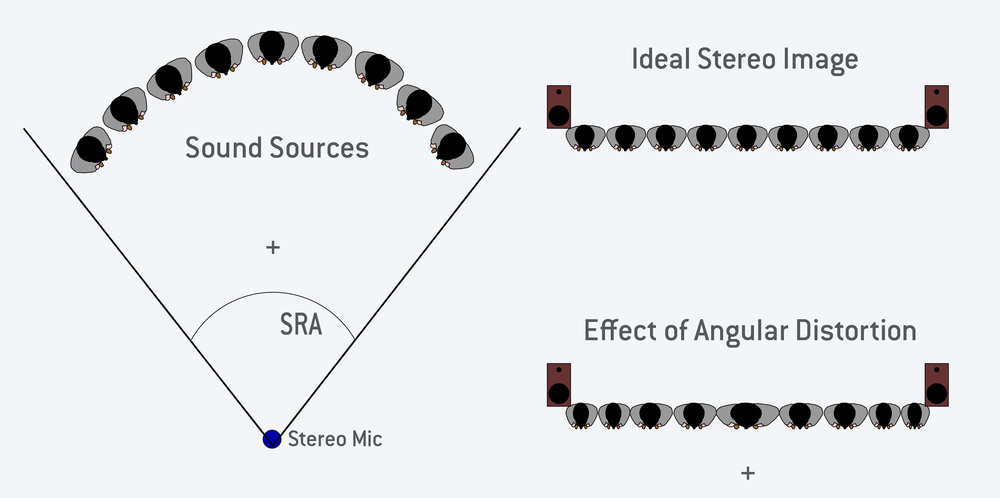 An illustration of angular distortion: sources further from the centre tend to be pushed outward towards the speakers.
As can be seen on the graph, the DIN array has the least angular distortion of all the hybrid arrays I’ve discussed so far, with NOS and ORTF both having a little more angular...
You are reading one of the locked Subscribers-only articles from our latest 5 issues.
You've read 30% of this article for FREE, so to continue reading...
- ✅ Log in - if you have a Digital Subscription you bought from SoundOnSound.com
- ⬇️ Buy & Download this Single Article in PDF format £0.83 GBP$1.49 USD
For less than the price of a coffee, buy now and immediately download to your computer, tablet or mobile. - ⬇️ ⬇️ ⬇️ Buy & Download the FULL ISSUE PDF
Our 'full SOS magazine' for smartphone/tablet/computer. More info... - 📲 Buy a DIGITAL subscription (or 📖 📲 Print + Digital sub)
Instantly unlock ALL Premium web articles! We often release online-only content.
Visit our ShopStore.