

You are here

Schoeps Desert Island Stereo Set

Capacitor Microphones By Sam Inglis
Published January 2026

Schoeps Desert Island Stereo Set

These pocket‑sized microphone pairs provide an easily understood entry point to Schoeps’ comprehensive catalogue.

Of all the great German microphone manufacturers, Schoeps seem to maintain the lowest profile. Most people who are serious about recording classical music will have extensive experience with Schoeps mics, but in the rock and pop world, they can fly a little under the radar. That’s partly because, unlike Sennheiser, Neumann or beyerdynamic, Schoeps are not generalists. They do not make dynamic mics, or large‑diaphragm models, and they don’t offer a range to suit every budget. Their entire product line is based around small‑diaphragm capsules, of uncompromising quality. Historically, moreover, there has been no obvious Schoeps counterpart to the U67 or MD441: no iconic, instantly identifiable object that is ever‑present in studio photos or documentaries about classic albums. Apart from the vocal‑oriented V4U, Schoeps mics are deliberately made to be self‑effacing and visually unobtrusive.

Click & Colette

At the heart of the Schoeps range is a series of no fewer than 20 different capsules. All 20 are available separately as options for the modular Colette system, in which they can be paired with one of a number of bodies such as the CMC 1U and CMC 6, as well as accessories such as pads and low‑cut filters. Almost all of the MK‑series capsules are also available as complete miniature mics, courtesy of the CCM range. So, for example, the CCM 2H miniature mic is functionally and sonically the same as the pairing of the CMC 1L body and MK2 capsule from the Colette range. You’d choose the former if you value convenience and compactness, the latter if you want the freedom to mix and match different preamps and capsules.

The Colette range is by far the most comprehensive modular mic system on the market, which is perhaps a double‑edged sword. On the one hand, there’s no recording task imaginable that can’t be handled by at least one of the 150‑plus combinations of body and capsule on offer. On the other, if you’re taking your first steps into Schoeps’ world, the immense wealth of options can be intimidating. I suspect that’s one of the major reasons behind the introduction of the Desert Island Stereo Set.

Small Is Beautiful

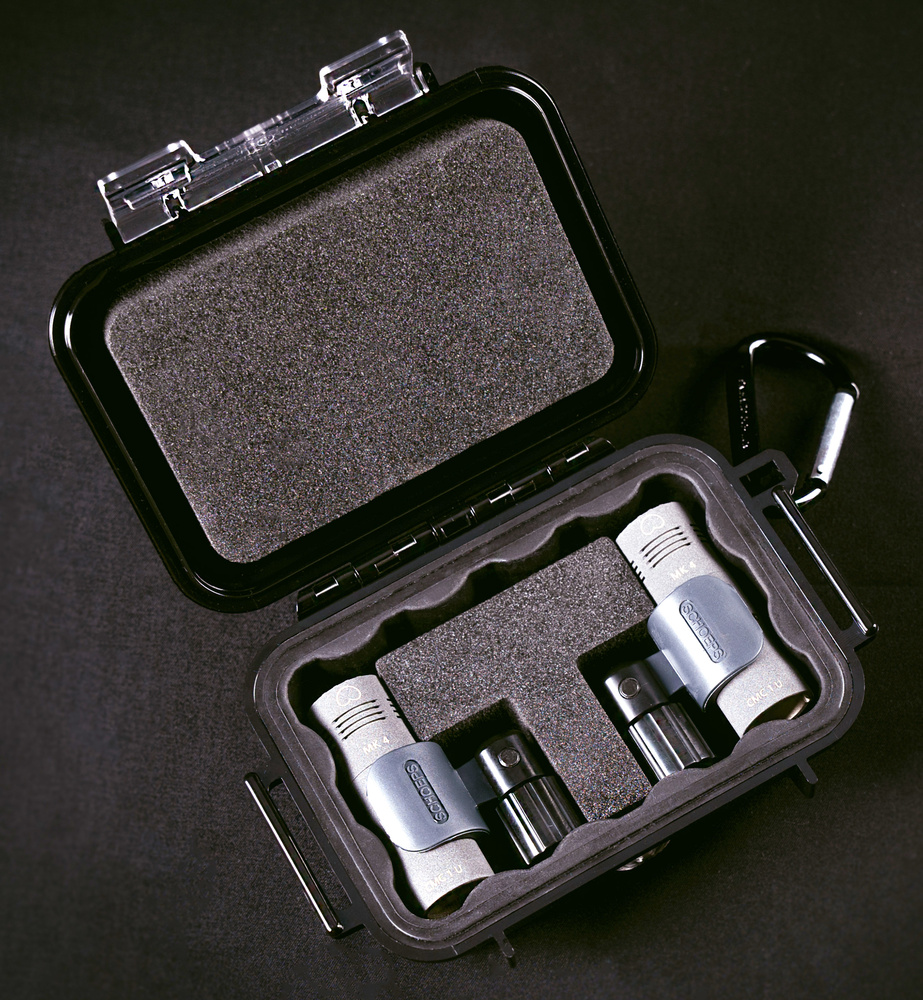
If you were actually stuck on a desert island, you’d have to keep a sharp eye out for thieving seabirds, because the Desert Island Stereo Set is remarkably compact. It comprises a pair of CMC 1U bodies, each about an inch and a half long, with your stereo‑matched choice from nine of the most popular MK‑series capsules. These are supplied with simple standmounting clips in a very robust black Peli case with a carabiner, so you can attach it to your belt in case of albatross attack. At around five inches by three, the case is genuinely pocket‑sized, and not much larger than one you might use for a pair of IEMs or similar.

There’s something awe‑inspiring about tiny things made to an incredibly high standard, and the Colette mics are just that.

Capsule options for the Desert Island Stereo Set include four MK2 omni types variously optimised to be flat in the nearfield, the diffuse field and distances in between, plus the MK21 wide cardioid, the MK22 open cardioid, the MK4 cardioid, the MK41 supercardioid, and the MK5, which uses a mechanical switching arrangement to offer both omni and cardioid patterns. Schoeps supplied the MK4 version for this review. As you’d expect given the price and Schoeps’ reputation, manufacturing quality is top‑notch. There’s something awe‑inspiring about tiny things made to an incredibly high standard, and the Colette mics are just that.

The CMC 1U body requires standard phantom power, with a range of 30 to 52 Volts specified, and its XLR output is electronically balanced. The CMC 1U / MK4 combo can accommodate sound pressure levels up to 135dB for 0.5% distortion, and if you anticipate recording anything louder than this, you can of course buy Schoeps’ inline pads separately. The CMC 1U has a frequency response that is flat from 20Hz upwards; below this, it is intentionally designed to roll off at 12dB per octave. Output impedance is 50Ω, and Schoeps say that the CMC 1U will drive cable runs of up to 400m.

The MK4 capsule, meanwhile, boasts specifications that look almost too good to be true. Its polar pattern is pretty much perfectly cardioid between 250Hz and 16kHz, although it’s a shame the graph does not include a measurement at 125Hz. Its on‑axis frequency response is ruler‑flat from about 180Hz upwards, below which a very gentle roll‑off reaches ‑3dB at 50Hz. Self‑noise is a state‑of‑the‑art 14dB (A‑weighted), and the system has a comfortable sensitivity of 15mV/Pa.

Pencil Pushing

Applications for a well‑matched pair of high‑quality cardioid pencil mics are legion, and if there’s one to which the CMC 1U / MK4 combo isn’t well suited, I didn’t find it during the review period. The compactness of the body is a real help when setting up something like an ORTF array; longer mics such as the old AKG C451 have to be offset vertically to stop the tails and cables fouling each other, but there are no such issues here (although setting a precise mutual angle by eye can be harder with such short bodies). ORTF and some other widely used stereo arrays also demand a good off‑axis response, since things that are in the centre of the stereo field are off‑axis to both mics. Schoeps’ capsules deliver exactly what’s needed in this respect.

There are also numerous studio applications for high‑quality cardioid pencil mics that don’t involve stereo, and these mics fulfil such roles with equal aplomb. It seems to be the fate of all small‑diaphragm cardioid mics to be compared with the Neumann KM84, which has become the gold standard in many engineers’ minds. I carried out several such comparisons during the review period. On some sources, such as close‑miked vocals, the two were largely indistinguishable, except in that the KM84 seemed more susceptible to popping. On others, notably acoustic guitar, there was a discernible difference, albeit one that was subtle and hard to describe. In most cases, the Neumann classic seemed to exhibit a slightly fuller low midrange, while the Schoeps mics felt more open and extended at the high end: not brighter, as such, but perhaps more natural.

Another favourite German small‑diaphragm cardioid mic of mine is the Sennheiser MKH40, now discontinued in favour of the MKH8040, but still very popular. In a direct comparison, the Sennheiser mic was significantly warmer‑sounding on all sources, and less ‘sparkly’ in the 10kHz region. And in each case my instincts told me to EQ the MKH40 to sound like the Schoeps, not the other way around!

The CMC 1U / MK4 pairing is undoubtedly much more similar in character to the KM84 than it is to the MKH40, and I think both the Schoeps and the Neumann mics manage to achieve the neat trick of measuring completely flat whilst sounding just a touch euphonic. It’s not the outright flattery that many large‑diaphragm mics provide (and which has to be weighed against their lumpy off‑axis response and other negatives), but a sort of twinkle in the eye that you wouldn’t get from, say, a typical measurement mic.

All in all, I was left thinking that the KM84’s legendary status is as much an accident of history as it is a reflection of that mic’s undoubted quality. The prominence of the Neumann name, and the KM84’s widespread use on classic records, has given it a profile that eludes the more understated Schoeps line. Yet the MK4 capsule has an equally rich history and pedigree. In combination with the CMC 1U or one of Schoeps’ other bodies, it achieves technical standards that the older mic can’t. And it sounds great, both in stereo and on its own. If engineers decide to elect this as the gold standard instead, I won’t stand in their way.

Summary

The Desert Island Stereo Set is the perfect, portable introduction to Schoeps’ exhaustive range of modular microphones.

Information

£2795, or £3355 with MK5 capsules. Prices include VAT.

www.schoeps.de

$3756, or $4510 with MK5 capsules.

www.reddingaudio.com

www.schoeps.de

When you purchase via links on our site, SOS may earn an affiliate commission. More info...

Sweetwater Affiliate logo 14px