

Sequencing in Eurorack has always felt like a bit of a problem. Perhaps it’s the standard of sequencing we expect these days versus the amount of physical space available in Eurorack, but it feels like sequencing is a question a lot of people are trying to find the answer to, and one which a lot of manufacturers are possibly making more complicated in their ever‑more inventive attempts to solve the problem.
Traditionally, modular sequencing means a step sequencer into which you program a pattern and then sit back as it loops endlessly. Nothing wrong with that — entire sub‑genres of electronic music have been built around it — but if you want to move away from that repeating pattern, a whole lot of options suddenly open up, and anyone looking to sequence a modular in 2026 is going to have to do a lot of thinking about how they want to do it.
Eight Steps & More
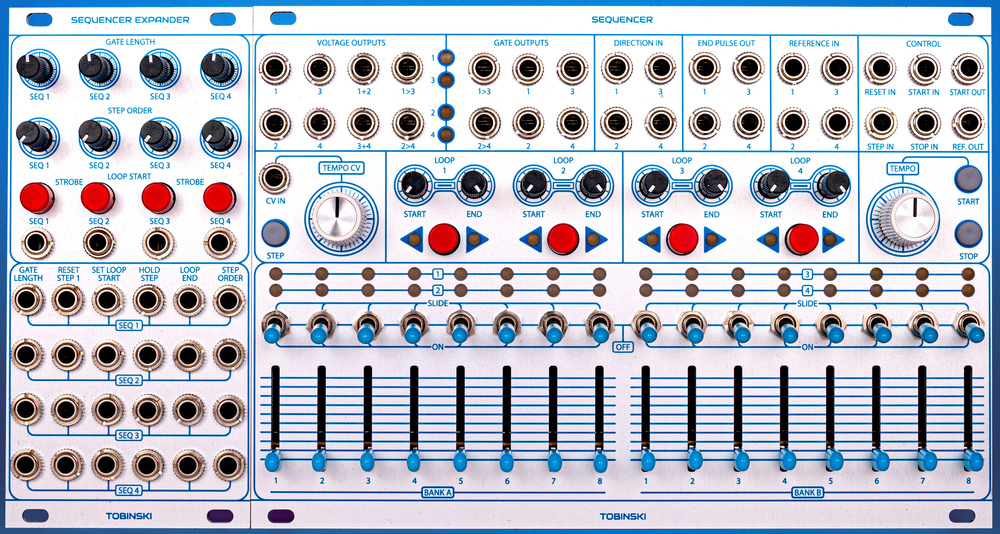
One approach, as demonstrated by the Tobinski Sequencer, is to go back to basic principles — analogue, unquantised, eight steps — and then mess with those principles. Yes, the Sequencer cycles eight‑step patterns, but it also gives you all sorts of opportunities to muck around with them and create variation.
At the heart of it are two banks of eight sliders and eight switches. The sliders adjust the pitch, the switches flip between gate on, gate off and slide. Each bank of sliders and switches, though, can be output separately — there are four CV outs and four gate outs. What’s the use of that, if it’s the same gates and pitches being output? Well, the first way to mess with your sequence is with the four sets of loop start and end controls. With sequences one and two patched to different voices, you just have to reduce the length of sequence one to seven steps and you’re off to the polyrhythmic races.
Using the different outputs at the top of the module, sequences one and three or two and four can be combined to form two 16‑step sequences, again sharing the same pitch and gate info but with individual lengths. There are also inputs and buttons to change each sequence’s direction as well as individual clock inputs (labelled Reference In) and End Pulse Outs for each channel. A final section at the top gives you Reset in, Step In (ie. global external clock), Start and Stop Ins, Start Out and Ref Out (ie. clock out). That’s a lot to take in at first, but what it gives you is a lot of flexibility in how you control the Sequencer and how the Sequencer controls what it’s connected to.
So, there are plenty of ways to mess with your eight‑ (or two‑, three‑, four...) step sequence here, but Tobinski also make an expander module called, ingeniously, the Sequencer Expander. This connects to the Sequencer via a ribbon cable and gives you per‑channel control over Gate Length, Step Order (which switches between six preset step patterns), Strobe, Loop Start, Loop End, step Hold and Reset. As you look into the wider Tobinski range, though, you find that this is very much the tip of an interconnected iceberg, designed to work with modules with such fascinating names as the Harmonic Timing Generator and the Interpolating Scanner, all of which have been cleverly conceived to work together as a complete system. It’s an ambitious and exciting project and clearly a lot of thought and work has gone into designing it, but it also represents one of the only problems with the Tobinski Sequencer: once you see the rest of the system, you’ll very likely want the whole thing! This in turn brings us to the other problem, which is that these modules are not cheap. Cost aside, though, this is an incredibly creative and comprehensive approach to modular, and proof that there’s plenty of life in analogue yet.
If you want an authentic, hands‑on analogue sequencing experience without any danger of boring yourself through repetition, the Tobinski Sequencer is highly recommended.
The Tobinski Sequencer is a very modular way of looking at sequencing. Instead of trying to imitate the sort of functions you’d find in a DAW or a modern groovebox, it takes us back to basic voltages and gates and gives you the tools to get creative with these. Analogue purism means that you may find yourself reaching for a quantiser, and the manual recommends a giving the Sequencer time to warm up before use, but there’s still a lot to be said for the back‑to‑basics approach; it’s about working out how to build something with the blocks you’ve got, rather than simply buying more blocks. And, naturally, this is a menu‑free domain. If you want an authentic, hands‑on analogue sequencing experience without any danger of boring yourself through repetition, the Tobinski Sequencer is highly recommended.
Information
£719, Sequencer Expander £294.
$919, Sequencer Expander $298.