Heavyocity Dystropia
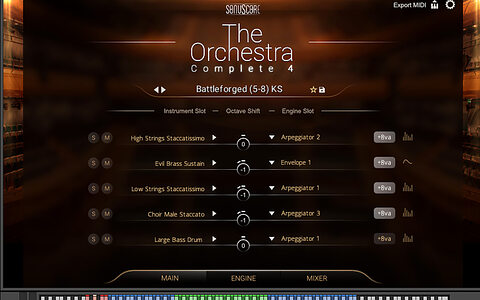
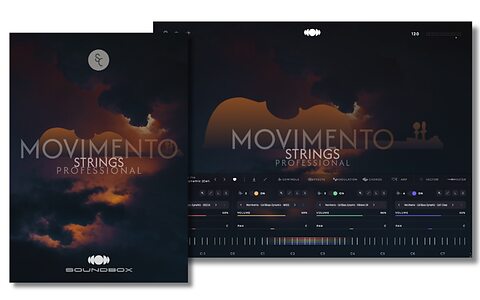
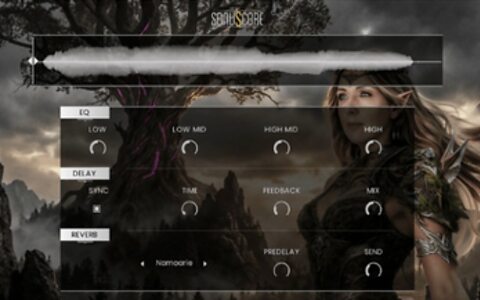
Rating: ★ ★ ★ ★ ★ 5/5 Stars. Designed for creating dark, tension‑filled, music meets sound‑design for modern sci‑fi, drama or horror set in a dystopian world.
To find the exact phrase, put the words in quotes or join them together with a plus sign e.g. live+recording or "live recording".
To find, say, all live recording articles that mention Avid, enter: live+recording +avid - and use sidebar filters to narrow down searches further.

Rating: ★ ★ ★ ★ ★ 5/5 Stars. Designed for creating dark, tension‑filled, music meets sound‑design for modern sci‑fi, drama or horror set in a dystopian world.

Rating: ★ ★ ★ ★ ★ 5/5 Stars. Built by sampling a classic Les Paul‑style electric guitar, what does Electric Blue have to offer to give it an edge within a very competitive marketplace?

The SOS Awards celebrate innovation and contemporary design. Congratulations to all the Winners, as well as the very worthy close contenders in each category who have been awarded our Highly Commended accolade.
These three audio examples demonstrate the Omnivocal techniques described in the Cubase workshop article that appears in SOS February 2026.

This Swedish‑made valve mic offers all the character of vintage designs, but without the noise!

To commemorate the centenary of electronic music pioneer Daphne Oram, Caro C explores Oram’s lasting influence in a conversation with Sarah Angliss and Ian Stonehouse.

Kevin Paul talks with Felipe Gutiérrez about his early career working at Soho Studios, Konk Studios and Mute Records. Their conversation explores the skills required to become a successful sound engineer.

Sometimes, nothing beats the unpredictable swoosh and whoosh of the classic tape flanging effect. And you can recreate it in your DAW...

Available now via Novation Components, the Launch Control XL 3's first major update adds compatibility for more DAWs, enhanced control for external hardware and deeper customisation options.
The area behind an acoustic baffle on the opposite side from the sound source where the sound level is greatly reduced due to sound diffracting around the baffle.
A signal processing technique first conceived by Alan Blumlein to correct for spatial imaging anomalies inherent in stereo microphone arrays and loudspeaker monitoring. All shuffling processes involve frequency-dependent adjustments to the width of a stereo signal at different frequencies.
A near-coincident stereo microphone array conceived by the Italian broadcaster Radio Audizioni Italiane (RAI) in the early 1960s. It comprises a pair of cardioid microphones with capsules spaced 21cm apart at a mutual angle of 100°. The resulting SRA is 93 degrees. This technique captures both time and level differences between channels, and is comparable to similar techniques such as NOS, ORTF, DIN, EBS, and others.
A capsule design in which the diaphragm is suspended in open air to detect the difference in relative air pressure on each side of the diaphragm. This design is most sensitive to sound waves arriving directly in front or from behind (the latter with opposite polarity). If the sound source moves above or below the diaphragm the difference in air pressure on each side reduces so the capsule becomes progressively less sensitive, giving a figure-8 polar pattern. The diaphragm mounting is designed to be very compliant at low frequencies to maximise the sensitivity to very small pressure differences. This creates a very strong proximity effect.
The simplest form of microphone capsule in which a diaphragm encloses a chamber of atmospheric air. A passing sound wave causes the diaphragm to move in and out as compressions and rarefactions pass, effectively comparing the air pressure variations of the sound wave with the static ambient air pressure held within the chamber. The diaphragm’s movement is not dependent on the direction of sound waves, merely their passing, so the polar pattern is omni-directional. There is also no proximity effect, and the system remains sensitive to very low frequencies.
An audio meter designed to indicate the phase relationships (correlation) between left and right stereo audio signals. Various meter formats are used, but most are scaled from +1 to -1, with zero at the centre. Full correlation (ie. dual-mono) is shown as +1, while opposite polarity is shown as -1. Fully-wide stereo material (decorrelated) would register around 0. Signals indicated anywhere between +1 and 0 are considered mono-compatible. Dips below 0 towards -1 suggest a listener of the summed mono signal will hear coloured or severely attenuated audio.
The name given to a binaural stereo microphone system developed by Jürg Jecklin but better known as the Jecklin Disc . The Optimal Stereo Signal is often abbreviated to OSS.
M3 is a reference to the attenuation applied to a summed-mono signal, particularly in application to audio metering systems, to maintain electrical headroom and to give a perceived acoustic volume consistent with the stereo source. M3 uses a 3dB attenuation ((A+B) – 3dB ) and is most appropriate where the stereo source comprises largely decorrelated signals (ie. normal stereo).
M6 is a reference to the attenuation applied to a summed-mono signal to maintain electrical headroom and to give equivalent metering levels with the stereo source. M6 uses a 6dB attenuation ((A+B) – 6dB ) and is most appropriate where the stereo source has largely correlated signals (ie. dual-mono).
See Goniometer
A two-dimensional visual pattern produced by the interaction of two independent signals, each controlling the amplitude of one display axis. Used in the Stereo Goniometer and Stereo Vectorscope