


We continue our countdown of the most significant technological breakthroughs in recording history.
Sound On Sound celebrates its 40th anniversary this year. To mark the occasion, we’ve surveyed the history of recorded music and put together our own Top 40, aiming to identify the most significant developments in music tech since music tech became a thing. In the second part, we count down from 30 to 21...
30: Pitch‑shifting
We take it for granted now that if you record something a little sharp or flat, you can knock it into shape with a readily available pitch‑shifting plug‑in. But no such luxury was around in 1955, when Musique Concrète pioneer Hugh Le Caine released ‘Dripsody’, a composition based around a recording of water dripping into a metal basket, where the tape was manipulated by looping it, reversing it, delaying it and, most notably, by adjusting the playback speed. Halving the speed would lower the pitch by an octave, and doubling it would play back an octave up, but Le Caine took things much further: he built a small keyboard that allowed him to play melodies — a remarkable achievement that now seems astonishingly prescient! Naturally, changing the speed of tape changes both the recording’s pitch and duration together, unlike the ‘pitch‑shifting’ we use in our DAWs today. It would be almost 20 years before a dedicated digital pitch‑shifter came out, but it was Le Caine who walked so that the Eventide H910 Harmonizer could run.
29: Digital delay
Delay effects in music, such as those pioneered by guitarist Les Paul, were initially tape‑recorder‑based. The mid‑’70s saw the advent of affordable, analogue, solid‑state delay units with short delay times and limited audio bandwidth from Electro‑Harmonix, MXR and others, but as digital memory chips became both more capable and affordable, mainly thanks to the growth of the computer industry, the first digital delay units were launched by Eventide, Lexicon and MXR. Even with, initially, limited delay times and low bit depth (often just 8‑ or 12‑bit), they were still more usable than anything that had gone before, as they allowed modulation, looping and even rudimentary sampling. Once 24‑bit conversion became available, a digitally delayed signal could be indistinguishable from the source, even at long delay settings. Now, many digital delay units, particularly in the guitar market, offer emulations of some of the lo‑fi ‘defects’ of earlier echo technologies, often felt to be more characterful and musical!
28: Distortion as an effect
Featuring Ike Turner but credited to Jackie Brenston & his Delta Cats, the 1951 hit ‘Rocket 88’ has been called the first rock & roll record. That may or may not be true, but it’s certainly remarkable for the sound of Willie Kizart’s electric guitar. Legend has it that the loudspeaker in his amplifier was damaged on the way to the session; producer Sam Phillips decided he liked the sound and featured it prominently in the recording. This accidental discovery kickstarted a process that would see the guitar take over as the dominant instrument in pop and rock music, and it wasn’t long before devices such as fuzzboxes were introduced to create similar effects in a more deliberate and controllable fashion. And it didn’t stop there. Everything from drums to didgeridoos has been distorted to creative effect, and it’s hard to imagine what rock or metal music might sound like without distortion.
27: Wireless microphones
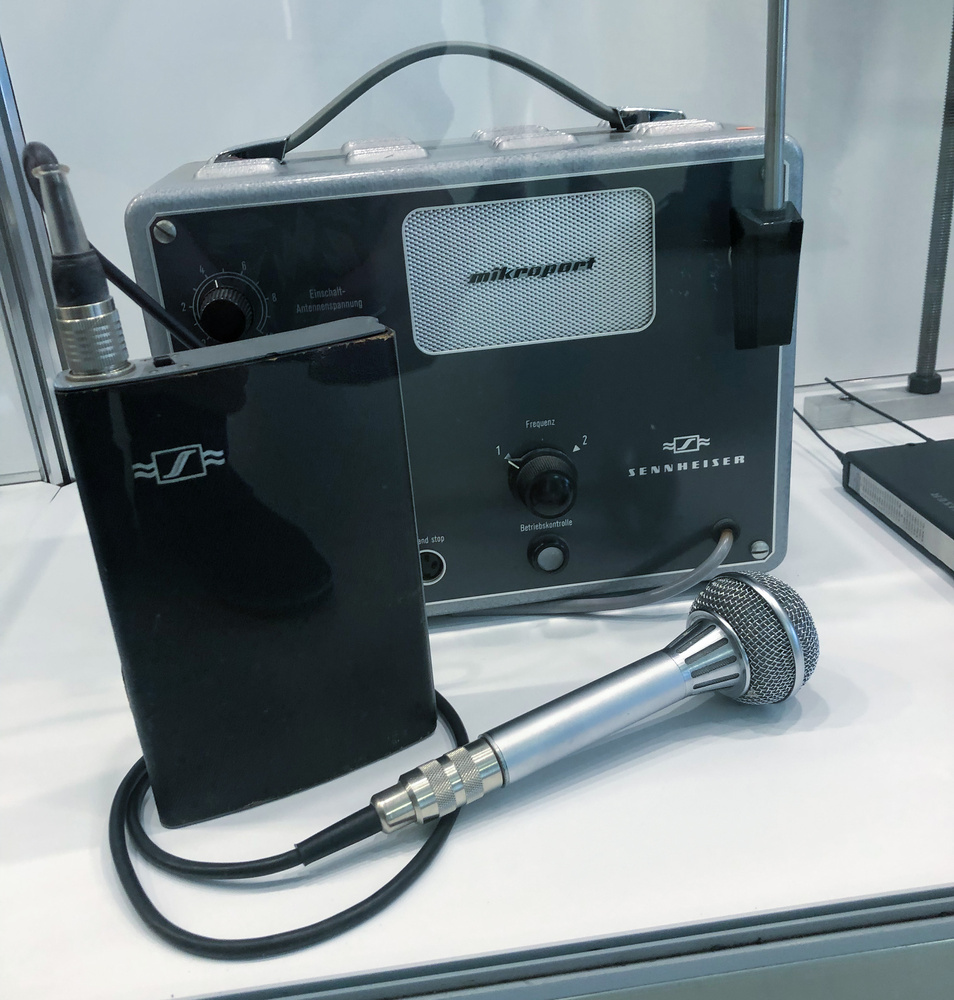 The Sennheiser Mikroport was the world’s first belt‑worn portable radio mic system.Cables can be enough of a nuisance in the studio, but in live performance and on television or movie sets, they really hamper freedom of expression. Several companies explored the idea of using a radio‑frequency link rather than a length of copper to connect microphone and preamp in the 1950s. Shure’s Vagabond system, introduced in 1953, featured an omnidirectional mic attached to a substantial stand which contained the transmitter electronics. Then, in 1957, Sennheiser introduced the Mikroport, the first ‘personal’ wireless system with a beltpack transmitter. Its valve‑based electronics could run for a whole 11 minutes on one set of batteries!
26: Audio over IP
SOS readers with long memories may recall Yamaha’s mLAN system, introduced around the turn of the century. At the time it was notable for being the first digital audio protocol to use the FireWire standard, but it was also one of the first attempts to create a networked system where multiple devices could communicate. Numerous manufacturers signed up to use the mLAN protocol, but relatively few products emerged. The appeal of networked audio remained, however, and once developers such as Audinate had solved the problems of using standard Ethernet infrastructure for audio traffic, audio over IP quickly made inroads in professional environments such as broadcast and live sound. The ability to distribute audio signals across a network rather than merely in a fixed chain has proved little short of revolutionary.
25: FM synthesis
Modulation of one signal by another is a basic principle of radio, and by the late ’60s, analogue synth designers had discovered the creative possibilities of allowing one wave to modulate either the amplitude or the frequency of another. Under some circumstances, the latter technique could produce musical sounds with harmonically related partials, but analogue oscillators were too unstable to do so repeatably and reliably across a wide range. However, Stanford University’s John Chowning developed a system whereby multiple digital ‘operators’ — essentially, simple oscillators outputting sine waves — could be combined to generate complex timbres. Having tried and failed to interest US synth companies in his work, he signed a deal with Yamaha. The first commercially available FM synth was 1980’s GS‑1, but it was the DX‑7, released in 1983, that would be FM’s breakthrough. Not only did the DX‑7 sound utterly unlike the analogue synths that had gone before; with its 16‑note polyphony and velocity‑sensitive keyboard, it was a completely different playing experience.
As productions became increasingly complex in the early ’70s, the challenges of mixing grew exponentially.
24: Mix automation
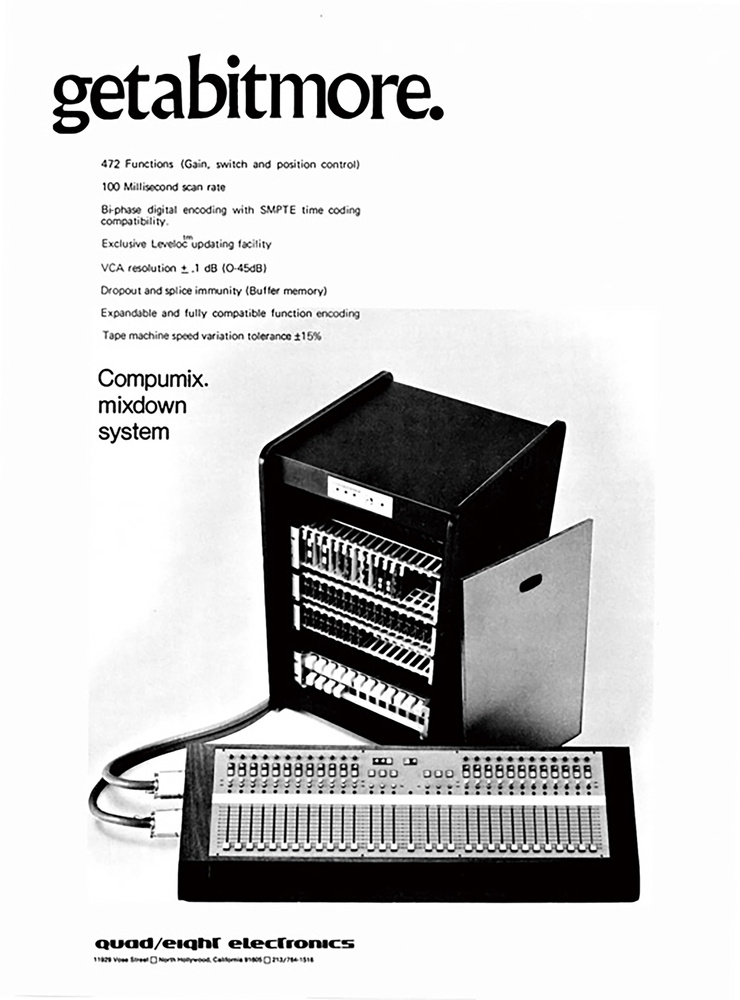 Quad‑Eight’s Compumix was one of the earliest commercial mix automation systems.As productions became increasingly complex in the early ’70s, the challenges of mixing grew exponentially. Multiple pairs of hands were needed to make all the necessary fader moves. A mix could not be recalled or repeated, and it was often necessary to piece together a master take from the best bits of several mixes. The advantages of automating the process were obvious, and by the turn of the next decade, Solid State Logic would be firmly established as market leaders. However, many other mixer manufacturers tried their hand at devising a computerised mix automation system, with varying degrees of success. Among the first to gain a foothold in the real world was the Quad‑Eight Compumix, as used on Neil Young’s 1973 live album Time Fades Away. Young himself hated the album so much he refused to issue it on CD until 2017.
23: Portable synthesizers
In its early days, electronic music was very much a studio‑based affair. Whether they worked with an assemblage of different devices, as in the BBC’s Radiophonic Workshop, or with a modular synth like the early Moog designs, logistical issues prevented synthesists from becoming just another member of the band. All that changed with the invention of compact, complete synths like the Moog Sonic Six, EMS VCS3 and, most influentially of all, the Minimoog. Suddenly, keyboard players could tour with an instrument that was small enough to be flightcased, and simple enough to be reprogrammed between songs. Is it a coincidence that progressive rock became popular at exactly the same time?
22: Direct injection
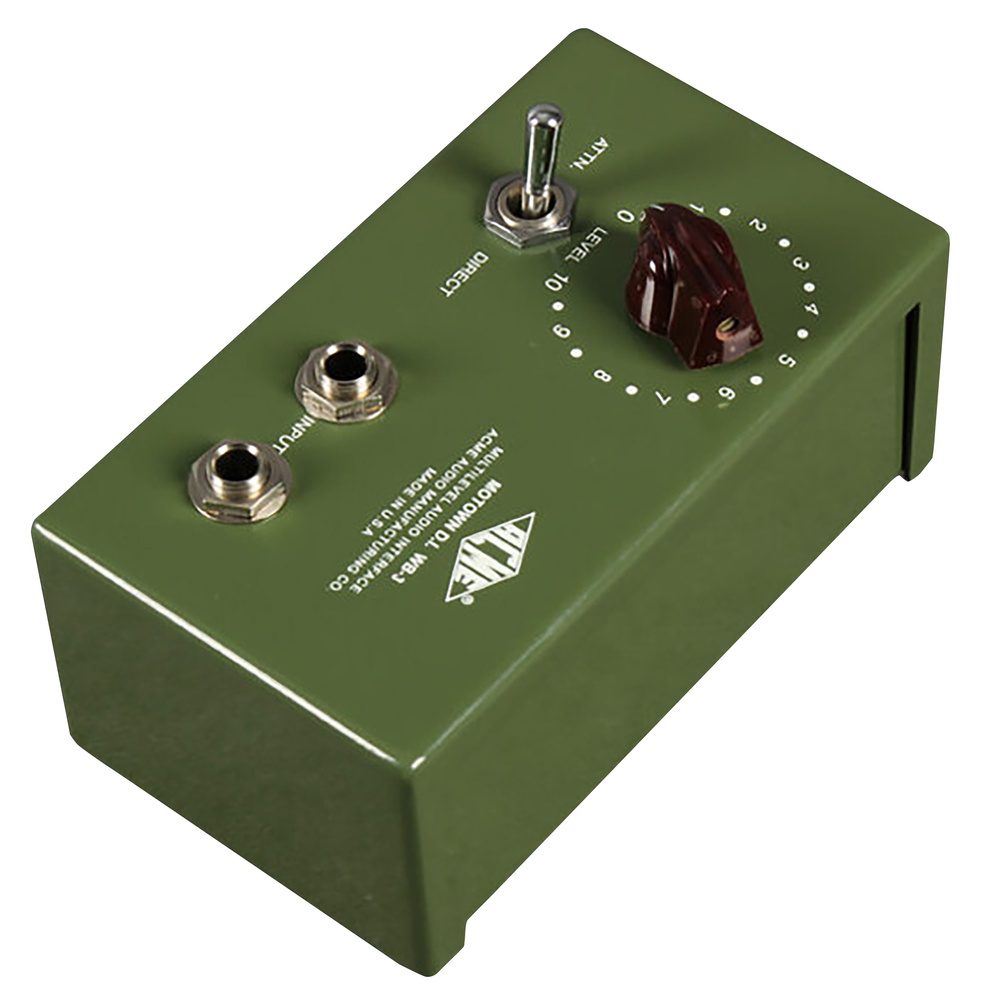 Modern manufacturers are still making DI boxes inspired by the famed Motown units.The idea of directly recording the output of electrical instruments, rather than miking an amp, seems so obvious in retrospect that no‑one seems to have thought the DI box an invention worth documenting. Most major studios had custom‑built DI systems by the mid ’60s, and direct injection often became the default approach for bass guitar in particular, notably at Motown in Detroit. However, pioneering British producer Joe Meek was certainly recording bass direct as early as the late ’50s, first at Lansdowne Studios and later at his own studio on London’s Holloway Road.
21: The pan pot
Early stereo mixes of pop and rock tracks often sound extreme to modern ears, because the individual sources are all either central or hard‑panned. There’s still something to be said for this as an approach to mixing, but in the ’60s, it was not done deliberately. The designers of most mixing consoles simply hadn’t anticipated that anyone would want to artificially synthesize a stereo picture from mono sources at mixdown. As four‑track gave way to eight‑ and then 16‑track recording, the scope for miking individual instruments separately grew exponentially — and the ability to place these sources at intermediate positions within the stereo field, and even have them appear to move, was vital.