

 The respondent base for our survey represents a true cross‑section of the music production world.
We asked music professionals how AI is changing their world.
So‑called artificial intelligence is the hottest topic in music tech. Generative AI services such as Suno and Udio allow users to create entire songs from simple prompts. Will they make conventional music production redundant? Or will producers take advantage of a wave of innovative, assistive AI tools to do their work faster, better and smarter?
Sonarworks are well known to SOS readers for their SoundID speaker and headphone correction tools. They too have recently branched out into AI, with the launch of their VoiceAI virtual vocalist. With new AI products seemingly appearing every week, Sonarworks decided it was a good time to take stock. Are musicians and producers embracing these tools? How are they using them, and what for? What opportunities and challenges does the rise of AI open up?
To answer these questions and more, Sonarworks commissioned Sound On Sound to carry out a comprehensive survey. Almost 1200 music creators responded, and we can be confident that the results are representative: over 70 percent are working professionals with more than a decade’s experience in production and engineering. This is one of the first comprehensive surveys of attitudes towards AI in music production, and as such, provides a unique snapshot of the current situation. You can read Sonarworks’ full analysis on their website; in this article, I’ll try to draw out some of the most important conclusions.
The Only Way Is Ethics
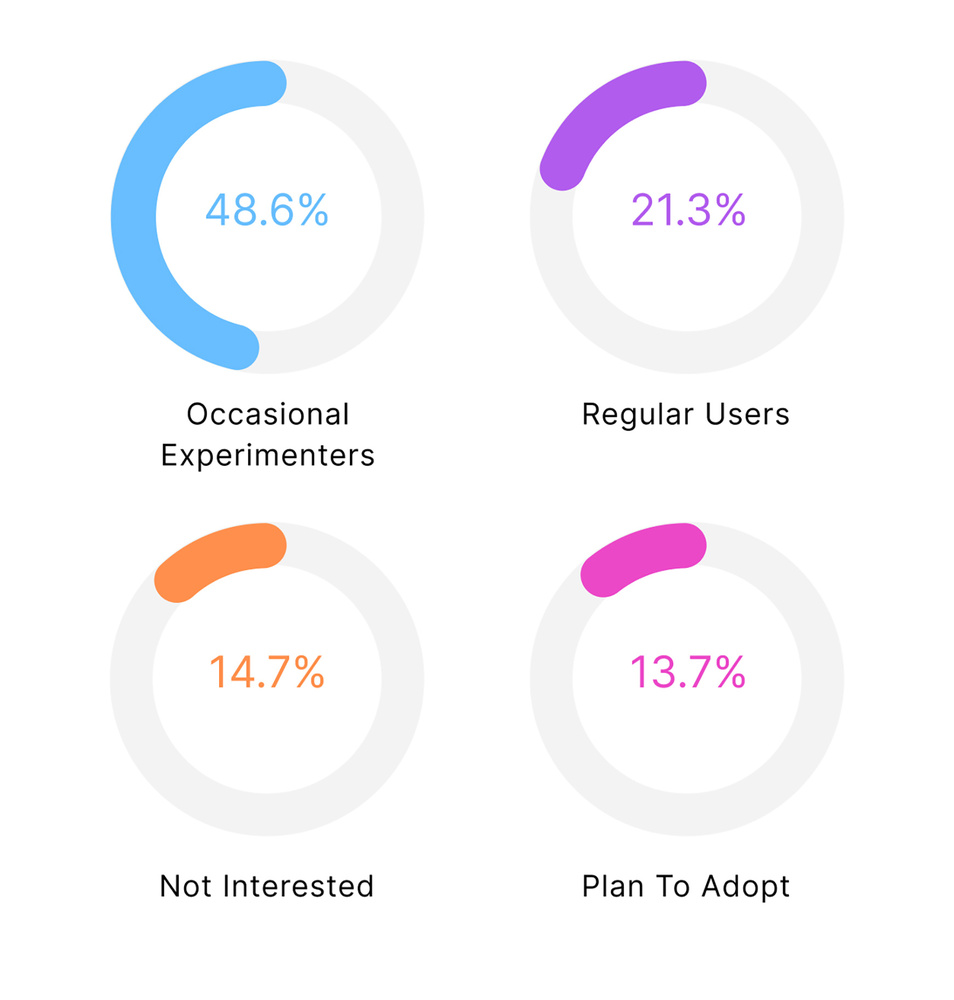 Our data shows that one in five producers is a regular AI user already, while almost half have used it experimentally.
In any technological revolution, there will be early adopters, and a larger body of people who are more cautious. That pattern is clearly evident in this survey. Around one in five respondents self‑describe as early adopters of new tech in general, and the same proportion claim to be regular users of AI products or services. By far the largest group, around half of the total, describe their use of AI as being in the occasional or experimental stage, whilst less than 20 percent express no interest in learning or using AI tools.
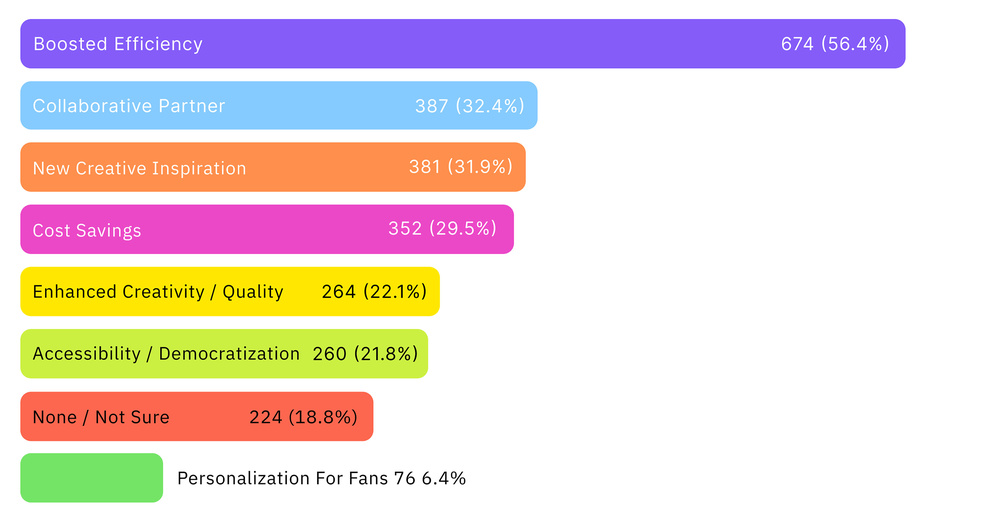 Efficiency is seen as the most likely benefit of AI, but many also perceive it as being a valuable creative partner.
When producers were asked what factors limit their use of AI, the most widespread concern that emerges is around creativity. More than a third of respondents worry that relying on AI tools would compromise their creative intent, or undermine the individuality of their work. Nearly as many express unease about the ethics of artificial intelligence. With many issues surrounding copyright and training still unresolved, some feel it’s too risky to depend on tools that have an uncertain legal basis, and that the use of AI tools is exploitative of the other musicians on whose work they may have been trained. More than a quarter of respondents also report that the AI tools they’ve tried simply aren’t yet of sufficient quality to be useful in a professional context. In many cases, this links back to the concern about creativity, with the output of AI often described as generic or bland.
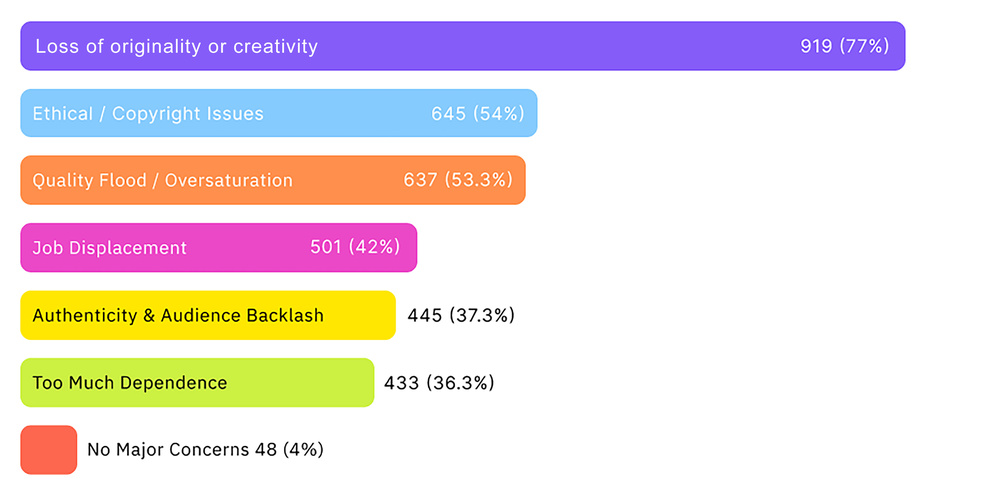 Loss of creativity and ethical doubts top respondents’ list of concerns about AI.
Whether or not participants are actually limiting their use of AI on ethical grounds, it is almost universally felt that attention to the ethical basis of AI products is non‑negotiable. Asked to evaluate the importance of ‘ethical sourcing’, two‑thirds of respondents rate it very important, and fewer than one in 10 rate it unimportant or relatively unimportant. Survey respondents are also alive to the ethical implications of their own use of AI, which principally centre around disclosure and transparency. A large majority advocate either full transparency over the use of AI, or ‘situational disclosure’, meaning they would acknowledge their use of AI if asked. Only 6 percent say they would prefer to deliberately conceal their use of AI.
Levelling Up
Concerns about creativity and the ethics of AI are reflected in assessments of its most fruitful use cases. Just under a third see it as a source of inspiration, while a similar proportion see it as enabling new forms of collaboration, or a route to saving money. However, almost three‑fifths of the survey participants recognise the potential for AI to speed up or automate tedious tasks such as vocal tuning, drum editing and file management. In other words, the applications to which respondents are most open are the most utilitarian ones. Producers are most willing to use AI for tasks they see as technical rather than creative.
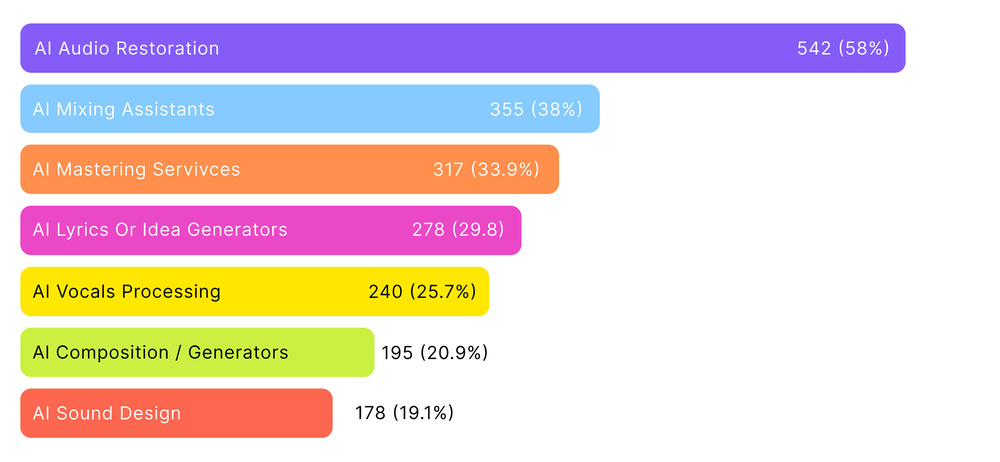 The most popular AI tool categories are currently those with relatively utilitarian functions.
This attitude ties in with the answers to wider questions about the skill sets that modern professionals need. There is a widespread perception that once‑essential technical skills such as notating and transcribing musical scores, manual audio editing and noise reduction are increasingly becoming redundant, and that this process is being accelerated by AI. Interestingly, a significant number of respondents also feel that basic ‘bread and butter’ mixing skills such as balancing, corrective EQ and dynamic control are becoming optional, with AI tools picking up the slack.
By contrast, the skills that are perceived as essential for modern producers and musicians are primarily the creative ones — musicality, instrumental ability, understanding of music theory, critical listening and compositional ability — alongside the ‘soft skills’ that foster collaboration and enable producers to get the most from people. It is also widely felt that engineers who specialise in old‑school analogue recording will continue to flourish, and that their skills will prove resistant to AI replacement. Half of participants agree that the most important differentiator for human producers in the AI era is the ability to find and pursue an original creative direction.
Respondents are also alive to the need to develop new skills, with around two‑fifths including the need to master AI tools as one example. Almost the same proportion point to the increasing importance of networking and marketing, and the same again to the need to look beyond music and acquire expertise in multimedia, video, virtual reality and other intersecting technologies. Perhaps most remarkably, almost a third of participants view coding and scripting as important for music production.
As Sonarworks point out, these results may have implications for educational institutions offering music tech programmes. Potential students will seek out courses offering what they perceive to be the skills needed to succeed in today’s landscape — and they may not be the ones that are favoured on existing curriculums.
Across The Board
Participants were asked to name up to three main genres in which they work. Around 45 percent specify rock and pop, with electronic music not far behind at 38 percent. The next most popular genres are ambient/new age and film or game scores, both polling around 24 percent. Only 13 percent cite metal as a primary genre, perhaps reflecting its longstanding status as a niche subculture.
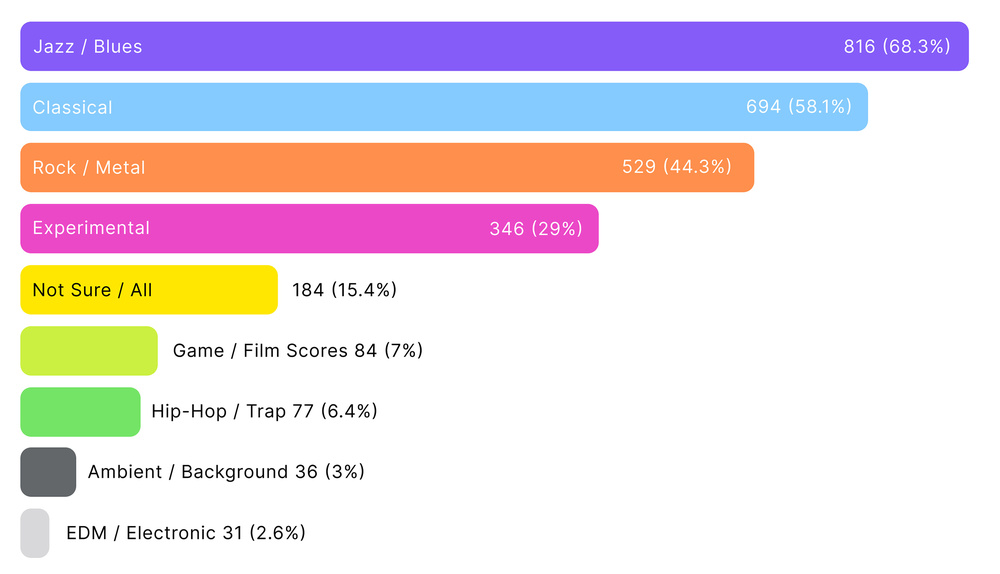 Jazz/blues and classical music are the genres seen as most resistant to AI.
It is widely anticipated that the impact of AI will vary with musical genre. Two‑thirds of respondents feel that EDM and mainstream pop will prove amenable to AI generation and replication, whilst ambient and ‘functional’ music are also expected to do so by half of the people answering the question. Interestingly, both game/film scores and hip‑hop/rap are seen as much less vulnerable to AI, for rather different reasons. Bespoke soundtracks are relatively long‑form and require a clearly identifiable compositional voice, whilst rap centres the human performer in a way that’s perceived as hard to replace. At the other end of the scale, the genres viewed as most resistant to AI generation are jazz, blues and classical music. It is felt that the subtlety and nuance of human interaction in these genres will prove hard to replicate.
Not All Doom & Gloom
Overall, participants express predominantly sceptical or negative judgements about AI in music technology. Only a fifth describe their feelings about AI as positive or very positive, whilst the remaining 80 percent are divided about equally between neutral, and negative or very negative. However, given the emphasis placed by most on creativity, it may be that this negativity relates less to assistive AI tools targeted at music production, and more to generative AI services that threaten to bypass the role of the music producer altogether.
AI is here to stay. Although a significant number feel it’s over‑hyped, only 3.6 percent believe it to be a passing fad, and nearly a third see it as revolutionising the music industry.
At the same time, the large majority of survey participants acknowledge that AI is here to stay. Although a significant number feel it’s over‑hyped, only 3.6 percent believe it to be a passing fad, and nearly a third see it as revolutionising the music industry. Going deeper, a small majority of respondents (58 percent) see the eventual role of AI in music production as primarily a supportive one. In this vision, human producers and musicians will retain firm control of the creative reins, but assistive AI tools will help them to realise their vision faster and more effectively. A further 21 percent selected “major automation with human oversight” as the most likely future for AI in music, with only 9 percent expecting “full automation” and human producers becoming largely redundant.
In short, the attitude of a majority of participants towards AI can probably be summed up as grudging acceptance of the inevitable. Consequently, developers of AI tools still have a lot of work to do in order to win hearts and minds in the music production community. AI products are most likely to gain acceptance if they can demonstrate their ethical credentials, and offer genuine assistance with jobs that human producers and engineers find tedious. Above all, they need to ensure that their users feel in control of the creative direction at all times. Artificial intelligence is both a novel challenge and a unique opportunity — but if it ends up sidelining human creativity, there will be no winners.
Listen to Sam's SOS Podcast interview with Sonarworks CEO Helmuts Bems: www.soundonsound.com/music-business/ai-and-music-tech-2026-sos-podcast