

The literature accompanying Expert Sleepers’ Disting NT multifunctional module includes a section titled “What is it not?”, which reads, “The Disting NT is not a ‘virtual modular’. There are no virtual cables flying around.” It continues: “It is not a ‘patch player’. It is not the intention that you do all the complex setup on a computer and then copy it over to the module.”
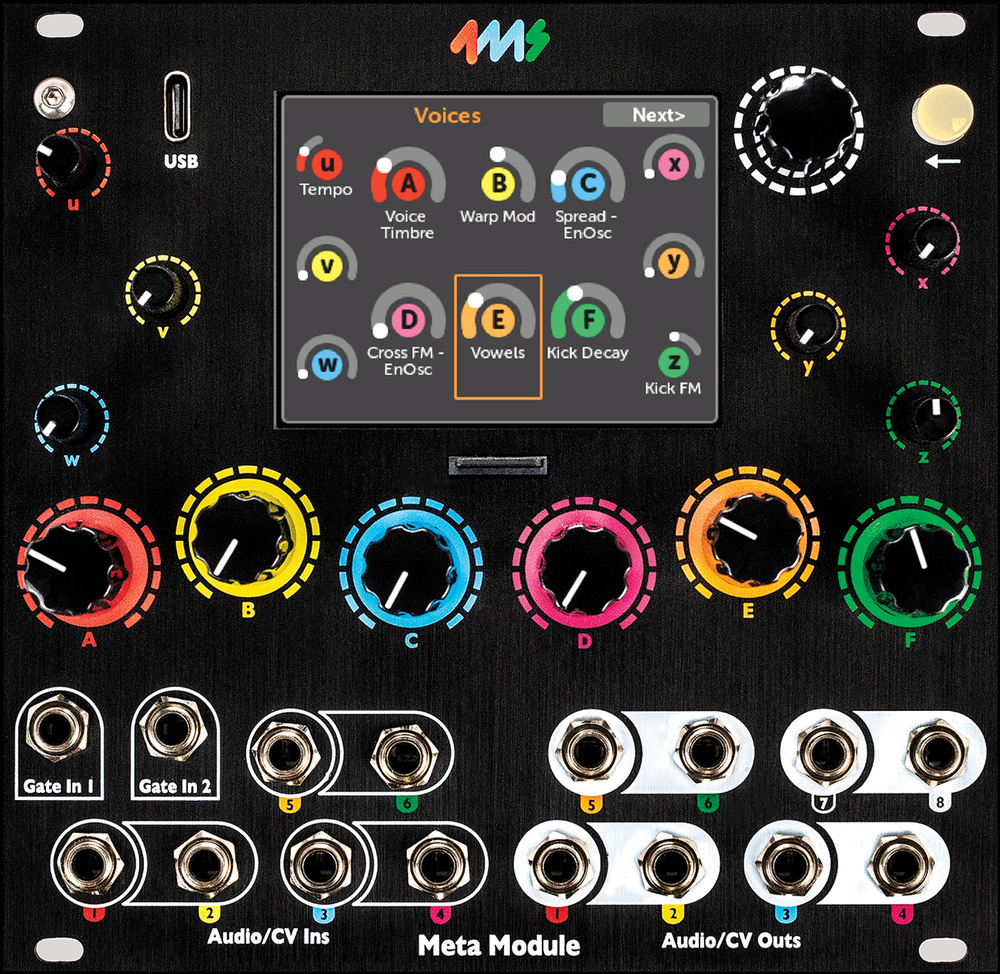
What could Expert Sleepers possibly be referring to here, I wonder? Surely not the MetaModule from Portland’s 4MS, with its computer‑programmable virtual modular environment and potential scores of virtual patch cables? Needless to say, as a doting user of the Disting NT, I was intrigued to find out. The MetaModule does indeed present a virtual modular environment that can accept patches ported over from the free VCV Rack, and which can also be used to create virtual patches internally. It has a central colour screen accompanied by a single encoder and button, with which virtual modules (‘plug‑ins’) are selected from an internal library and compiled into patches. These can then interface with the rest of a physical system via a set of 12 assignable knobs, as well as eight assignable inputs and outputs. There’s a microSD card slot to accommodate memory, a USB‑C port and — at least on the MetaModule proper — that’s about it.
As for the library of modules on offer, suffice to say it’s extensive: 1500 emulations are currently available. Whew! Mutable Instruments designs are available as clones through Cloned Instruments, as is a wide selection of 4MS modules, including classics like the VCA Matrix and Ensemble Oscillator. There are offerings from Befaco and Moffenzeef (whose founder Ross Fish, I notice, is now working with 4MS, excitingly), and many, many more. It’s not a stretch to say I’d be getting my money’s worth with ‘just’ a module that could be more or less any Mutable Instruments module I pleased, let alone the rest. The option to incorporate MIDI via a virtual MIDI‑CV interface module also expands many familiar favourites’ functionality considerably.
Virtual patches can’t expand forever, since the CPU can only handle so many modules (depending on their complexity). As such it will not co‑operate with more than a modest handful if you’re operating at the more CPU‑intensive end of the spectrum. I was not disappointed by this: things can quickly get visually complicated on that little screen, and it can become laborious tracing reams of virtual patch cables and navigating through layers of different ‘knob Sets’ (since the virtual controls are likely to outnumber the physical ones, it’s possible to create more than one mapping per patch). In short, the more there is going on, the less playable the MetaModule becomes, and the less creative it feels. Even a simple patch consisting of a Mutable Instruments Rings clone, a Music Thing Modular Turing Machine emulation from Stellare Modular and a 4MS Listen Four mixer, for example, took time to construct and configure in the first instance, but once patched and mapped I was away, tweaking in real time and patching it into the rest of my system.
Indeed, I found much of the beauty of the MetaModule to lie in the simple — but expandable — things. Using it solely to emulate a simple mixer, for example, is very useful. But using it to emulate a mixer with a different insert effect on each channel is fantastic. It can be a 909‑style drum array ready to pair with an external sequencer, but if desired, that array can also take care of its own bus compression or effects. When it comes to my own workflow, these sorts of use cases are where the MetaModule works at its best, but that’s just me: happily I can say it very much retains all the open‑ended adaptability we would hope for in modular.
Expansion Options
Beyond the MetaModule itself are some expansion options: there’s a Wi‑Fi expander for wireless patch transfer from VCV, a button expander with eight extra buttons, and an I/O expander with six extra inputs and eight extra outputs. So not only is the MetaModule customisable virtually, but different combinations of hardware can also adapt to your workflow or particular patch needs. You can, for instance, chain MetaButtons units to give a whole grid of buttons if that’s your bag. The full set at the time of writing will set you back over $1000, which is no snip, but needless to say, their combined functionality might span a clutch of modules worth three times that amount.
It’s fair to say there are some areas that feel ripe for expansion and improvement here: the size and resolution of the screen struggles at times with more detailed module panels, and in the absence of a computer, the process of patching several jacks together can be very slow going with just one encoder and button. In practice, the latency between spotting a specific parameter to edit and actually editing it feels longer than is comfortable — at least, in the ordinarily tactile and immediate world of Eurorack. When it comes to VCV, not all VCV modules work on the MetaModule, so be ready to save the Module Finder page on the 4MS website to your ‘favourites’ (VCV itself — very much an unofficial partner of the MetaModule — has no dedicated directory of compatible modules).
This said, you’re unlikely to be left frustrated with the compendium on offer, and it would be prudish not to assume that this catalogue is only going to expand, as is that of hardware expansion offerings, from what I gather. It’s in light of thoughts like this that the MetaModule, while hugely functional, has the air of a relatively early step down a rich avenue of potential. I wouldn’t be hugely surprised — certainly not disappointed — if other iterations of the platform were to emerge (one wonders if the Wi‑Fi expander doesn’t open up the potential to pair with an iPad app), or if 4MS came to release their own software modular environment specifically for pairing with the MetaModule.
Can I imagine the MetaModule living in my system for a long time to come? The answer is yes.
In any case, the key question is: can I imagine the MetaModule living in my system for a long time to come? The answer is yes. It’s not about to replace a raft of modules with virtual equivalents, but I don’t think that’s its intention. Atop that, it’s fast becoming the best of friends with my Disting NT.