

This highly impressive new large‑diaphragm FET mic brings a touch of Nordic noir to the studio.
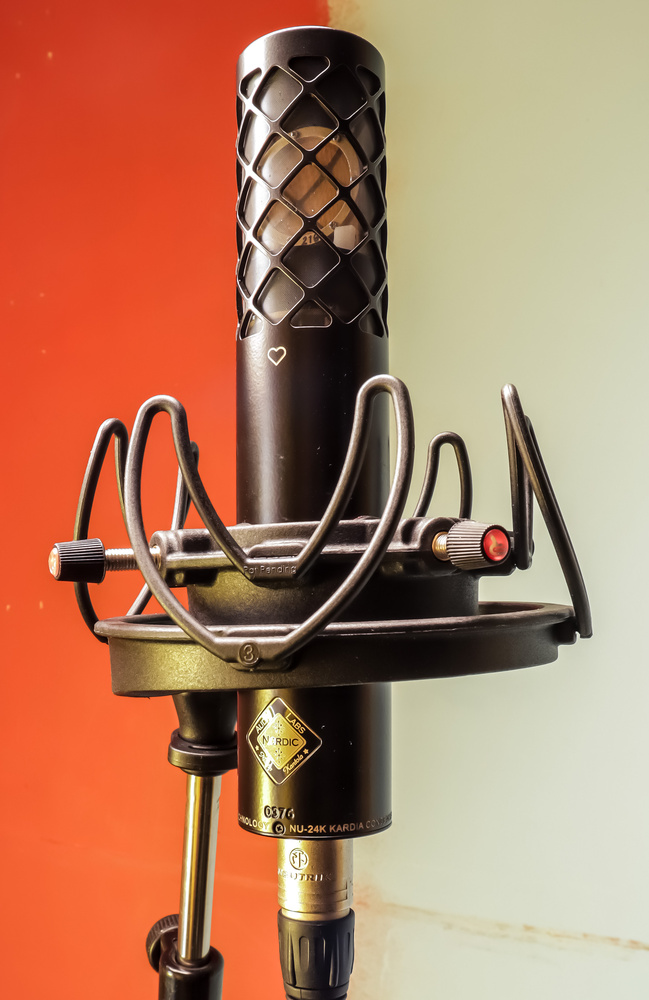 Finnish engineer Martin Kantola has been building microphones for more than 30 years. Like many ‘boutique’ makers, he was initially inspired by the classic Neumann valve mics, but in 2019, he started building a new large‑diaphragm capsule to his own design. The D100K is a 30mm, edge‑terminated capsule for which Nordic Audio Labs claim “excellent off‑axis phase response, super realistic transient response and [a] very smooth top end”.
So far, this capsule has been offered in the multi‑pattern NU‑100K and the NU‑880K, which uses two D100K capsules mounted at a 90‑degree mutual angle to offer stereo and horizontal B‑format output. Nordic Audio Labs also manufacture the unique NU‑314K, a large‑diaphragm pressure mic with a pure omni pattern, and the NU‑47V, which aims to match the sound of the immortal Neumann U47 but without using valves. Apart from the NU‑47V, all Nordic mics share a similar look and feel, and they’re very much premium products, typically costing several thousand pounds.
For those who want to explore the advantages of the D100K capsule in a somewhat more affordable package, Nordic Audio Labs have now launched the NU‑24K: a no‑frills, fixed‑cardioid mic that has neither a valve nor an output transformer, but uses a proprietary solid‑state circuit called FloFET that is claimed to sound “smooth and flattering”.
Hey, Good Lookin’
The NU‑24K ships in a small Peli‑type case, with a Rycote InVision shockmount. To say that this is an attractive mic to look at is a serious understatement. The proportions are spot‑on, build quality is absolutely impeccable, the understated black finish with gold legending is classy without being tacky, and the open headbasket with its super‑fine gauze is a work of art. The aforementioned D100K capsule is clearly visible through this gauze, but does not give up its mysteries easily. In some large‑diaphragm capsules, the membrane is transparent enough that you can see the pattern of holes in the backplate, but not so here.
As I’ve already mentioned, the NU‑24K is a transformerless, solid‑state mic, and as such requires standard 48V phantom power, from which it draws a modest 3.5mA. The specifications make for interesting reading, if you’re so inclined. The polar pattern is described as “cardioid to supercardioid (frequency dependent)” — which, to be fair, is true of most large‑diaphragm capacitor mics — and output impedance is an unusually low 22Ω. Self‑noise is quoted at 17.6dBA “with 6dB/oct roll‑off towards 2kHz”, which suggests that the FloFET circuit somehow shapes an otherwise fairly high noise level to be less obnoxious in practice. In my experience, noise is most troublesome when it’s higher up the frequency spectrum, so this isn’t a bad idea, and subjectively, noise is not an issue with the NU‑24K. Sensitivity is a fairly standard 18mV/Pa.
The NU‑24K is marketed primarily as a vocal mic. This sometimes indicates that the manufacturer has deliberately attenuated the low end, but not here: the ‑3dB points are at 17Hz and 27kHz, and the frequency response chart shows quite a large bump centred around 35Hz, which is deeper than even the most Russian of basses can produce. From 100Hz or so upwards, the response is broadly flat to about 3kHz, whereupon a presence lift rises steadily, plateauing between 10 and 20 kHz and extending right up to that 27kHz mark. On paper, this make the NU‑24K look like a very bright mic — or, given its strong bass, like a mic with a ‘scooped’ frequency response.
Off The Charts
Any engineer who’s been around the block will tell you that microphone frequency response charts, at best, tell a small part of the story. A mic that employs a K67‑style capsule without de‑emphasis might measure somewhat like the NU‑24K yet sound totally different, with an edgy character and an uncomfortable emphasis on sibilants. That’s absolutely not the case here. That treble lift, or mid scoop if you prefer, manifests itself here as clarity rather than sharpness. And although we typically associate the quality of smoothness with a subdued high‑frequency response, I think Nordic Audio Labs are absolutely correct to claim it for the NU‑24K.
Female vocals can be a challenge to record well, and whilst no mic is universally good for every singer, I’d go as far as to say that I don’t recall ever hearing a mic that works better on this source.
I had the opportunity to try it on several different vocalists during the review period, and also tested it on instruments such as acoustic guitar. Female vocals can be a challenge to record well, and whilst no mic is universally good for every singer, I’d go as far as to say that I don’t recall ever hearing a mic that works better on this source. It’s no slouch on male vocals either, and what particularly struck me in both cases was how natural its capture of the human voice is. It may well be emphasising the high end, or subtly attenuating the midrange, but what’s more important is what it’s not doing. This is a mic that doesn’t smear transients, or emphasise nasal resonances, or sound hard when the singer belts it out. Other large‑diaphragm mics, even very good ones, often sound slightly artificial or woolly in comparison.
The unusually open headbasket probably plays a role here, but the capsule is the most important component in any mic, and I’m convinced that Martin Kantola has come up with something truly special in the D100K. Nearly all capacitor mic capsules fall into one of very few design families, and the vast majority are based on the Neumann K47 or K67. The D100K sounds nothing like any Neumann‑derived capsule I’ve ever heard. By contrast, it does have a lot in common sonically with the fabled AKG ‘brass ring’ CK12, and of all the mics I put it up against, the NU‑24K was most similar to my old C414 EB. In fact, it has all the strengths of that classic, but arguably sounds better. The 414 sometimes seems to add a touch of fur to the source, perhaps because of its relatively small output transformer; switch to the NU‑24K and it’s like someone has taken a veil off the same mic. Turn again to a U87 and you’re left wondering why the Neumann sounds so nasal and honky. There were some sources, such as resonator guitar, where that quality was desirable, but in the majority of cases I preferred the NU‑24K.
...few have impresed me as much as the NU‑24K.
A Bit Of All Right
I’ve had the good fortune to review lots of new microphones for this magazine, including some very expensive boutique models. Many have impressed me, but few have impresed me as much as the NU‑24K. This is a pretty special microphone, to the point of making me wonder if it’s time to retire some of my beloved vintage models. It’s clear, natural and smooth, but not at all sterile or boring. I loved it on the human voice, liked it very much on most acoustic instruments, and several times wished for a pair so that I could try them out as drum overheads. The NU‑24K has all the makings of a future classic, and belongs in the top drawer of any mic locker.
Summary
The NU‑24K is beautifully made and looks stunning, but it’s the sound that will sell it. This is just a superb vocal and instrument mic.