

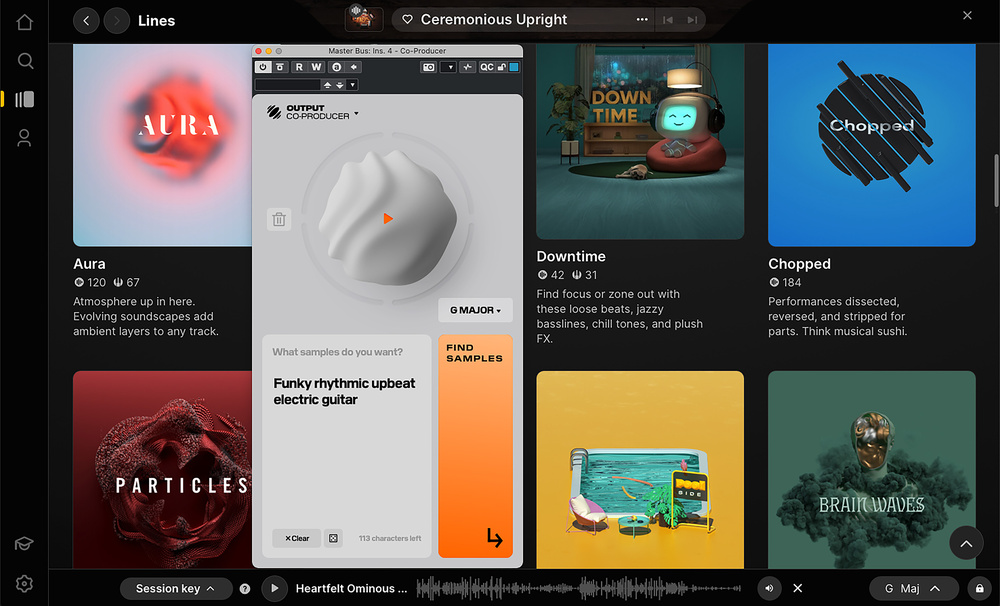
 While Co‑Producer is its own thing, the plug‑in is also an excellent complement to Output’s Arcade.
Find the perfect samples for your track with a little help from Output’s Co‑Producer.
If your music production workflow includes creative use of loops and one‑shot samples, the odds are you will be familiar with Output’s Arcade. Paul White reviewed Arcade when it was first released (see SOS September 2018) and, with its extensive (and regularly expanding) collection of royalty‑free sample content organised into themed ‘Lines’, it provides an array of creative tools for working with loops, creating chromatic virtual instruments, and applying cool effects. For pop, electronic, hip‑hop, R&B and related music styles, it’s an impressive source of inspiration and production ear candy.
However, as outlined by Output’s CEO Gregg Lehrman (see the Q&A box elsewhere in this article), while the size of the Arcade sample library is undoubtedly appreciated by users, a regular request was for a more sophisticated way to search through that content to find potential fits for an ongoing project. Output’s response to that user feedback is Co‑Producer and, while it certainly fills that ‘search and find’ role for Arcade’s content, as we will see in a moment, Co‑Producer actually does more than that. So, could your loop‑ and sample‑based music production benefit from a Co‑Producer? Let’s find out...
Super Sub
Like Arcade, Co‑Producer is available on a subscription basis. This provides you with unlimited access to the Co‑Producer plug‑in and the associated sample library. This includes the entire Arcade sample library but also additional content thanks to Output’s partnerships with the likes of Minimal Audio, Cinesamples, Zenhiser and Black Octopus Sound. As with Arcade, Co‑Producer’s sample catalogue is also being expanded on a regular basis.
The Co‑Producer subscription is priced at $9.99 per month, while an Arcade subscription is currently priced at $12.99 per month. However, Output also offer a further subscription — named Output One — that’s priced at $14.99 per month. This includes both Arcade and Co‑Producer, but also adds access to Output’s very creative Portal FX, Thermal FX, Movement FX and all the FX Expansions. The Output One subscription is likely to be an easy stretch for existing Arcade users, but it would also seem to be a very attractive upsell from the Co‑Producer option. You can, of course, make your own mind up; Output offer a seven‑day free trial for all their subscription packages.
Listen & Learn
Co‑Producer’s primary function is to search its available sample library to find loops that might (a) work within your existing arrangement and (b) match the search criteria that you specify. The plug‑in will detect the tempo of the project from your host DAW but, if you identify the project’s key (root note and major or minor) prior to initiating a search process, any loops suggested by the plug‑in will be matched to this.
In use, the Co‑Producer plug‑in is placed on your master bus or main stereo output. This is so that the plug‑in can audition a four‑ or eight‑bar section of the existing arrangement and apply its AI algorithm to get a sense of the rhythmic and harmonic content of the incoming audio. Once the analysis process is complete (this takes only as long as the four‑ or eight‑bar playback section), you can simply initiate a search. However, if you have something specific in mind, you can also add a text prompt (up to 150 characters) and Co‑Producer’s AI will also use that information. As with any prompt‑based AI, you can fine‑tune your text entry but, in testing, I found a combination of terms related to music genre, instrument type and mood (for example, ‘funky rhythmic upbeat electric guitar’) produced the best results.
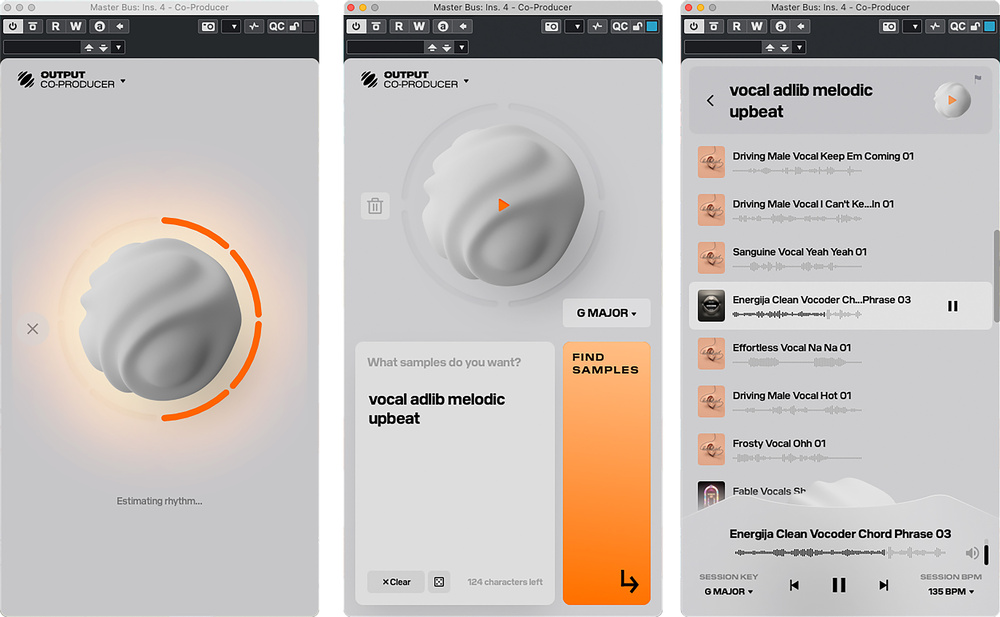 Co‑Producer will listen to a section of your track (left), let you provide a text prompt to identify what you are looking for (centre), and then use its AI smarts to identify some suitable loop options for you to audition (right).
You then simply hit the Find Samples button and Co‑Producer will apply it’s AI algorithms to search the online sample catalogue. The process takes just a few seconds and the UI then offers a list of possible loop options. You can audition any of these, either individually or in sync with playback of your DAW. And if you find a loop you think might work, you simply drag and drop it from Co‑Producer to a suitable track within your DAW or move it over to an instance of Arcade if you also have a subscription to that.
I’ll say a little more about the nature of the results of this process — and a couple of the interesting additional options that are available — in a minute but, given that many working within the creative arts community are very wary of AI technology, it’s worth emphasising that there are no creator copyright issues to worry about here; all the sample content is royalty‑free and has been correctly licensed for use within Co‑Producer. All the AI is doing is attempting to facilitate searching the catalogue to find you some inspiring options. As an example of AI use within the creative process, personally, I think Output are on safe ground here.
Collaborative Effort
So just how well does this co‑production process work in practice? As might be expected, the results undoubtedly depend upon the musical context and the kinds of additional content you are attempting to find. A couple of simple examples can illustrate this. For example, if your initial starting point was a four‑bar pattern combining drum and synth bass loops, and you wanted Co‑Producer to find some options to work alongside that, whether you asked for guitar, keyboard, vocal or percussion suggestions, the odds are you would find plenty of suitable possibilities. However, if your initial arrangement included more complex harmonic content — such as a clearly defined piano chord sequence — you might find Co‑Producer’s search results don’t always deliver a direct match, particularly if you want a loop that directly follows the underlying chordal structure. That said, if you are looking for a melodic element to overlay with your piano chords — such as a vocal ad lib or guitar melody — then, again, you will undoubtedly get some interesting options.
Co‑Producer can generate some truly magical options but, of course, not every suggestion is going to work. For example, beyond matching the key, Co‑Producer does not (at least, not yet) re‑harmonise its sample content to fit a specific chord sequence. The bottom line here is that you still have to use your ears with any of Co‑Producer’s musical suggestions. That is, I think, a good thing, but do keep your ears open; sometimes Co‑Producer can surprise you with an unusual suggestion that suddenly takes the project off in an interesting new direction.
In this context, two additional features are worth highlighting, both of which apply once you have identified a specific loop within Co‑Producer’s suggestions. If you click on the three vertical dots to the right of the loop, alongside some options applicable to Arcade subscribers, you have two additional buttons. The first of these — Show Similar — essentially gets Co‑Producer to generate a new suggestion list populated with loops similar to your chosen target. For example, if the loop comes from a particular Arcade Line, the results might include other loops from within the same Line.
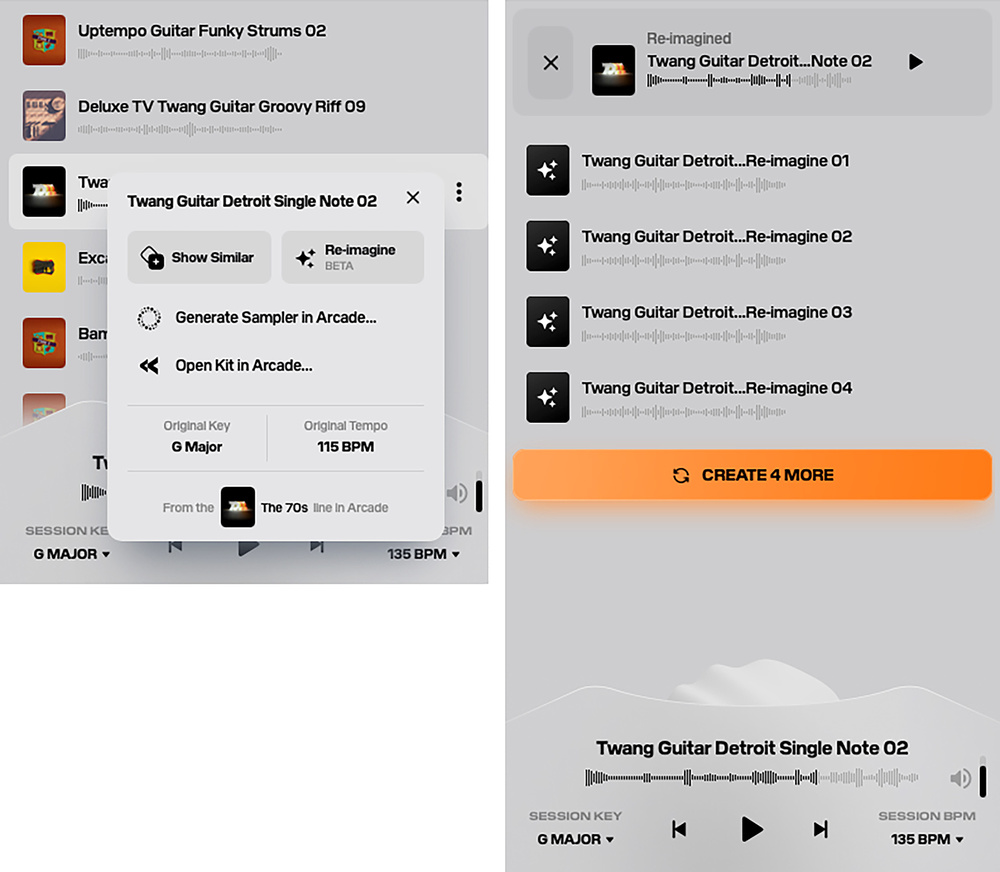 Co‑Producer includes the Show Similar and Re‑Imagine features (left) and the latter, which will generate alternative versions of a selected loop (right), makes it clear that the plug‑in is more than just an AI‑powered search engine.
Show Similar has been available since Co‑Producer launched but, as shown within the screenshot, the second option — Re‑Imagine — is new (it was still in beta when I used it but should be publicly available by the time the review is published). Co‑Producer essentially takes the selected loop and — presumably through some manipulation of the original audio — generates batches of four alternative versions of it. These might have rhythmic variations or melodic changes but, being based upon the same sound/instrument, they can easily be used as either an alternative to the original loop or alongside it. While this is obviously an early iteration of the process, the potential of the concept is very obvious. Given just how capable the algorithms available for tempo and pitch manipulation of audio now are, with a little crystal ball gazing, you can begin to speculate about where Output might take this. I’m sure Co‑Producer’s existing user base will lap this up when it is formally released.
Ready To Co‑Produce?
Subscription‑based access to music software, virtual instruments and sample content is now commonplace. However, for many potential users, budgets often mean they have to be selective about the subscription platforms they invest in, choosing the combination of features, content and price that best matches their specific needs. In this regard, I do think the Output One subscription is a pretty compelling offer, especially if you are already an Arcade user.
Output obviously see Co‑Producer as more than just an intelligent sample library search engine.
Clearly, Co‑Producer is going to be of most interest to those whose music creation process features loops and samples. However, in that context, it is a very interesting addition to the Output ecosystem. Its long‑term success will obviously depend upon the combination of features and the sample content it offers. By leaning into the Arcade library, the latter is impressive from the get‑go. In terms of the former, and hinted at by the Re‑Imagine feature, Output obviously see Co‑Producer as more than just an intelligent sample library search engine and, with the potential obvious, it will be fascinating to see where they take the concept. If you want to explore that potential for yourself, then the Co‑Producer (or, better yet, Output One) seven‑day free trial is highly recommended.
Q&A With Gregg Lehrman, CEO Of Output

What inspired the development of Co‑Producer?
Gregg: Arcade draws upon a pretty extensive sample library. One of the most common requests we received was for easier ways to refine searching that library to find the samples you were looking for. Co‑Producer is designed to address that request.
Co‑Producer is, however, its own product, so what’s the relationship between Arcade and Co‑Producer? Do they draw on the same sample content?
All of the Arcade content is searchable via Co‑Producer but, in addition, Co‑Producer also has access to sample content supplied by our various partners such as Minimal Audio, Cinesamples, Zenhiser and Black Octopus Sound. That sample content is expanding all the time. When Co‑Producer suggests samples from a search, you can easily see where they are sourced from, whether that’s an Arcade Line or one of our partner‑supplied libraries. All the samples are royalty‑free, and a Co‑Producer subscription provides unlimited access to the sample collection.
What does the AI technology within Co‑Producer bring to the sample search process over and above that of a typical tag‑based browser experience?
There are two main strands to this. First, any text prompt the user enters is analysed within a Large Language Model (LLM). Obviously, this helps find samples that might match their search criteria but, equally, when a user then identifies and downloads a suggested sample, the model itself learns from that, noting a ‘successful’ match to the criteria. In that way, the LLM is constantly evolving and improving how it interprets specific combinations of text within prompts. Second, having auditioned your existing audio, as well as more routine tasks such as tempo and key/root note matching, Co‑Producer’s AI can analyse the harmonic content and try to find samples that it thinks will be the most appropriate fit. Again, the AI will continue to learn, and this is undoubtedly an area that will continue to evolve based upon user feedback.
Did you have any concerns about the reaction to Co‑Producer given how polarising AI can be within a creative context such as music production?
I totally get that concern, but I think there are plenty of use cases for AI in a creative workflow where it is clearly being used as a tool to facilitate the artist’s creativity rather than to replace it. We see Co‑Producer as very much in this role. It makes a specific technical process — searching a sample library catalogue to find the sounds your project needs — more efficient. It’s then up to the user to determine the creative direction taken with any samples that Co‑Producer might suggest.
Are you able to say anything about the future direction of travel for Co‑Producer?
Well, obviously, we will continue to expand the sample content. However, we are also excited to see the functionality evolve. In this context, user feedback is absolutely critical. We have a team of trusted beta testers within our user community and, even in the few months since the initial release, we have issued a series of updates in response to their feedback. We are particularly excited by the next update [This will be available by the time you read this; see the comments in the main review — Ed.]. When you find a sample that is close to what you are looking for, you will be able to ‘Re‑Imagine’ it. This essentially uses AI technology to generate alternative versions of the sample, giving you a greater number of creative options. The beta tester response to this has been overwhelmingly positive and, again, it’s that feedback that will help us focus Co‑Producer’s development to best meet our user’s needs.
Pros
- Co‑Producer is more than just an AI‑based sample library search tool.
- The Output One subscription, which includes Co‑Producer, is a compelling option for loop‑ and sample‑based music‑makers.
Cons
- Some are still resistant to subscription‑based products.
Summary
Output clearly see Co‑Producer as more than an intelligent sample search tool and, even in this early stage, the potential is enticing. It also makes a great companion to Arcade.
Information
From $9.99/month including VAT.
From $9.99/month including VAT.