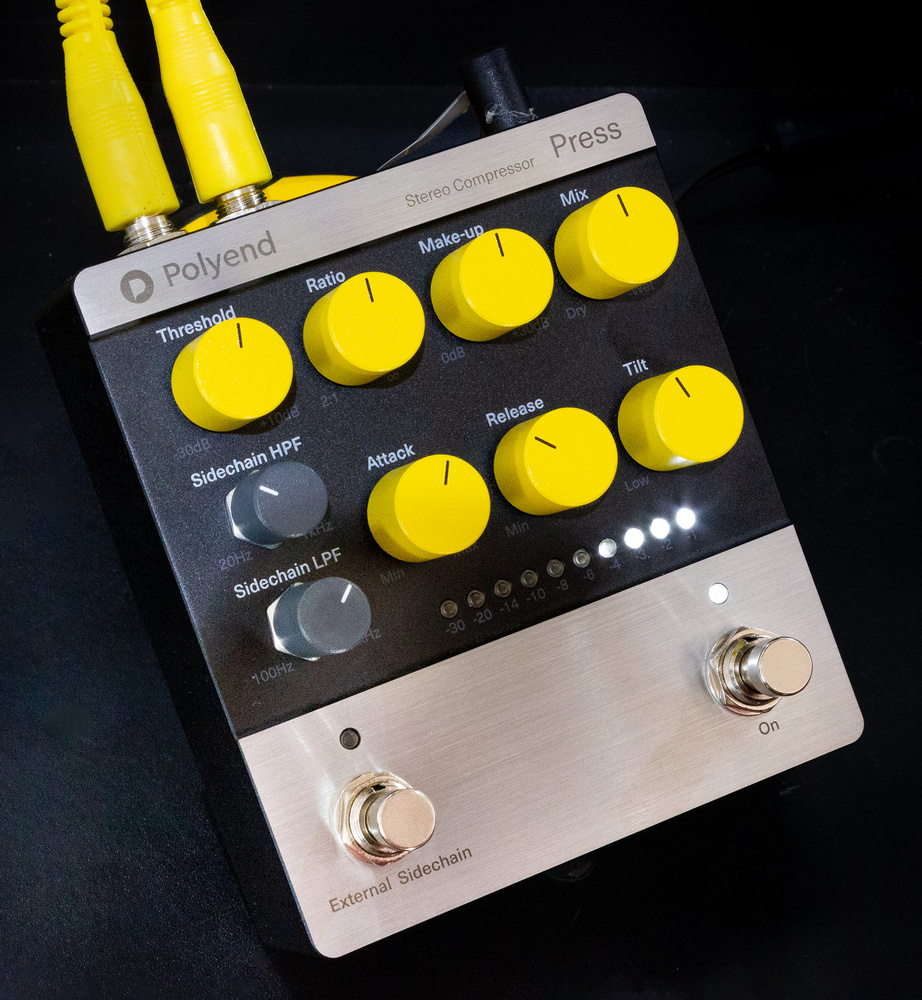
It may come in the form of a stompbox, but there’s studio‑quality processing inside — and more than enough control for serious mixing.
There was a time when the best you could hope for from a compressor pedal was a few knobs and a half‑decent chance of increasing an instrument’s sustain. I never really got on with that sort of thing — it just felt clumsy and unsatisfying to me, and I much preferred studio‑style compressors, whose settings I could dial in more precisely. Thankfully, recent years have seen quite a few more capable dynamics processors packed into pedal‑sized boxes. As well as the various excellent analogue‑modelling digital devices, we’ve seen a range of good analogue options, including FET compressors (for example from Origin Effects), optical compressors (such as the JoeMeek Floor‑Q) and some excellent VCA compressors (from Becos FX, amongst others). And some of them do much more than control the attack, sustain and dynamic range of a signal, for example offering side‑chain control, dual bands, EQ and filtering, or saturation/distortion.
Press Pack
The latest company to tread this path are Polyend, who I’d hitherto thought of mostly as a company whose focus was firmly on the synth market. But while their new Press VCA compressor pedal caters for that crowd, of course, it also boasts a number of interesting features that should mean it has just as much appeal for guitarists and bassists, and, in fact, pretty much anyone who’s looking for a pedal or tabletop compressor to use on stage or in the studio.
With a footprint of about 105mm (a shade over four inches) by 120mm (4.75 inches), it takes up a chunk of pedalboard real estate if that’s where you want to put it, but it’s not unreasonably large. It’s powered by a 9V, centre‑negative PSU of the sort usually used for guitar effects and pedalboards. There isn’t one included and there’s no internal battery option; you’ll need a PSU capable of supplying 350mA. The power inlet is on the back panel, of course, and there you’ll also find the main I/O on two quarter‑inch TRS jacks.
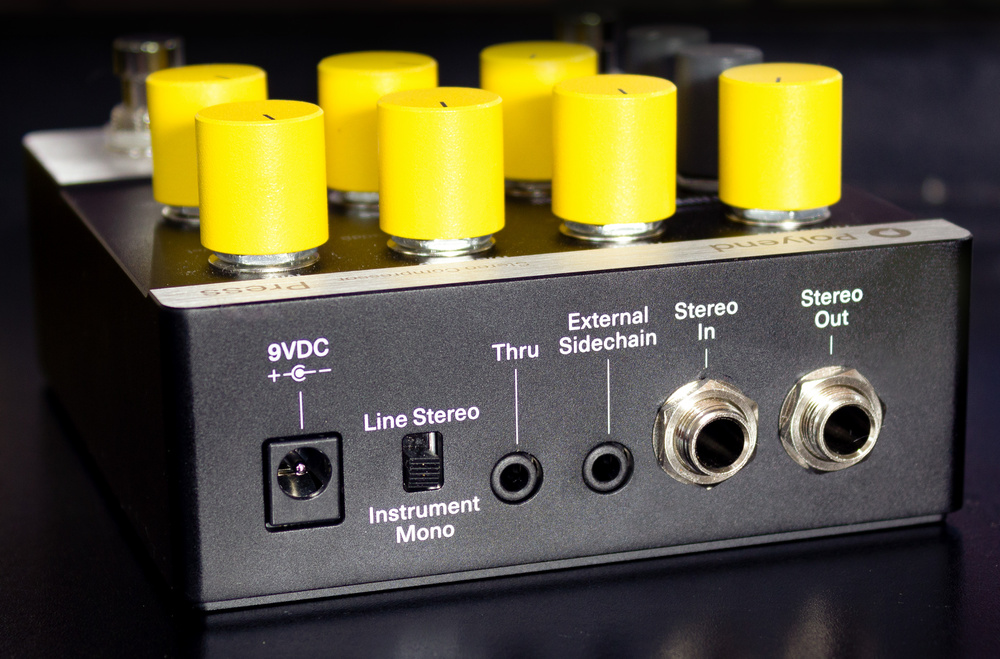 As well as the main mono/stereo I/O, there are also mini‑jacks for an external side‑chain input, and to pass the input/side‑chain signal on to another device.
The input/output jacks cater for mono instrument or unbalanced stereo line‑level I/O, selected using a slide switch. You could, for example feed the left and right TS jack outs from a synth or drum machine into it, using a Y‑lead, or connect a guitar directly to it with the usual TS jack cable. There are also two further connectors on the back: TRS mini‑jacks that provide a thru output, for passing the incoming signal on to other devices, and an external side‑chain input, for triggering compression from sources other than the one being processed. So, for instance, you could send a kick signal to duck a bass, or to get a whole mix pumping in time to the beat.
Everything else of interest is on the top. Here, there are seven bright‑yellow, cylindrical knobs, accompanied by two smaller black knobs and two 10mm footswitches. You’ll also find a 10‑LED gain reduction meter, and status LEDS for the switches. It looks great, but I did find that some of the labels were often unhelpfully obscured from view by the tall knobs, and personally I’d have preferred all of the labels to be as bright as those on the left — some are darker and harder to read against the black, and the numbers beneath the gain‑reduction meter are so muted as to be almost unreadable. Still, you soon get a feel for what everything does, so none of this really impacts on operation in the longer term.
The footswitch on the right is for on/bypass, while that on the left brings the external side‑chain into play. The main compressor controls are on the yellow knobs, all of which turn continuous analogue pots. Again, dark labels beneath serve as an aide memoire of the values, so let’s put them in clearer black and white! The threshold can be set anywhere from ‑30 to +10 dB. The ratio ranges from a bus‑compressor‑friendly 2:1 right up to infinity:1 (effectively limiting). The separate attack and release knobs are both marked from 1 to 10, and there’s 0‑30 dB of make‑up gain available. The other two yellow knobs are Mix, a wet/dry blend control that gives you instant access to parallel compression, and Tilt, which applies a tilt EQ with a fixed centre frequency. Turn this anticlockwise for more bass and less treble, and clockwise for the opposite. It acts on the wet signal only, but if you set the threshold control for no gain reduction and the mix control to 100 percent wet, you can use this on the input signal, which can be incredibly useful.
Filtration Station
So there’s plenty of control to start with, but the final two knobs (the smaller black ones on the left) make this compressor particularly versatile: one is a high‑pass filter (20Hz to 1kHz) and the other a low‑pass filter (100Hz to 20kHz), and they act on the side‑chain signal (whether internal or external, this is the control signal used to trigger the compression; shape this and you change how the compressor reacts). Most of us are accustomed to using high‑pass filters in the side‑chain to reduce a compressor’s sensitivity to low frequencies, but adding a low‑pass filter to this lets you do so much more. For instance, if feeding a drum loop into the external side‑chain, you could roll the high‑pass filter down so it has no effect, and bring the low‑pass filter down until compression is triggered only by the low‑frequency energy of the kick. Alternatively, you could use the two in tandem as a ‘bracket filter’, and really target a narrow band, for example as a de‑esser. You get the idea: extra control and versatility.
In Use
I tested the Press using a range of different material, including vocals, acoustic and electronic drums, acoustic and electric guitar, bass, and some synths and keys. The first thing that struck me was just how clean and transparent the unit was when not applying any gain reduction. It may have unbalanced I/O but noise wasn’t ever a problem, and when sending line‑level signals out from my audio interface there seemed to be plenty of headroom.
The sound is everything you’d expect of a VCA compressor... Dialling in the desired result is quick and easy.
The sound is everything you’d expect of a VCA compressor: it can act very fast if you want that, or you can set it up for a more relaxed feel. It might not deliver quite the sonic vibe of a FET or opto compressor, but dialling in the desired result is quick and easy, despite those ‘camouflaged’ labels. The yellow knobs have a black line to indicate the position, while the black ones have a white line, and these high‑contrast markings make it easy to see what’s what. You soon find that a quick glance is enough to take in the whole unit’s settings, or to set things up from your notes or a recall sheet. There are some presets laid out like that in the manual, and if you’re less used to studio compressors, these can be great for initial orientation. The footswitches, given plenty of space, work well too: easy to hit with a foot, while pressing with fingers doesn’t require undue pressure.
Polyend put great emphasis on the importance of the high‑ and low‑pass side‑chain filters, and that’s understandable: they really help when you want to focus the action only on sounds you wish to squish. But for me, Tilt is the star of the show. It’s a simple idea really, but I’ve only ever encountered a tilt EQ on one other company’s pedals (Becos FX’s Stella range), and they’re great for making broad darker/brighter tonal shifts that don’t otherwise mess with the sound. And that can be really handy for correcting any tonal changes resulting from more aggressive compression.
Hot Off The Press
What this all boils down to is a compressor that is stylish, neatly assembled, versatile and easy to use. I love that it can be deployed on mono or stereo sources; it’s just as at home smoothing my (reasonable) guitar playing or pinning my (somewhat ham‑fisted!) bass playing in place, as it is parallel‑processing a drum bus, just tickling the mix bus, or injecting a side‑chain‑driven bounce into an EDM track. Given the quality, its stereo capability, and the bells and whistles, it’s decently priced too. So if you’re looking for a portable analogue compressor, this one’s well worth checking out.
Summary
A high‑quality analogue compressor in a format that you can take anywhere, and deploy on pretty much anything!
When you purchase via links on our site, SOS may earn an affiliate commission. More info...