

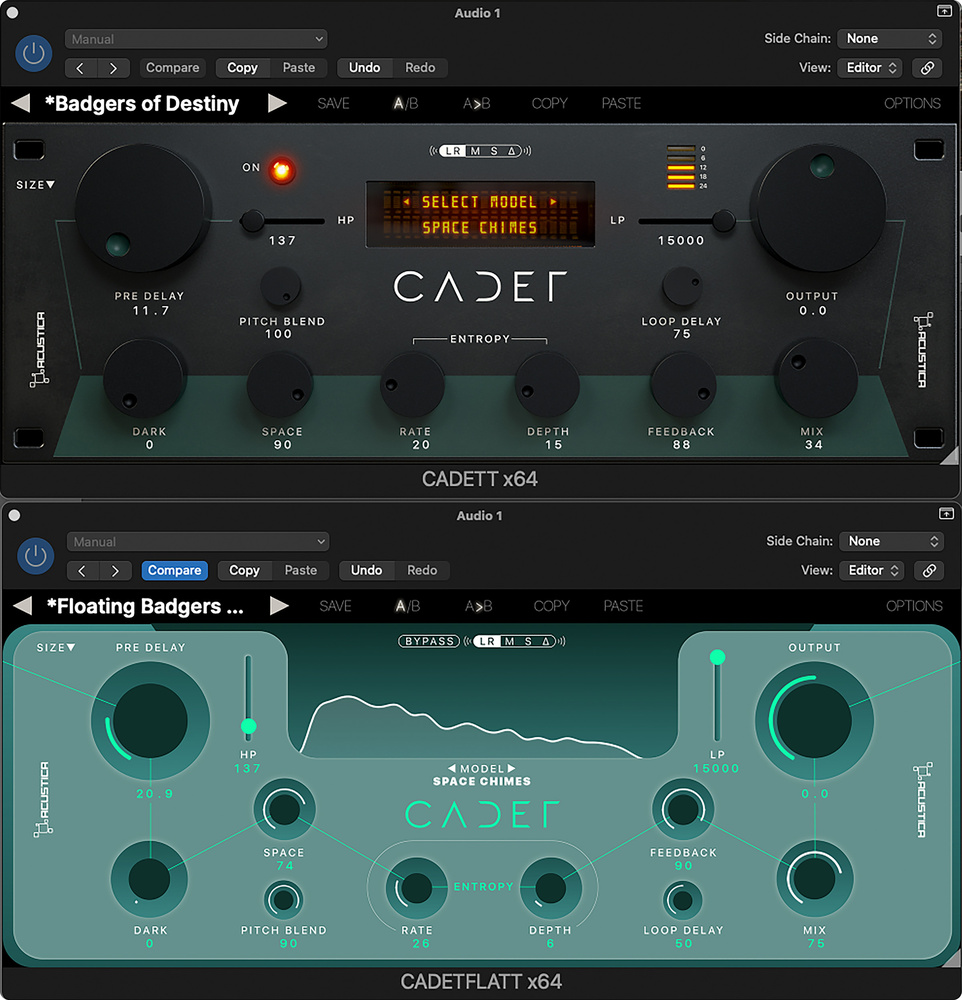
 There are two versions of Cadet, each with a different GUI style.
Supporting all the mainstream plug‑in platforms for Mac and Windows DAWs, Cadet actually comes as two separate plug‑ins, Cadet and Cadet Flat, that are identical other than in their resizeable GUIs. Cadet provides the familiar photorealistic control panel, while Cadet Flat has a contemporary 2D style that’s been optimised for clarity on modern displays or mobile setups, and includes a spectral energy display at the top centre of the window.
The reverb market is a pretty busy place, but Acustica have approached things a little differently from most. Cadet combines impulse responses with algorithmic elements to give the user flexibility in adjusting the settings, and also includes pitch processing that can create shimmer‑style effects without any grainy artefacts. The Space control adjusts the reverb decay time, as you might expect, but where Cadet really differs from typical reverb plug‑ins is that within the reverb engine is a feedback loop that can be modulated using the Entropy Rate and Depth controls, to create effects that stray well beyond the boundaries of straightforward reverb. The delay lines and the internal feedback loop make extensive use of convolutional techniques, while the pitch‑shifting stage is entirely based on a Fourier transform process. The modulation section includes Doppler‑like effects and also employs convolution. The designers offer that Cadet includes internal envelope followers that continuously monitor and shape the dynamics of the reverb tail and the feedback network, with the aim of maintaining a stable and musically evolving reverb decay.
The reverb engine produces a wide stereo soundscape, and is capable of sounding very natural on vocals, acoustic instruments and percussive sounds, in addition to creating special effects. Though there are relatively few controls, they’re effective: they can be used to modify the 11 factory reverb models, and to adjust the pre‑delay time (up to 100ms). A Dark filter allows for some high‑end damping while Pitch Blend brings in the shifted signal to create shimmer‑style treatments. The aforementioned feedback loop is adjustable for Loop Delay, Feedback and Entropy modulation. That leaves Output and Mix, as well as high‑ and low‑pass filters that can be adjusted in frequency.
The straightforward control set allows users to make adjustments without getting bogged down in arcane menus, and there’s a generous set of factory presets that include the panel control settings. The preset models cover small, medium and large spaces and while Cadet does not extend to creating unnaturally long reverbs, it nonetheless has some special‑effect potential. For example, choosing Cosmic Church and then going wild with the modulation and pitch‑shifting options can create a somewhat unsettling, haunted effect. As you change models the panel settings remain the same, so it’s easy to explore the differences between the models.
Additional smooth pitch and modulation facilities provide sound designers with scope for shimmers, subtle modulations or out‑and‑out excess.
Sonically Cadet is capable of being a very musical studio reverb for use in general mixing roles, but its additional smooth pitch and modulation facilities provide sound designers with scope for shimmers, subtle modulations or out‑and‑out excess. Those into ambient music might have appreciated a longer maximum reverb time, but everybody else should feel comfortable with something that goes from a tight space to a church. Best of all is that you can download a demo version allowing you to try before you buy.
Information
€95 including VAT.
€95 (about $110 when going to press).