

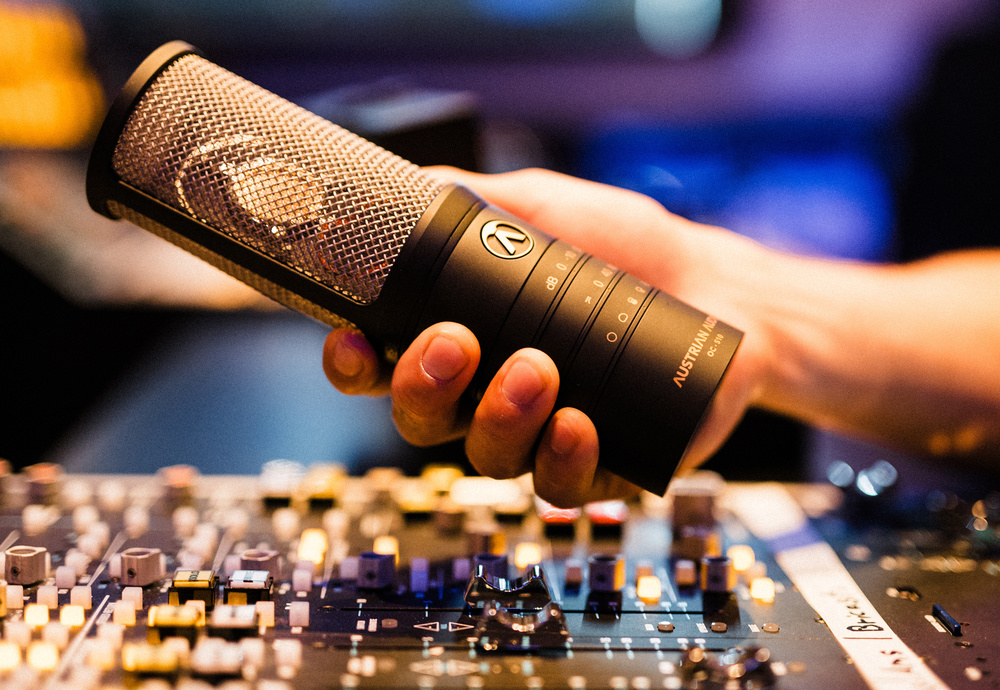
The OC‑S10 is a premium vehicle for Austrian Audio’s highly regarded CKR‑12 microphone capsule.
Most of the products we review in Sound On Sound are good. Companies who make bad products don’t tend to stay in business for long! Even so, it’s rare to encounter something that instantly screams “modern classic”, but Austrian Audio’s first product was one such. Released in 2019, the OC818 is a multi‑pattern capacitor microphone based around a re‑engineered take on AKG’s celebrated CK12 capsule. Employing a ceramic surround rather than the original 'brass ring', Austrian Audio’s CKR‑12 is more consistent, more stable and easier to manufacture than the original — but, crucially, it shares all of its positive sonic qualities.
Had Austrian Audio simply used this capsule in a faithful recreation of the C414, it would no doubt have been very popular. But what makes the OC818 a modern classic is that they opted not to be limited by AKG’s 50‑year‑old design choices. The OC818 dispenses with the C414EB’s output transformer, improving its specs and producing a cleaner sound. It uses microprocessor control to adjust the polarisation voltages to each side of the capsule, for superb polar pattern accuracy. Cutting‑edge manufacturing techniques deliver unprecedented consistency, meaning that any two OC818s can be used as a pair with no need for additional matching. And not only can the polar pattern be controlled remotely over Bluetooth, but the signals from the front and rear of the capsule can be recorded independently, whereupon Austrian’s Polar Designer and Stereo Designer plug‑ins enable far greater control over the directionality of the mic than would be possible with switches alone.
What’s perhaps most impressive of all about the OC818 is that it remains relatively affordable, retailing at well under £1000. That’s not something you can say of many modern classics, or indeed of second‑hand C414EBs. What’s more, Austrian Audio have used the same capsule in two even more wallet‑friendly mics, the fixed‑cardioid OC18 and OC16. They’ve also diversified into headphones, pencil mics and stage dynamic mics, with solid results. Until now, however, they haven’t entered the premium tier of the mic market.
Launched at this year’s NAMM Show, the OC‑S10 is very definitely a premium studio microphone. In creating it, Austrian Audio haven’t steered away from the trusty CKR‑12, but nor have they taken some of the more obvious paths open to them. They could, for example, have used this capsule as the basis for a high‑end valve mic, or added an expensive output transformer and fancy Japanese capacitors. They could even have made a stereo mic. What they’ve actually done, however, is more subtle.
Doing The Rounds
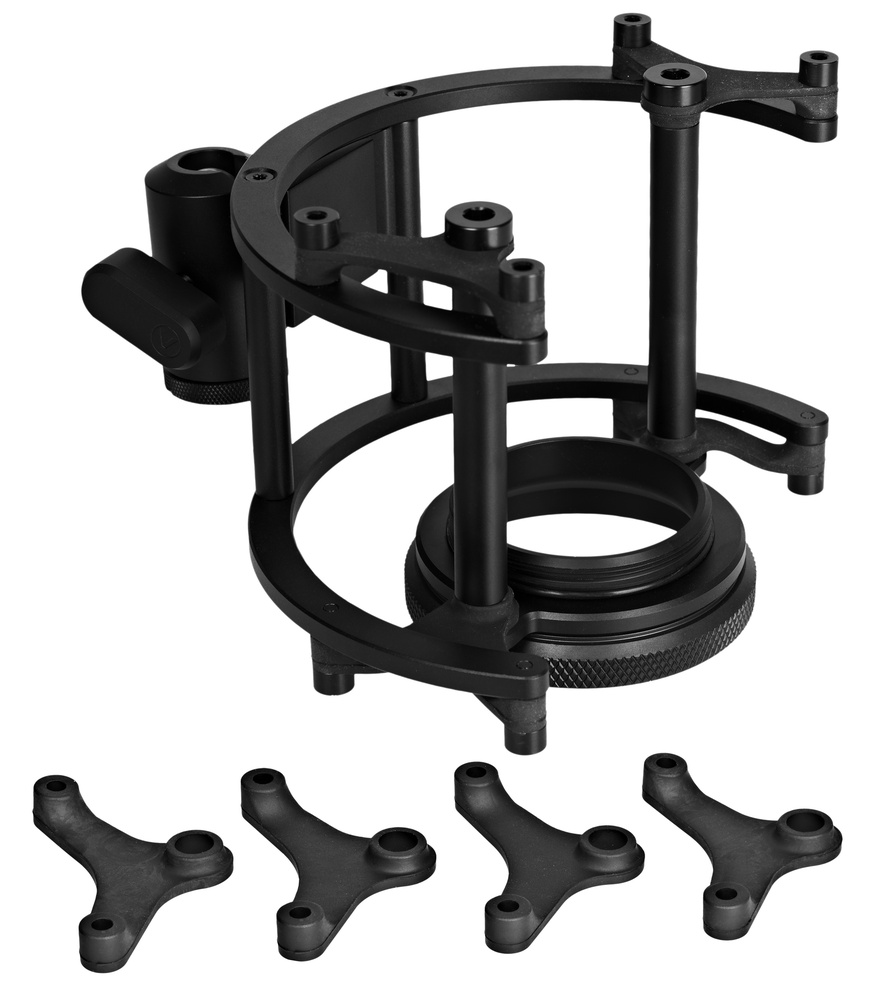
Unusually, the shockmount does not use elastic cord; the inner cradle is suspended using triangular pieces of rubber‑like material.The OC818, 18 and 16 all share a distinctive body shape, which is a little reminiscent of a hip flask. In its way, this is as individual and recognisable as the angular C414 body, and has some advantages over that design, including reduced susceptibility to RF interference. The OC‑S10, though, looks nothing like either. Its generously sized, cylindrical body is outwardly more conventional than that of the OC818, but in its own way represents an equally innovative design.
Five basic polar patterns are available — omni, subcardioid, cardioid, hypercardioid and figure‑8 — and the OC‑S10 has the same complement of pad and high‑pass filter settings as the OC818. Rather than being adjusted using switches, however, these are selected using detented rings that surround the entire body of the mic. These are satisfyingly solid in operation, but more practically, they make the current setting easily visible from any angle, since the legends for each position are reproduced on the rear side.
The OC818 already has an unusually open headbasket, but the OC‑S10 goes even further, suspending the capsule in a considerable volume of free space. A similar three‑point elastic capsule mount is used, and this in itself offers a decent degree of shock protection, but one of the OC‑S10’s outstanding features is the dedicated shockmount that Austrian Audio have developed. A threaded ring holds the mic in place within an inner cradle, which in turn is suspended within a rigid outer frame. The linkages between the two are not formed from conventional elastic bands, but from Y‑shaped pieces of soft rubber. These provide support in compression as well as in tension, and so even though the mic itself is only attached at one end, there’s minimal droop when used horizontally.
I’d go as far as to say that this is the most effective shockmount I’ve ever tested.
This mounting system is remarkably good at preventing the transmission of mechanical noise. In fact, I’d go as far as to say that this is the most effective shockmount I’ve ever tested, especially considering the not inconsiderable size and weight of the mic itself. Tap your finger on the mic stand or even on the outer frame of the mount, and you’ll hear nothing but what the mic is picking up through the air — no rumbles, thumps or extra low‑frequency components at all.
My favourite feature, though, is the universal ball‑and‑socket joint through which it attaches to the mic stand. This permits a wide range of rotation in three dimensions, and holds the mic securely at whatever angle you choose. Similar mechanisms are offered by specialist manufacturers such as Triad‑Orbit, and until you’ve tried them, you won’t realise what a difference they make to the usability of a mic.
The foamed metal pop shield attaches magnetically to the shockmount.In addition, the OC‑S10 comes with its own custom pop shield. This attaches magnetically to the mount, and disperses wind blasts using a fairly thick but lightweight screen made of foamed metal. In practice, I found that the dual‑layer mesh in the mic itself was already reasonably effective at minimising pops, and the pop screen completely eliminates them. I’m never 100 percent convinced that pop screens are sonically transparent in other respects, but this one is as good as I’ve heard, with no ringing and minimal high‑frequency loss.
Splitting The Difference
As previously mentioned, the OC818 offers remote pattern control courtesy of the optional OCR8 Bluetooth dongle, plus the option to record the output from the rear side of the capsule separately, enabling the pattern to be decided after the fact. This is the one aspect of the OC818 design that sometimes feels a bit clumsy, because the second output appears on a mini‑XLR socket, and the necessary adaptor cable tends to foul the mic clip.
Bluetooth control is not supported on the OC‑S10, but dual‑output recording very much is, and its larger body has enough room for two full‑sized XLRs. These are positioned side by side, at the base of the body where nothing can get in the way. The obvious risk with this idea is that in normal use, when you’re only connecting one cable, you might accidentally plug it into the wrong socket. Austrian Audio have prevented this through an ingenious mechanical locking arrangement, which blocks access to the second XLR unless a cable is plugged into the main socket.
Finally, premium mics are often distinguished by premium packaging, and the OC‑S10 is no exception. The mic itself comes in a very nice wooden box with a magnetic closer, which is almost identical to the boxes Extinct Audio use for their BM9s. This, in turn, is housed in a robust hard‑shelled case with compartments for the shockmount and pop filter. Austrian Audio put each production mic through a rigorous test procedure, and individual frequency response charts are supplied for each of the five polar patterns.
Whereas the OC818 has a thoroughly modern look and feel, the OC‑S10 package embodies a slightly more timeless approach to industrial design. It’s not retro, but nor does it wear its innovations on its sleeve in quite the same way. The overriding impression is of a seriously high‑class product, constructed to the highest standards without any compromises. I think Austrian Audio have struck a really nice balance between form and function here.
Twin Peaks
The OC‑S10 requires standard 48V phantom power to operate, and draws a modest 3mA or less. Its specifications are, unsurprisingly, very similar to those of the OC818, although it slightly betters that mic in a couple of ways. Self‑noise is just 8dBA, a 1dB improvement over the 818, and sensitivity is 14mV/Pa to the 818’s 13. On the down side, there’s 1dB less headroom, but since the maximum SPL is still 157dB, that’s unlikely to be a problem in the real world. Output impedance is considerably lower, at 108Ω to the OC818’s 275Ω.
Polar pattern, pad and filter settings are chosen using indented rings that rotate around the body of the mic.
As previously mentioned, the pad and filter implementations are the same as those of the 818. The pad operates in two 10dB stages, the first of which reduces the polarisation voltage of the capsule, while the second introduces attenuation in the internal circuitry. The corner frequency of the filter can be set to either 40Hz or 80Hz, with a 12dB/octave slope, or to 160Hz, in which case the slope is 6dB/octave above 80Hz and 12dB/octave thereafter. This offers a good array of options for tackling both subsonic noise and low‑frequency build‑up due to proximity effect.
The individual frequency response charts for the review mic corresponded closely with the generic measurements published in the manual. These, in turn, display a fairly strong family resemblance with the equivalent charts for the OC818 — and, completing the chain, with many mics based on the original AKG CK12 capsule. Mics based on this capsule design tend to exhibit the same general character, with a flat or even recessed midrange and a generous high‑frequency lift. This treble emphasis often appears as two separate peaks on the response chart, which assume different proportions depending on the polar pattern.
In the OC‑S10, the upper peak is the broader. Centred around 10kHz and spanning nearly an octave, it’s at its most obvious in omnidirectional mode, being almost 5dB up. As you shift the pattern towards cardioid, this starts to flatten out and a second peak starts to develop, centred around 5kHz. By the time you reach figure‑8, the 10kHz peak is barely 2dB above the nominal zero, whilst 5kHz is boosted by as much as 5 or 6 dB.
In practice, although some shift in on‑axis tonality is audible as you change the polar pattern, it’s more consistent and less obnoxious than it is in many large‑diaphragm mics. I tend to avoid using my U87s and C414EBs in figure‑8, as that upper‑midrange emphasis can make things sound edgy, but the OC‑S10 remains comparatively smooth. I suspect that’s partly because there’s no output transformer to add a layer of grit.
OG OC?
The OC818 was conceived, it seems to me, as the mic AKG would have made 50 years ago had the technology been available to manufacture the CK12 consistently and exploit its strengths fully. As a consequence, it performs much better than the C414EB from a technical point of view, and does not have the same design or construction faults. It also does not reproduce some of the sonic characteristics that were, arguably, accidents of that design.
Something of the signature sound of AKG’s CK12‑based mics is undoubtedly down to the rather small Haufe T14/1 output transformer that was used in nearly all of them. This seems to add its own contribution to the sound, and I suspect it’s partly responsible for the high‑frequency sparkle that distinguishes those mics. That’s not present in the OC818, or at least, not in the same way, and the same goes for the OC‑S10. If you want that slightly pushed, insistent treble, you’ll have to manufacture it by passing the OC‑S10 through a coloured preamp. Because, by itself, this is just a wonderfully natural‑sounding mic. It doesn’t have the ruler‑flat response you’ll get in a good pencil mic, but more importantly, it never feels as though the mic is coming between the source and the listener. Inasmuch as this is a flattering mic, it carries out its flattery in a completely invisible fashion.
The OC‑S10 is a very fine microphone, and had Austrian Audio launched this rather than the OC818 back in 2019, I’ve no doubt that it too would have become an instant classic. However, given that the earlier mic has established itself so successfully, the question arises as to why you’d pay more than twice as much for a new model that, on paper, is very similar.
I didn’t have an OC818 available for comparison, but I didn’t hear anything from the OC‑S10 to suggest that there’s likely to be a huge sonic difference between them — and nor would I want there to be. Why would Austrian Audio choose to change a winning formula? However, the OC‑S10 is a real improvement in other ways. The second full‑size XLR turns the option of recording the two sides separately from something that’s nice to have in theory into something you’ll actually use in practice. The shockmount is an absolutely outstanding piece of engineering that offers better isolation from stand‑borne noise than anything else I’ve come across. The pop shield is likewise one of the very best designs you can buy. And the whole package just has an air of understated class that will fit perfectly into today’s boutique destination studios.
Would I buy an OC‑S10 when I could get an OC818 Dual Set and have money left over for more mics? That’s a tough question, and ultimately the answer to that would depend on how I anticipated using them. If I needed a pair of dogsbody mics to handle everything from drum overheads to brass overdubs, the 818s would be right at the top of my list. But if I wanted one statement mic to place in front of the most demanding vocalists, I’d have every confidence in the OC‑S10 to do me proud.
Plug & Play
By selecting the central (cardioid) polar pattern and connecting a second XLR cable, it’s possible to record the outputs from the front and rear sides of the OC‑S10’s capsule separately. Assuming you’re careful to match the gain across both preamp channels, the resulting two‑channel recording can then be processed using one of three native plug‑ins, all of which are available for free on Austrian Audio’s website. These were developed for the OC818, but as far as I’m aware, should work equally well with the newer mic.
Polar Designer allows you to recombine the two channels to synthesize your chosen polar pattern after the fact. It goes much further than simply offering a single, continuously variable pattern, though. You can vary the polar pattern independently across up to five separate frequency bands, or ask the plug‑in to automatically optimise the pattern so as to maximise capture of the wanted sound or minimise spill pick‑up. It’s also possible to reduce or enhance proximity effect.
A new version 3 of the Polar Designer plug‑in is in the beta stage.
In some circumstances, the two‑channel output can also be valuable as a source of stereo information. In its raw form, the stereo track represents a coincident array of cardioid mics at a 180‑degree mutual angle. This is not an oft‑used setup, though there are times when it might get you out of a hole. In this situation, the second of Austrian Audio’s plug‑ins, Stereo Creator, allows you to vary the polar pattern of both sides simultaneously. It really comes into its own, however, if you have two coincident dual‑output mics mounted at a 90‑degree angle. By recording all four outputs to the channels of a quad track, you can then decode all sorts of different stereo arrays. Taking this further, AmbiCreator derives a B‑format signal from the same mic setup, allowing you to use it as the basis for a two‑dimensional Ambisonic array.
All of the plug‑ins are elegantly presented and easy to set up, but it should be noted that until now, there have been no Apple Silicon native versions. However, Austrian Audio confirmed that these are in the works, and an open beta of Polar Designer 3 with Apple Silicon support and other enhancements is already available.
Alternatives
To my mind, the most obvious rival to the OC‑S10 is Nordic Audio Labs’ NU‑100K, which is based on a new capsule design that seems to have a lot in common sonically with the AKG CK12.
Pros
- Gorgeous, natural, open sound.
- Superb shockmount and pop shield design.
- Dual‑output configuration makes it very versatile.
Cons
- You can buy two OC818s for less — and those are great mics too.
Summary
Austrian Audio have pulled out all the stops to create their new flagship model, and the results are most impressive.
Information
£2299 including VAT.
DPA Microphones UK +44 020 3008 7530.
When you purchase via links on our site, SOS may earn an affiliate commission. More info...

