Royer have powered up their most affordable ribbon mic with active electronics.
 David Royer might be the most influential microphone designer in the business today. When he set up Royer Labs back in the ’90s, the ribbon mic was a moribund technology, largely forgotten by the studio world. Royer’s first product, the R‑121, demonstrated not only that there was a place for ribbon mics in contemporary recording, but that there was still scope for technological innovation, thanks to developments such as rare‑earth magnets and Royer’s then‑unique ‘offset ribbon’ motor.
Not content with reinvigorating ribbons, David went on to set up Mojave Microphones to commercialise his ideas around capacitor mic design. Meanwhile, the R‑121 is still widely regarded as the gold standard for recording electric guitar amps, among other things. As befits a premium US‑made mic, however, the R‑121 is relatively costly, and perhaps out of the reach of many people who would like to own one.
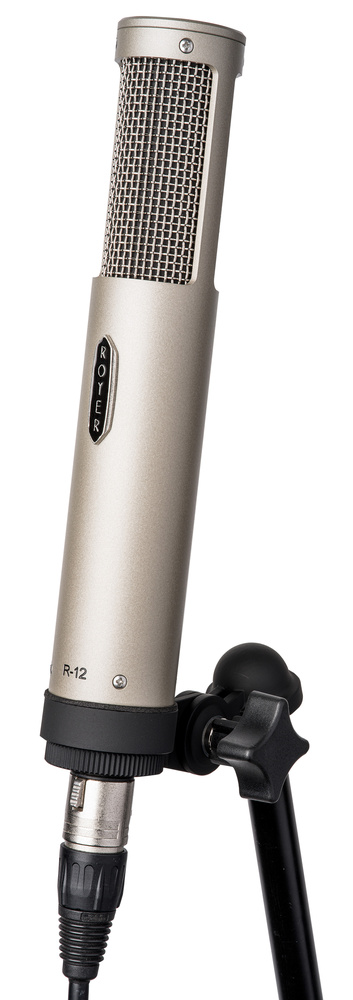
With this in mind, Royer first created the R‑101, and then later the R‑10, aiming to boil down the essential qualities of the flagship model into a more affordable package. The latter mic was reviewed by Hugh Robjohns in the January 2018 issue of SOS and remains a current product. It has now been joined by a sister mic called the R‑12.
Attractive Active
One of Royer’s biggest innovations came in 2002 with the launch of the R‑122: an active, phantom‑powered version of the R‑121, with a sensitivity comparable to most capacitor microphones and the ability to drive long cable runs without the sound suffering. On paper, the concept of an active ribbon mic sounds trivial to realise, but in practice, Royer had to overcome significant technical hurdles to get it to work, as the company’s co‑founder Rick Perrotta explains in the boxout. In Royer’s approach, the active circuitry doesn’t provide any amplification as such. Rather, it acts as a buffer and line driver, the extra sensitivity coming from the use of a transformer with much higher voltage gain than can be employed in a passive mic.
In Royer’s approach, the active circuitry doesn’t provide any amplification as such. Rather, it acts as a buffer and line driver, the extra sensitivity coming from the use of a transformer with much higher voltage gain than can be employed in a passive mic.
The R‑122 is also still a current product, and its present MkII iteration features a switchable high‑pass filter and ‑15dB pad. Both of those features have been carried over into the new R‑12 — which, as you’ve probably twigged by now, is an active version of the R‑10. Like the R‑122, it achieves its extra sensitivity by the use of a special output transformer, which is stabilised by an active buffer. One benefit of Royer’s approach is that the R‑12 can handle sound pressure levels up to an ear‑melting 160dB.
Twelve Tones
Royer sent a pair of R‑12s for review, housed in a compact hard case. Each mic comes with a swivel mount, but — unsurprisingly in view of the wish to keep costs down — there are no shockmounts or stereo bar. For the most part, it’s visually identical to the R‑10, except that the Royer badge is black rather than green, and the rear side of the mic has discreet recessed switches to activate the pad and filter.
The R‑12 has a natively figure‑8 polar pattern, but as with other Royer models, its ribbon is offset within the magnet gap. Consequently, the on‑axis frequency response is slightly different depending on whether the front or back of the mic is pointing towards the source, although Royer told me that this effect is less pronounced in the R‑12 than in the original R‑121. On paper, this feature has both pros and cons. It gives you what is essentially two different voicings that you can try when close‑miking individual sources, but also means that if you were to use two R‑12s as a Blumlein pair, any sources behind them might be represented slightly differently to sources in front. The published frequency response chart relates to the front side of the mic, and shows a broadly flat response from 20Hz to 15kHz, albeit dialled back by a couple of dB above 7kHz or so.
In theory, the use of a different transformer could mean that the R‑12 doesn’t sound exactly like the R‑10. I wasn’t able to compare the two directly, but I did have an R‑121 to hand, and my experiences with the R‑12 very closely mirrored those of Hugh Robjohns when he tested its passive sibling. One of the hallmarks of the R‑121 is an attractive airy, almost sparkly quality that you perhaps wouldn’t expect from a ribbon mic. It’s one of the brighter ribbon mics around, but importantly, that brightness isn’t accompanied by any sense of ‘hardness’ in the midrange. The R‑12 is likewise much less dark than, say, a Coles 4038, but that distinctive sparkle in the 5‑10 kHz region is less apparent than it is on the R‑121. In other respects, the sound is broadly similar, and I’ve no doubt that on most sources, you could EQ one to sound much like the other. There’s plenty of low end on offer, with the substantial proximity effect you’d expect from a figure‑8 mic, but not so much that it’s simply overwhelming, as can be the case on some ribbons. Turn the mic around, and you’ll notice a slight shift in timbral focus; the rear side is a little more forward in the 2‑3 kHz region, and perhaps slightly softer in the high frequencies.
Activity Centre
Being an active ribbon, the R‑12 is relatively indifferent to the vagaries of mic preamp input impedances. With a sensitivity specified at 16mV/Pa, it also puts out a comfortable level even on relatively quiet sources. Self‑noise is specified at less than 16dBA, which is roughly comparable with most small‑diaphragm capacitor mics. I’ve seen similar figures quoted for cheap Far Eastern active ribbons that are patently false, but there is no cause for concern here, and in use, the R‑12 is about as quiet as active ribbon mics get.
Another thing that can be inadequate on cheap ribbon mics is pair matching. I tried Hugh Robjohns’ patented stereo matching test, rigging the two R‑12s as coincidentally as possible in the same orientation, and walking around them whilst talking. The ensuing recording remained bang in the centre of the stereo image throughout, indicating that the two mics were closely matched both in terms of sensitivity and frequency response. Indeed, the peak signal level on both channels as measured by Pro Tools was identical.
Much of Royer’s early success in triggering a new wave of interest in ribbon mics was down to the fact that they were able to retain the strengths of the old models — unrivalled smoothness and a near‑perfect figure‑8 polar pattern — whilst improving sensitivity, robustness and high‑frequency extension. The R‑12 doesn’t sound exactly like the R‑122 MkII, but it absolutely does the same things, and at a far more affordable price.
Going Active
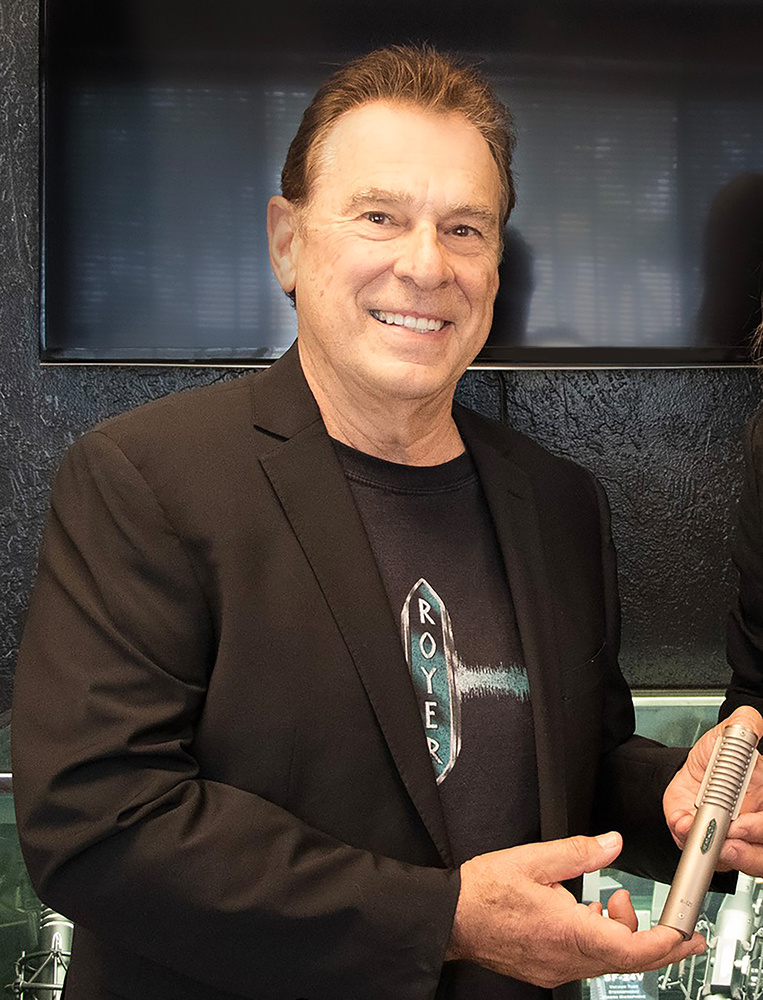 Royer Labs co‑founder Rick Perrotta.“When we were developing the first active ribbon mic a few decades ago the biggest challenge was noise,” says Royer Labs co‑founder Rick Perrotta. “Other companies had tried and failed, primarily due to the lack of low‑noise amplification components. Transformer technology at the time was such that it was difficult to get much ‘free’ gain out of a transformer, because toroid cores and multi‑filar winding techniques were still relatively new. When winding for higher gain in a standard transformer, the frequency response becomes very non‑linear, translating into very erratic frequency response. Add that to an amp stage that loads the transformer, and things get worse.
“Our approach was to tackle the transformer issue, which we felt possible because of new techniques that had become available. Royer developed a very sophisticated transformer that provided the needed gain and remained very linear. We simply followed that with an impedance converter that added no gain and therefore no appreciable noise. It also didn’t load the transformer in any way.
“Originally, we considered using bipolar transistors that were available at that time and were quieter than FETs, but there was a problem. When using the standard bipolar transistor topography, a phenomenon occurred which we believed would have negative effects on the ribbon: when the mic was plugged into active phantom, or when phantom was switched on, the transistors acted like forward‑biased diodes and would send a voltage pulse to the ribbon through the transformer. This was unacceptable to us as it would degrade the corrugated ribbon over time by gradually relaxing the corrugations, which would lead to ribbon sag.
“As far as using a simpler cascading FET arrangement, the simple fact was that FETs of the era were plagued with shot‑noise in certain configurations, so we chose the method we did, given the tools we had available then. The bottom line is that as we were the first to offer an active ribbon mic, we addressed the low‑output ribbon characteristics the best way we could think of when there was no playbook. We must have done something right, because what we accomplished has been copied by almost everyone producing ribbon mics today! Back in the ’90s there were only a few companies even making ribbon mics — Coles and beyerdynamic come to mind — and those were for specific purposes.”
Royer’s active models also benefited from the developments that made their passive mics more sensitive than older ribbons. “We employed neodymium magnets that were not commonly used in microphone design. We started with grade 38 neo; and, as the magnets improve, we keep getting the stronger and stronger versions. We use grade 52 now and that alone gives us several dB of extra ‘free’ gain.”
Summary
The R‑12 might be less expensive than Royer’s flagship models, but any cost savings certainly haven’t come at the expense of quality. This is a very fine active ribbon mic indeed.
Information
£899, matched pair £1799. Prices include VAT.
SX Pro +44 (0)800 6522 320.
$899; matched pair £1849.
When you purchase via links on our site, SOS may earn an affiliate commission. More info...