With two separate compressors on board and various ways to deploy them, RND’s new OptoFET is an intriguing prospect.
Despite the physical resemblance to its stablemates, the new OptoFET is a pretty bold move for Rupert Neve Designs (RND). Rupert Neve’s classic diode‑bridge and VCA compressor designs are well known, of course, but this one is based around two other compressor types: one FET and the other optical. That’s a tried‑and‑tested combination in music production — for years, many engineers have partnered an 1176 with an LA‑2A, for vocal processing in particular. But the OptoFET isn’t simply a case of nicking that idea. I’m told their R&D team have been toying with different FET compressor designs for years (even if this is the first they’ve released), and they’ve included multiple routing options here, as well as implementing two new ‘character’ options, called Grit and Bloom.
Controls & Construction
As you’d hope of gear at this price (very much in ‘professional’ territory, though a keener one than some others in RND’s range), the 1U 19‑inch rackmount OptoFET’s build quality is flawless. The case and controls are reassuringly solid, with plenty of finger space around the knobs (all turning 31‑position detented pots) and buttons. Visual feedback is instantly informative, and the painted finish oozes class. None of which will be a surprise if you’ve used RND gear previously!
 The rear panel, with a combi jack/XLR for the electronically balanced input, and an XLR for the transformer‑balanced output.On the rear, there’s an IEC C14 mains inlet (100‑240 Volts AC, 50 or 60 Hz) with an integral power on/off switch. There’s a power indicator LED on the front too, but no switch; ideally, I’d like a second switch there to allow powering off when my studio rack is powered up. Back on the rear, as well as a ground‑lift slide switch, you’ll find a single Neutrik Combo XLR to route line‑level sources to the electronically balanced input stage, and a male Neutrik XLR to deliver the custom‑transformer balanced output. That arrangement is perfectly normal for mono processors like this, but it does mean you can’t simultaneously deploy each compressor on different sources. Such a facility would have added to the unit’s versatility, but the additional I/O would also have increased the asking price, particularly with a second transformer‑balanced output. There’s no external side‑chain input, and no provision for stereo linking either, which RND say is because matching the optical cells to the precision they’d want is nigh on impossible!
On the front, working from the outside in, there’s a ±12dB input gain knob with signal‑present LED on the left (green, turning red when approaching clipping), and a ±12dB master output level control on the right, whose eight‑LED output level meter ranges from ‑10 to +22 dBU. Inside those I/O controls, visually separated by white lines, are the FET compressor controls on the left, those for the opto compressor on the right and, between, them a central section with the routing controls.
Those routing options need explaining before we can explore the performance of, and potential applications for, this processor. At the top‑left corner of this central section, a backlit hard‑wired bypass button takes everything, including the input and output stages, out of the signal path. Alongside this, another button labelled X‑Over In determines whether the OptoFET’s compression stages are configured to act in series on the whole signal, or independently on low and high frequency bands. In the latter scenario, a knob immediately below sets the crossover filter frequency (50 to 500 Hz).
A third top‑row button, labelled Flip, swaps where the compressors are deployed. If in series mode, engaging this puts the opto compressor first in the chain, while in X‑Over mode it determines which compressor is assigned to the low band and which to the high. Two quartets of LEDs below, one either side of the frequency knob, indicate the current assignment for each compressor: there’s an LED each for stages A and B in series mode, and for HF and LF in X‑Over mode; the current selection lights green. It’s a neat, intuitive system that’s also quick, since there’s no manual patching involved.
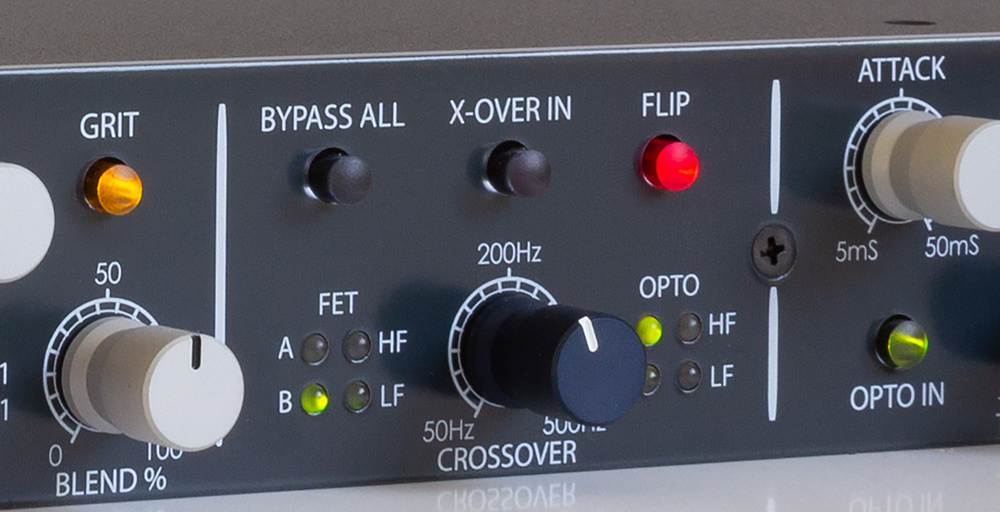 The central control section: this is where you decide where the two compressors will act on your signal; one before the other, or each on a different frequency band.
Each compressor’s control set is almost identical. To the right of their green backlit in/bypass button is a dark‑blue threshold knob, though the two have different ranges: ‑15 to +20 dBu for the FET, with ‑5dBu at the top position; and ‑10 to +20 dBu for the opto, with ‑8dBu at the top. Silver‑coloured knobs govern the attack (0.1 to 50 ms for the FET, 5‑50 ms for the opto) and release (50ms to 1.5s for both) times, and each processor has a wet/dry blend knob too.
A button toggles between two ratio options (4:1 and 8:1 for the FET; 2:1 and 5:1 for the opto, though the opto’s ratio actually varies somewhat with the signal level). These ones are the only buttons on this device that don’t light — usually, you can see easily enough when these buttons are depressed, but my ‘moody’ studio lighting sometimes made it trickier. A further (green backlit) button switches in a 125Hz, first‑order high‑pass filter for the side‑chain signal, while another (yellow) one engages the Grit function for the FET compressor, or Bloom for the opto. Finally, we have an eight‑LED bar meter above each compressor’s controls to indicate gain reduction (1‑22 dB).
True Grit
So what does this thing sound like? Why have RND put two compressors in one box, and what applications do all those routing and character options open up? To answer such questions, I spent a few weeks auditioning a pair of OptoFETs on several active projects. But first, even before dialling in any compression, I should spell out very clearly that it sounds great: full, clear, and with all the details in the source being conveyed with precision.
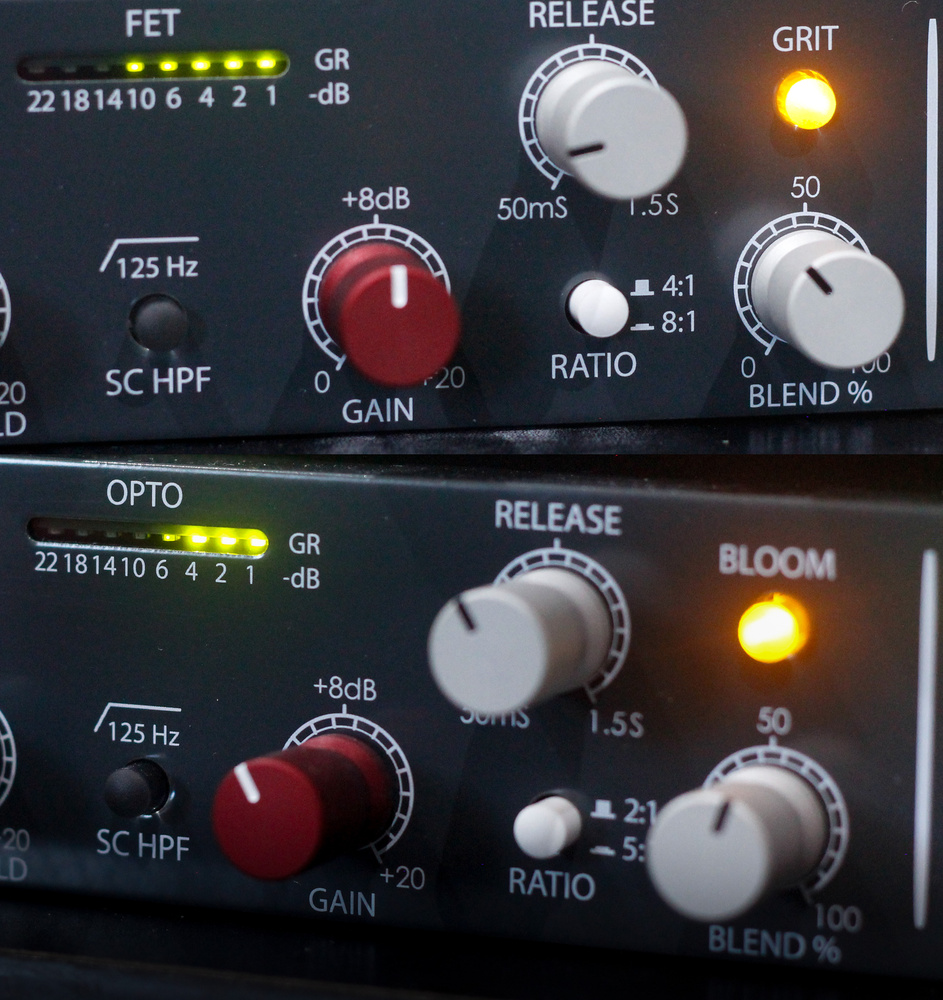 The FET compressor’s Grit feature and the optical compressor’s Bloom can both speed up the compression and add character.Patching in just the FET compressor, I began by experimenting with some vocal compression, before turning my attention to bass guitar, acoustic and electric guitar, and acoustic and electronic drums. This compressor, which has a soft knee, served admirably in the vocal smoothing role. With a 4:1 ratio and a long‑ish attack and release, it delivered elegant control of male and female voices, and evened out the dynamics of guitar and bass parts nicely too, without suffocating note onsets. Switching to 8:1, I found more scope to shape the envelope of bass guitar notes and individual drums. It can be really fast too, such that you can clamp right down on transients — a tactic that can be really useful when you bring the mix control into play. While you have only two ratio choices, not the four of the 1176 (never mind its ‘all buttons in’ trick), this isn’t really trying to be an 1176, and there are further factors to consider in any case. First, there’s that mix control, for parallel compression. Second, there’s still a whole other compression stage to play with, should you wish to get more assertive. And third, there’s Grit...
Before I looked too deeply into this unit, I’d imagined that Grit might be a dedicated saturation circuit, but it’s more sophisticated than that. When not engaged, there is (for both compressors) some smoothing of the side‑chain signal going on behind the scenes. Switch in Grit, though, and this is removed, leading the FET compressor to act faster and more assertively, introducing some upper‑mid and high‑frequency harmonics in the process. This can lend energy and urgency to proceedings, and usually without making things sound overcooked. But push the compression harder and it becomes more obvious, and again, I particularly enjoyed doing that and using the mix knob to blend this in as an effect.
The optical compressor’s character is different, partly because the ratio increases with the signal level, partly because it has a harder knee. It sounds rather more forgiving on most sources; it’s harder to, erm... ‘fudge things up’.
Bloom serves to lend a thicker, richer character to a signal. I found it particularly appealing when processing acoustic sources.
Conceptually similar to Grit, Bloom causes the attack and release to quicken, though it can’t ever react as fast as its FET sibling can. This time, the added energy is in the lows and low mids, so it’s a thicker, richer character. I’m sure it has wider applications, but I found it particularly appealing on clean or thin‑sounding acoustic sources: it can, for instance, lend much‑needed authority to a female vocal, or satisfying weight to an exposed acoustic guitar. It can do lovely things to clean‑sounding bass parts too, and all the while the compression can keep that low end under control.
It Takes Two, Baby!
You can use either compressor alone on the whole signal, but the idea is that you’ll deploy them in tandem, and with the controls for both in one box this soon becomes second nature. The obvious combination is in series in the default positions, with a faster FET stage at 8:1 to tame the peaks, and the opto set up to more gently smooth the signal. This works well, not least on vocals, and I felt that this configuration could easily form part of a go‑to recording front end.
The OptoFET is also adept at controlling parts whose levels change significantly at different points in a song. For instance, use one stage in parallel to crush the peaks and raise up the quieter, more intimate details in a verse vocal, and feed the result to the other, set fully wet, to pull down the peaks in a strident chorus. There are other ways to manage that (eg. automation), but this one is quick and convenient, and could be really useful in an analogue live‑sound rig.
Should you want to experiment with the order of your compressors, it helps if you’re fastidious about gain staging: keep the input level and both compressors’ output levels in the same ballpark, and no matter what you bypass or in which order you place the compressors, you’ll have broadly similar levels hitting the thresholds.
This isn’t the place for a multiband compression tutorial, but I will say that two bands are often enough! In particular, I love using two‑band compression on bass guitar to ensure a solid low end, without suffocating the life out of the part. But note that not only can you target different frequency bands with compression, but X‑Over mode can be used to shift the focus of the Grit and Bloom ‘effects’.
Finally, while there’s no stereo linking, don’t write off using a pair of OptoFETS on stereo sources. Using unlinked compressors on the left and right channels of a drum or mix bus can help retain a sense of ‘life’ in some material, while you apply the ‘mix glue’. You just have to be careful not to go over the top with the gain reduction, which makes centrally panned sources wander. I particularly enjoyed using the two review units in split‑band mode on a stereo backing vocal bus: instant cohesion that felt like a cheat code! I could be more assertive when processing a drum bus, where dominant, centre‑panned kick and snare drums always triggered compression on both channels, but tom and cymbal hits panned in one direction or the other were kept in check without too great an impact on the stereo image.
Good Optics?
As I said above, this is a bold stride outside of RND’s comfort zone, and they’re to be commended for that. More importantly, this is an incredibly versatile, beautiful‑sounding piece of kit, and it almost certainly offers something your existing gear doesn’t. If you’re in the market for a high‑quality analogue compressor, it’s worth a test drive!
Technical Performance
The technical specs given in the manual are exemplary, and were borne out by my listening tests. Highlights include a frequency response within ±0.1dB of flat between 6Hz and 70kHz, and within ±3dB from less than 5Hz right up to 183kHz. THD+N at 1kHz is quoted as 0.002% at 0dBu, and 0.0006% at +20dBu. The maximum input and output levels (1kHz) are each +24dBu, while the input impedance is 10kΩ and the output impedance 40Ω.
Pros
- Great technical performance.
- Subjectively appealing compression.
- Versatile routing and band splitting.
- Grit and Bloom increase the appeal.
Cons
- Can’t deploy the two compressors on separate sources.
Summary
Two high‑quality compressors in one, with versatile routing and character options to boot. What’s not to like?
Information
£1859 each including VAT.
Rupert Neve Designs Europe +44 (0)20 8191 0058.
When you purchase via links on our site, SOS may earn an affiliate commission. More info...