

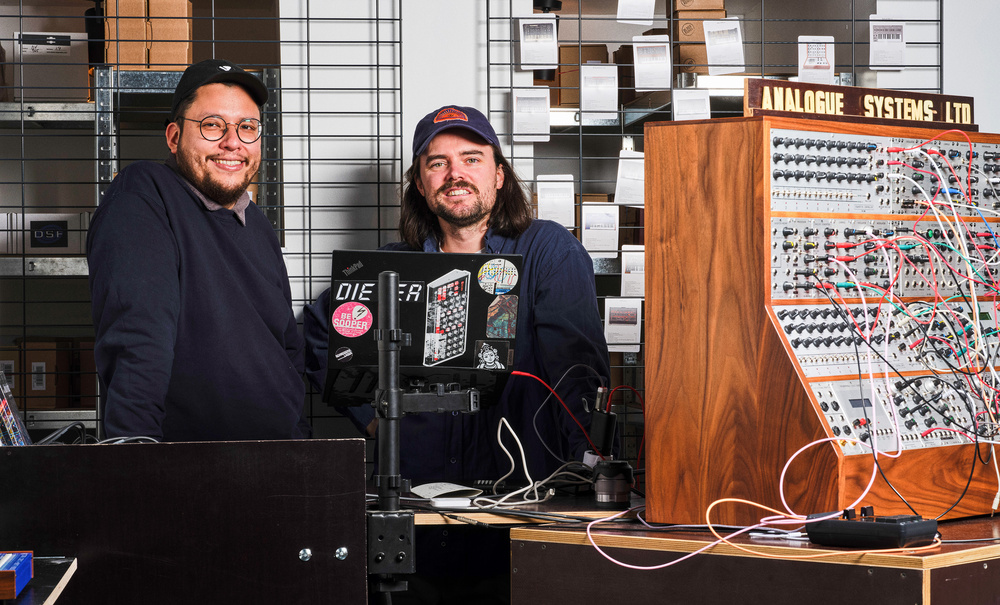
Edd Butterworth and Jean‑Marcel Fricke are the joint helmsmen of the recently opened SchneidersKeller (an offshoot of Berlin’s venerable SchneidersLaden) situated on the famous Denmark Street in the heart of central London. Butterworth has long been a pillar of the London scene — not least as part of the much‑missed boutique London Modular. Fricke, meanwhile, cut his teeth working with Andreas Schneider at SchneidersLaden (the organisers of the Superbooth events); though he also has control voltage in his blood, being the son of the late, legendary drum machine and synth designer Manfred Fricke.
On their entry into modular:
Edd Butterworth: I was working in a studio that had a bunch of classic analogue synths and outboard, mostly, Moogs, Korgs, Rolands... Everything was patched into the patchbays, including external inputs into the filters and CV/gate, et cetera. I was fascinated with routing things in and out of the synths and outboard. I got really into setting up these complicated routing scenarios. So when I wanted to buy some of my own gear I wanted that flexibility and decided on Eurorack as the best solution. I spent all the money I had on a Tiptop Happy Ending kit, the Expert Sleepers ES‑5, Intellijel Dixie and Quadra, Doepfer VCA/Mixer and standard VCO and a Malekko Wiard Borg 2 filter. I still have the Borg, the Quadra and the Doepfer VCAs!
Jean‑Marcel Fricke: I was familiar with modular synthesizers through my dad’s work, but I never took a serious interest in them. To me, they mostly sounded like quirky bleeps and bloops without much musical context. That changed when I did an internship at SchneidersLaden in Berlin when I was 18. During that time, I met Mark Verbos of Verbos Electronics. He took me to a gig and played a fully improvised live set using his system and a TR‑909.
I thought, ‘I could do that too!’. I convinced my dad to give me a Tanzbär [drum machine], along with an MFB OSC‑03, MFB Dual LFO, MFB VCF, and ADSR — basically everything I needed to build a monophonic synth voice. When he saw how much I enjoyed it, he let me start doing demos at conventions like Superbooth, and I began performing live gigs. After my father passed away, I became a salesman at SchneidersLaden.
On their go‑to modules:
EB: Doepfer VCAs: cheap and useful. Also, the Doepfer A‑199 spring reverb. It’s cheap and nasty, a little bit noisy, but I just love it, feedback patching with it is wicked too. I also blew mine up by reversing the power and they fixed it for free.
Then, Pamela’s Pro Workout. Can’t leave home without it. It constantly amazes me with the things it can do and how programmable it is.
J‑M F: The MFB Dual LFO: two LFOs in just 8HP with switchable waveforms, cross‑modulation, and attenuated CV inputs — a solid modulation source. Also, the MFB Digital Delay, which brings vintage delay vibes in just 8HP and is, in my opinion, pretty underrated. I’ll use the Bastl Instruments Pizza for precise and bitey sounds, and the Verbos Electronics Complex Oscillator for warmer, organic leads. For sequencing, the Verbos Electronics Multi‑Stage. As you may realise, I prefer everything hands‑on without too much menu diving! The only exception is the ALM MFX. I just love experimenting with it.
On creating SchneidersKeller:
EB: It was important for us to have lots of places to sit in the space so that people could relax and also not be too intimidated by massive racks of modular. Yes, a massive system is wicked, but we really want to present the modular as distinct instruments that can interact with one another.
Edd Butterworth: I want people to feel comfortable coming to the space, take their time learning or checking out a module or instrument and leave with the correct tool.
I want people to feel comfortable coming to the space, take their time learning or checking out a module or instrument and leave with the correct tool. A lot of the time when buying stuff online you might think that something is exactly what you want, then once you get it in your hands or start using it, it just doesn’t work for you.
J‑M F: For us, having a shop also means building a community. Engaging with other artists and synth enthusiasts is always fun and inspiring — not just on a technical or musical level, but also through the simple joy of connecting with people who share the same passion.
On what’s next:
EB: More live shows... We recently had our first live event with Yann Tiersen. It was really exciting to have a live show in the basement. Yann is a master, total synth nerd and just such a nice guy! We have a great‑sounding Neumann system, the space is super flexible so we can move everything around and make the space suit the event. I’m not sure we’ll get away with a full‑on rave, but an intimate space where people can get up close and personal with the artists and their gear is what we’re aiming for.
J‑M F: And workshops! Sometimes people wander down the stairs [from Rough Trade] looking for more records, only to discover our little synth dungeon. Often, they’re curious. Once we encourage them to tweak a knob or push a button, they usually get excited — so why not show them the basics in an intimate setting?
We also want to inspire those who are already a bit more advanced. Our goal is to keep the momentum going and help them get even more out of their systems. We also plan to have workshops which are hosted by the manufacturers themselves, who dive deep into their own creations, explain what drives them, and share their unique design philosophies.
On the culture of modular:
EB: I think there can be a culture of ignoring the basics... Doepfer absolutely has you covered here. People want the sexy things. But the basics are really where the fun starts. Understanding the basics means that the sexy things are incredibly more useful. I am constantly amazed by what I can get out of the Doepfer Basic System 3 we have in the shop. Once you start thinking about truly modular systems you can build all sorts of unique sequencers, or weird modulations with switches, clock dividers and function generators. You don’t need that new, exciting thing because you can create a totally different thing each time you patch it.
J‑M F: In my opinion, modular synthesis is rooted in experimentation, individuality and hands‑on sound creation. It encourages building a personalised system and engaging deeply with the creative process — while also requiring discipline to explore the full sonic potential of your setup. However, I feel that parts of the scene have shifted: modular has increasingly become a collector’s game. Limited releases, aesthetic‑driven purchases and rising prices can sometimes overshadow its original purpose, which is sonic exploration.