

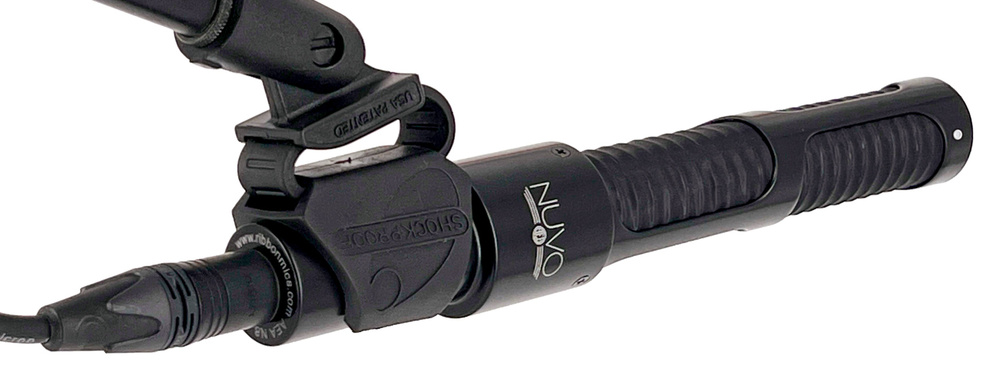
 The N28’s clip is decoupled from the stand by a soft plastic loop that adds a degree of shock protection.
AEA aim for the middle ground with an intriguing new stereo ribbon mic.
It’s hard to describe the sonic character of a microphone without resorting to cliché. In the case of ribbon microphones, those clichés often involve adjectives like ‘smooth’, ‘warm’ or ‘dark’. But are those really fundamental aspects of ribbon mic ‘tone’? Or do they arise because of the way the mics are being used?
If you swap out a typical capacitor mic for a ribbon in a close mic placement, the chances are you will notice that the sound is indeed thicker and richer at the low end. But that is partly because nearly all ribbon mics have a native figure‑8 polar pattern, and consequently exhibit lots of proximity effect. In terms of true low‑end response, a pure velocity mic such as a ribbon struggles to go as low as an omni capacitor mic — so if you carried out the same swap in a distant mic placement, it might well be the capacitor mics that sound deeper.
At the same time, most ribbons have less high‑frequency extension and presence than their capacitor brethren. Consequently, if a ribbon mic is ‘voiced’ so as to sound balanced in close‑mic placements — perhaps by deliberately attenuating the low end to compensate for proximity effect — it may well sound middly and boxy in distant applications, lacking both air at the top end and weight at the low end. That’s a phenomenon AEA have tried to counter in their well‑established R88, which is described as a “far‑field stereo ribbon mic”, and offers greater than usual high‑ and low‑frequency extension.
The R88 is available in active and passive versions, and has also spawned a mono derivative called the N8. But now AEA have introduced a second stereo model, with slightly different applications in mind.
Active Service
The Nuvo N28 is available only in an active version, and is significantly more compact than the R88. Its two ribbon motors are likewise mounted one above the other in a fixed Blumlein configuration. Below this, a bulge in the body of the mic houses a pair of Lehle transformers with a 1:89 step‑up ratio, and a newly developed buffer/line‑driver circuit that delivers a comfortable sensitivity of 6.1mV/Pa. Finished in satin black, the N28 is very attractive in a self‑effacing sort of way, with a helpful white circle identifying the front. It ships with a compact, allegedly shock‑absorbing...
You are reading one of the locked Subscribers-only articles from our latest 5 issues.
You've read 30% of this article for FREE, so to continue reading...
- ✅ Log in - if you have a Digital Subscription you bought from SoundOnSound.com
- ⬇️ Buy & Download this Single Article in PDF format £0.83 GBP$1.49 USD
For less than the price of a coffee, buy now and immediately download to your computer, tablet or mobile. - ⬇️ ⬇️ ⬇️ Buy & Download the FULL ISSUE PDF
Our 'full SOS magazine' for smartphone/tablet/computer. More info... - 📲 Buy a DIGITAL subscription (or 📖 📲 Print + Digital sub)
Instantly unlock ALL Premium web articles! We often release online-only content.
Visit our ShopStore.