

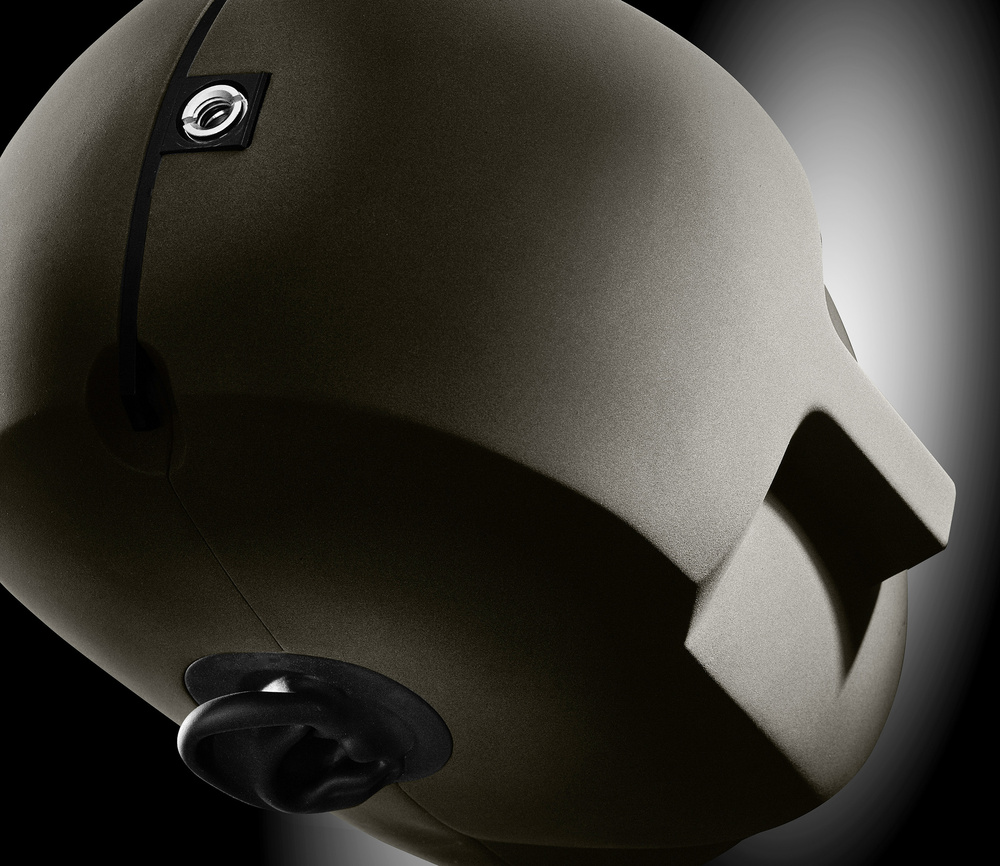
Concluding our series on advanced stereo mic techniques, we explore binaural recording, disc‑shaped baffles and dummy heads, as well as a clever process called ‘Stereo Shuffling’.
The preceding parts of this series took us on a journey from the fundamental concepts of stereo sound recording and reproduction to the theory and practical aspects of a wide range of stereo microphone techniques. We’ve explored Blumlein’s coincident arrays, including Mid‑Sides, that focus on capturing and reproducing only amplitude differences between channels; and the wide‑spaced omni‑mic arrays that capture mainly time‑of‑arrival differences between channels. We went on to consider a number of popular near‑spaced arrays that were designed to combine both amplitude and timing differences between channels — the best of both worlds — before also contemplating some of the more complex stereo mic arrays that combine both spaced omnis and near‑spaced arrays, including a brief look at the famous Decca Tree.
By this point, then, you’d be forgiven for thinking that there couldn’t possibly be any more stereo mic arrays to examine! But there are — and if you’ve been working through the audio example files associated with this series, you’ll already be aware of one example: the Schneider Disc. This, with variations upon it, is the last stereo mic array that I want to discuss in this series, as it represents a final class of stereo microphone techniques that aim to replicate the human hearing physiology — to a greater or lesser extent.
Dummy Head
If the idea of stereo recording is to replicate the human experience of listening to performers on a stage, arguably the most obvious approach is to imitate the human listening apparatus. Basically, that means using a head‑shaped construction with microphones in place of the ears. This concept, popularly known as the ‘dummy head’, has been explored in depth for decades, and there are several commercial examples, including Neumann’s original KU80 and current KU100, and Sennheiser’s now discontinues MZK2002, amongst various others.
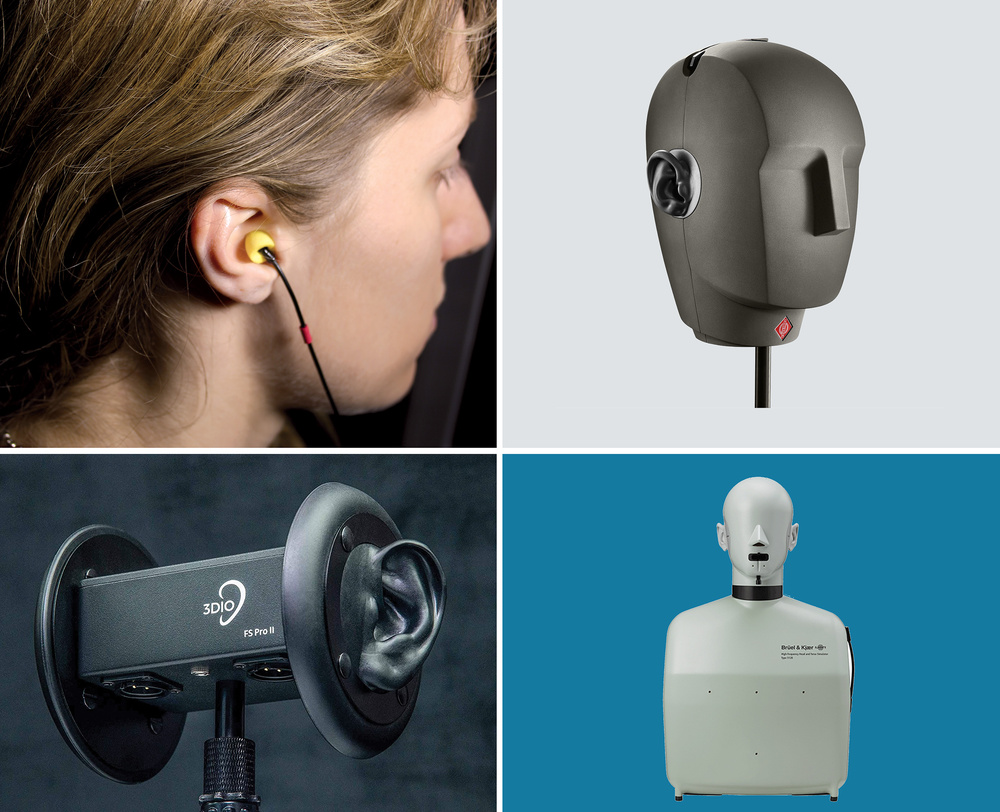 A range of mics intended to replicate the human listening experience. Clockwise from top right: the Neumann KU100 dummy head; Bruel & Kjaer’s HATS system; the 3DIO FS Pro II; and some ear‑worn mics. The last of these could potentially be the most convincing — but only for the person who wore the mics!
These dummy head systems produce a stereo signal in a format generally referred to as ‘binaural’, and intended exclusively for headphone listening. However, the success of these dummy head recordings, in terms of imaging stability and source location realism, depends very heavily on how closely the listener’s anatomy matches that of the dummy head, particularly in terms of head size and ear spacing (early dummy heads don’t attempt to replicate the folds and curves of the pinnae which, as we know, play an important role in vertical and front/back source location). The physiological parameters of the listener’s head/ears determine what is now known as the ‘Head Related Transfer Function’ or HRTF, which is unique to each individual listener, and it is these parameters that define how we individually perceive sound locations within a binaural signal.
As it happens, I own a Sennheiser MZK2002 dummy head. The recordings I’ve made with it certainly sound spacious and are interesting, but I don’t find them consistent, stable or precise. That’s probably in large part because the dummy head is physically smaller than my own. If I attach the same Sennheiser microphones to my own ears for recording, then playing back the audio files gives me remarkably precise and stable imaging information. But it’s important to note two things... First, if you move your head at all, you change the perspective of the mics. And second, this approach benefits me alone — others who’ve listened to recordings I’ve captured that way usually find the imaging to be imprecise and unstable again. This highlights the critical importance of personal HRTFs for accurate spatial imaging in binaural listening.
Today, of course, there’s a huge academic and commercial interest in binaural stereo, not least because of the vast numbers of people who now listen over headphones habitually. And while personalised binaural recordings might not transfer well from one listener to another, binaural reproduction is an ideal format for low‑cost immersive‑audio playback. Indeed, with the benefit of sophisticated digital signal processing, and the ability to create and implement personal HRTFs for playback over headphones, binaural stereo is making significant headway in popularity, and many manufacturers are now incorporating this technology in smartphones, tablets, laptops and more.
One down side of binaural stereo and dummy‑head recordings is that the format is specifically intended for use with headphones, and the stereo imaging is usually very poor when heard over loudspeakers.
One down side of binaural stereo and dummy‑head recordings, though, is that the format is specifically intended for use with headphones, and the stereo imaging is usually very poor when auditioned over loudspeakers. That wouldn’t be a problem if the entire audience were known to use headphones, but in most cases a significant proportion of the audience for commercial music is likely to be listening over loudspeakers. So is there an alternative technique that could offer better compatibility between headphone and loudspeaker listening?
Optimal Stereo Signal (OSS)
Take away the physical differences between individuals’ heads and ears, and the main significance of the replica head in dummy head recordings is that it acts as an acoustic baffle, reducing the strength of high frequencies from a source on one side reaching the ear on the opposite side, as well as introducing a time delay to the further ear. So why not just reduce the ‘dummy head’ to its simplest form: a flat baffle, with microphones placed on either side?
Needless to say, it’s been done... and as you might already have guessed, the first person to do it was Alan Blumlein, back in the early 1930s. One of his earliest experiments involved a pair of pressure (omnidirectional) mic capsules separated by an acoustic baffle. He described the setup in his famous patent, along with sophisticated signal processing to make it work better for loudspeaker listening, which is something I’ll come back to shortly. It wasn’t a line of enquiry Blumlein pursued at the time, though, as he chose instead to focus his work on coincident velocity (directional) microphones, which, to his mind, gave better results with loudspeaker auditioning. But good ideas have a habit of resurfacing sooner or later, and it was the work of Jürg Jecklin in the early 1980s, at the University of Music and the Performing Arts in Vienna, that resurrected the interest and popularity of Blumlein’s idea. He called the technique the Optimal Stereo Signal or OSS — but it became far better known for its physical appearance, and...
You are reading one of the locked Subscribers-only articles from our latest 5 issues.
You've read 30% of this article for FREE, so to continue reading...
- ✅ Log in - if you have a Digital Subscription you bought from SoundOnSound.com
- ⬇️ Buy & Download this Single Article in PDF format £0.83 GBP$1.49 USD
For less than the price of a coffee, buy now and immediately download to your computer, tablet or mobile. - ⬇️ ⬇️ ⬇️ Buy & Download the FULL ISSUE PDF
Our 'full SOS magazine' for smartphone/tablet/computer. More info... - 📲 Buy a DIGITAL subscription (or 📖 📲 Print + Digital sub)
Instantly unlock ALL Premium web articles! We often release online-only content.
Visit our ShopStore.