

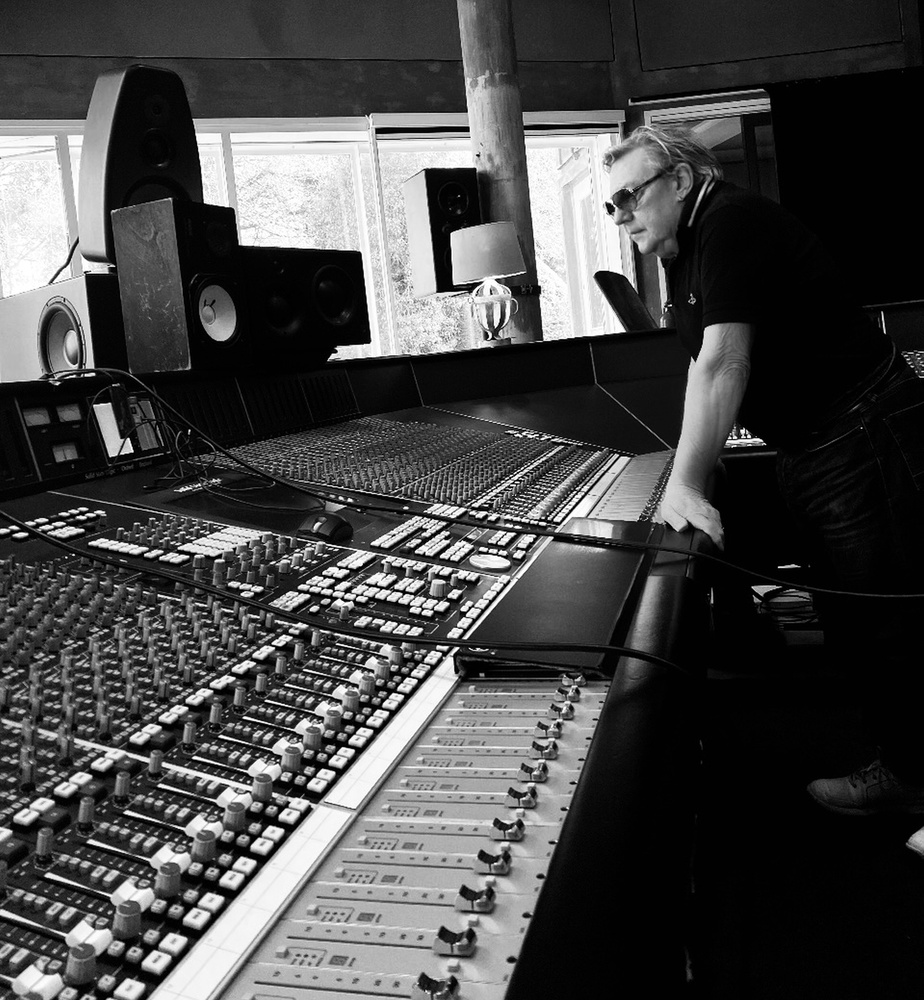
Across a career spanning more than 45 years, multi‑award‑winning English music producer and engineer David Tickle has worked with some of the industry’s biggest names, including Blondie, Prince, Peter Gabriel, Joan Armatrading, Split Enz, U2, Joe Cocker and the Police. Here, Tickle explains how he created the mysterious and ethereal sound that weaves in and out of U2’s ‘All I Want Is You’.
“On the right side of the mix at the beginning, I recorded The Edge sitting next to me in the control room. I used an SM57 on his guitar — which was a beaten up old 1930s acoustic guitar — close to the soundhole. We listened to it via Yamaha NS10 monitor speakers while he was playing, so there were no headphones. It’s all kind of done as live as possible, as that’s how I wanted to capture the sound of the recording.
 “Then we recorded a track of rhythm guitar, a kind of delayed jangly guitar that The Edge used and which is playing the eighth notes, but with delays on it. With that track, I sent that guitar into three different delays, using Lexicon PCM42s. So, I now have a 16th note, an eighth note, and a quarter note. With these three different delays, I’m sending them back through the SSL console and then feeding them back into each other, so that they start to collide, and become this kind of deeper delay thing.”
Full Pitch
“I send into an AMS harmoniser with an octave above, and an octave below. I’ve got two channels that I can send into, so with the outputs of these delays, I then bring those channels up by pushing the faders up and down, which allows me to send certain amounts of them to either the higher octave or the lower octave that then goes into a Lexicon 480 reverb. I think it probably had about 5.6 to 8 seconds of reverb delay, which is fairly long, and using the Church ambience program.
“The Lexicon 480 comes back into the console, and I feed a bit of that back again into the delays and into the Harmonizer. But again, I’m controlling these faders so that it starts to regenerate, and I do it quickly otherwise it can get out of control. I use EQ and filters, and filter out a lot of the low end, so I don’t get this big humming bottom end on the regeneration, being careful about the high end too.
David Tickle: I can make it sound like voices or strings, depending on the EQ that I’m boosting or cutting.
“I then make dips in the middle, or boost around about the 1.4 to 2 kHz area, so that’s it’s almost glassy‑sounding in certain areas of the mix. Meanwhile, the tape’s playing, and I’ve got this jangly guitar that is going into this mixture. But then by moving the faders slowly, and it takes a few run‑throughs to get it to balance, I get it to soar by moving up and down utilising the AMS 15. Then with the EQ, I make it sound really quite ethereal. I can make it sound like voices or strings, depending on the EQ that I’m boosting or cutting. So, I can give it these different tones or textures, and that’s coming out in this kind of beautiful stereo, but it’s all caused by regeneration of this one guitar. And a lot of that guitar actually isn’t being played in the actual song.”