

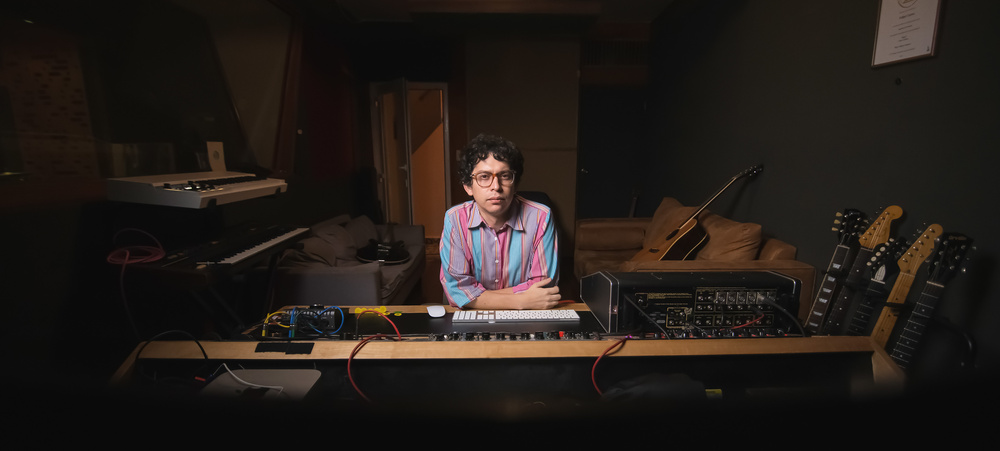
Estudio Novena in Mexico City is just four years old, yet has already played host to artists from across Latin America, as well as global chart‑toppers like Charli XCX. This, says founder Felipe Castro, is down to its simple but unwavering value system: good gear and a good environment means good recordings.
“I’ve always liked having great instruments for everyone who comes to record,” the producer and engineer explains. “Many people come to record here because I love recording drums and have been collecting vintage gear for a long time, which I feel is the core identity of the studio. The live room has specific sweet spots which were designed to make certain instruments sound fuller and sweeter. If you record vocals right in the centre or in the far‑right corner, they will sound fuller. Or if you place the drums at either end of the room they will sound more focused. I am really in tune with every part of the studio!”
This focus on the studio environment extends far beyond the technical, of course. “The studio has become a hub and second home for many international and local musicians in the city,” Castro reflects. “There’s an open door policy, where people can come hang out whenever we aren’t in session.”
At the moment I can’t stop listening to
TEED’s album When The Lights Go is the one I’ve listened to the most in recent years. It’s an album that I think perfectly reflects the evolution of music: an excellent record that combines songwriting with electronic music. His vocals are beautiful and very special. I love the depth of the songs, their excellent melodies and impactful rhythms. ‘Blood In The Snow’ and ‘Forever’ are my favourites; they are masterpieces for me. It was produced, composed, and mixed by Orlando Higginbottom — I was with him, in a studio here in Mexico City, but at the time wasn’t familiar with TEED’s music. When the album came out, I was shocked! The sound of the dark synths combined with some very bright elements... it creates a contrast that I think is so well‑crafted and precise. I like all kinds of music, but as a fan of British electronic music, synth music, this album feels different from the rest of what I was discovering these years.
The artist I’d most like to record
I would have loved to record David Bowie — during any of his eras! He was always years ahead of everything that was coming out culturally. It must have been incredibly exciting, to be in any of his sessions. I’ve read and researched a lot about his collaborators and the studios where he worked. I love how he always came up with very strange and unique intros for each song, like ‘Ashes To Ashes’, ‘Fame’, and ‘Aladdin Sane’.
I also love the use of certain pieces of gear, like the EMS Synthi AKS and the Eventide H910, which Brian Eno and Tony Visconti used, starting with Low. The way Mick Ronson and Carlos Alomar crafted arrangements and enhanced the songwriting. How Gerry Leonard used his looping technique and pedal effects to reinterpret the songs... Years ago, I was really lucky to have the chance to chat with Mario J McNulty, who worked with Bowie on lots of projects, particularly on the albums Reality and The Next Day, and in studios like The Looking Glass and Magic Shop.
Felipe Castro: Trusting, or knowing how a studio sounds, is extremely important to me.
The first thing I look for in a studio
I’m obsessed with knowing everything about the control room. Especially the speakers. Working in a new place can always be a good surprise — or a bad one. That’s why I prefer studios that have monitors like Yamaha NS10s, at the least, or Neumann, perhaps vintage Genelecs, or certain specific models from ADAM or Tannoy. Trusting, or knowing how a studio sounds, is extremely important to me.
Also, if I see a studio has any Chandler gear, I immediately feel confident, especially the TG2 preamp. I could just record everything with that! I also really like and frequently use Overstayer equipment. What else... If I spot something from Burl, like the BAD8 or B4, I’m also very reassured.
In terms of instruments, a Juno, a Moog or a Mellotron in the room is of course always a welcome bonus. And aside from gear, natural light is super important to me in a studio. And I love when there’s a dog or a cat hanging around too!
The person I would consider my mentor
His name is José Jaras, and he was the one who opened the doors of his studio in Santiago, Chile to me at the end of 2010. He just shared all his passion and knowledge with me — about things like drum tuning, about selecting the right gear for each project. He shared his philosophy and his respect for the studio. I just loved the way his studio sounded. He had so many CDs to listen to on the studio monitors, and it was the first time I could hear the fine details of the music that had shaped me. We spent a lot of time analysing what we listened to in there.
My go‑to reference track or album
‘Charcoal Baby’ by Blood Orange is the song I listen to in every place I go to work. I think that song is so very well mixed. It has everything I’m looking for in a song that moves me, that I can listen to over and over again. It’s been several years and it’s still one of my favourites! I feel it transmits the spirit of the song in its sound so well.
My secret weapon in the studio is
At the moment in my studio I am working a lot with the Overstayer Modular Channel. It is a great stereo channel strip with very expressive filters, it has a simple and very flexible EQ. The VCA compressor and the different ways of saturating the signal are extremely musical. I use it a lot, obviously, for recording drums — that could be the overheads, kick, snare or room — but also for piano, or simply in the mix bus. I would love to get another one, to be able to use two together.
The studio session I wish I’d witnessed
I would have loved to be at the Pet Sounds sessions with the Beach Boys. Hearing the Wrecking Crew play live and create that wall of sound, plus listening to the Beach Boys sing their harmonies? That would have been absolutely incredible. I would have especially loved to witness how they recorded ‘Don’t Talk’ or ‘God Only Knows’.
The producer I’d most like to work with
James Ford is one of the producers I would most like to collaborate with these days. I love British music, and everything he has worked on has inspired me so much. From his work with the Last Shadow Puppets to his latest albums, he’s worked with a lot of people who I’ve learned a lot from, just by listening, and before I knew he produced I was already a fan just by watching him play drums! A true genius.
Funnily enough, an interview with James in Sound On Sound about producing Arctic Monkeys really inspired me when I first started producing [www.soundonsound.com/people/james-ford-producing-arctic-monkeys]. His ‘2011 era’ impacted me a lot, because at that time I didn’t know he was a producer. So when I found out I became obsessed with everything he was doing. I really love his drum style and the overall sound of the first Last Shadow Puppets album. In that interview he talks a lot about the way he records drums, which became a central inspiration for how I now record drums. He inspired me to use the Glyn Johns technique as well as using PZM microphones as room mics. I love how even producing both Arctic Monkeys and the Last Shadow Puppets, he chose to create very different drum sounds for each and give them both unique identities.
The studio experience that taught me the most
Seven years ago, I joined a very special album project for a band called Pillanes, which was assembled just for that occasion. The band consisted of seasoned artists who had written some of Chile’s most important songs. For the session we had to set up a 32‑channel studio, in a house in the port city of Valparaíso, and I only had two weeks to pull everything together. On top of that, the project was secret! We spent 10 days living together, enjoying ourselves, but also working hard because there were no finished songs when we arrived to record. The album was essentially composed through jams. It was such an adventurous experience. One I’d love to relive.
The advice I’d give myself of 10 years ago
I really need to learn more about rights and how to negotiate contracts. I started out very young, during a time when the music industry was much tougher than it is now — at least in Chile, where I’m originally from and where I began my music career. There were no real references, there wasn’t a very active market. It’s crazy for me to think that, despite this, I’ve managed to emerge and build a professional career in this field. Maybe I should have taken the advice to leave the country earlier...